Question 1:
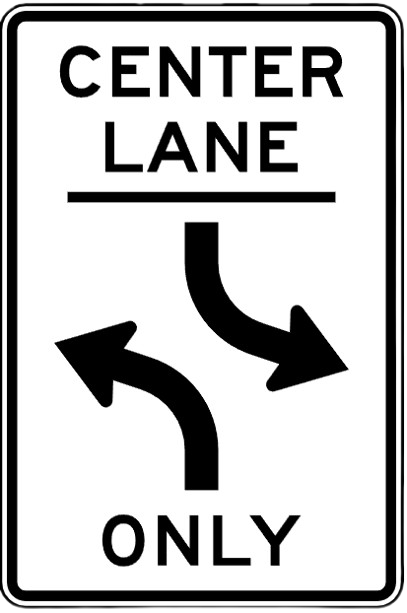 This sign means:
A
The center lane is shared for left turns.
B
Left turns in both directions of travel are not permitted.
C
Vehicles may only turn left.
Answer Explanation
This traffic sign indicates: The center lane is shared for left turns. Observing and obeying all roadway signs ensures safe traffic flow and legal driving.
This traffic sign indicates: The center lane is shared for left turns. Observing and obeying all roadway signs ensures safe traffic flow and legal driving.
Question 2:
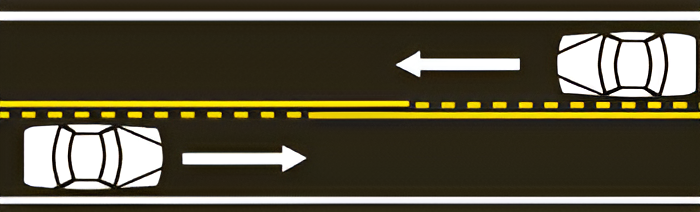 A solid yellow line to the right of a broken yellow center line means:
A
you are on a shared lane.
B
passing or crossing is prohibited in that lane, except when turning left.
C
drivers are traveling on reversible lanes.
D
vehicles may cross these lines when changing lanes.
Answer Explanation
The correct driving rule is: passing or crossing is prohibited in that lane, except when turning left. Following standard DMV road rules and practicing defensive driving ensures safety for all road users.
The correct driving rule is: passing or crossing is prohibited in that lane, except when turning left. Following standard DMV road rules and practicing defensive driving ensures safety for all road users.
Question 3:
When you are stopped by a law enforcement officer you should:
A
pull off to the extreme left.
B
pull off to the extreme right.
C
increase your speed to avoid being arrested.
D
decrease your speed as you may be driving too fast.
Answer Explanation
The correct driving rule is: pull off to the extreme right. Following standard DMV road rules and practicing defensive driving ensures safety for all road users.
The correct driving rule is: pull off to the extreme right. Following standard DMV road rules and practicing defensive driving ensures safety for all road users.
Question 4:
If traffic on the other side of an intersection is backed up and you cannot get completely through, you must:
A
enter the intersection and try to avoid blocking it.
B
enter the intersection and proceed with caution.
C
wait until traffic ahead is clear.
Answer Explanation
According to standard right-of-way regulations: wait until traffic ahead is clear. Yielding appropriately prevents intersection collisions and maintains safe traffic flow.
According to standard right-of-way regulations: wait until traffic ahead is clear. Yielding appropriately prevents intersection collisions and maintains safe traffic flow.
Question 5:
The 2 red taillights mounted on the rear of a vehicle must be visible from ____ feet.
A
100
B
2000
C
1000
D
450
Answer Explanation
The correct driving rule is: 1000. Following standard DMV road rules and practicing defensive driving ensures safety for all road users.
The correct driving rule is: 1000. Following standard DMV road rules and practicing defensive driving ensures safety for all road users.
Question 6:
Which of the following is NOT a defensive driving tip:
A
It is better to swerve right instead of toward oncoming traffic to prevent a crash.
B
Hitting a row of bushes is better than hitting a tree.
C
It is better to hit a vehicle moving toward you instead of something that is not moving.
D
It is better to drive off the road than skid off when avoiding a crash.
Answer Explanation
The correct driving rule is: it is better to hit a vehicle moving toward you instead of something that is not moving. Following standard DMV road rules and practicing defensive driving ensures safety for all road users.
The correct driving rule is: it is better to hit a vehicle moving toward you instead of something that is not moving. Following standard DMV road rules and practicing defensive driving ensures safety for all road users.
Question 7:
When a pedestrian is crossing a public street and the pedestrian is using a crutch, drivers must:
A
turn off the ignition.
B
shift to a lower gear.
C
show empathy.
D
come to a complete stop.
Answer Explanation
Drivers must always yield the right-of-way to pedestrians crossing at intersections and crosswalks: come to a complete stop. Stop and allow them to clear the lane safely.
Drivers must always yield the right-of-way to pedestrians crossing at intersections and crosswalks: come to a complete stop. Stop and allow them to clear the lane safely.
Question 8:
If a traffic officer signals you to drive through a red light:
A
you must do it.
B
you must wait for the red light to turn green.
C
you must not obey the officer. Signs and signals take precedence over directions given by traffic officers.
Answer Explanation
According to standard right-of-way regulations: you must do it. Yielding appropriately prevents intersection collisions and maintains safe traffic flow.
According to standard right-of-way regulations: you must do it. Yielding appropriately prevents intersection collisions and maintains safe traffic flow.
Question 9:
If a driver triples the speed of a car, he/she increases its force of impact:
A
4 times.
B
6 times.
C
9 times
D
3 times.
Answer Explanation
For safe speed and stopping control: 9 times. Adjusting speed to match visibility and road traction prevents loss of steering grip.
For safe speed and stopping control: 9 times. Adjusting speed to match visibility and road traction prevents loss of steering grip.
Question 10:
Restricted lanes are usually reserved for:
A
bikes during week-ends.
B
cars in school or work zones.
C
vehicles in one-way streets.
D
car-pool vehicles or buses during rush hour traffic.
Answer Explanation
The correct driving rule is: car-pool vehicles or buses during rush hour traffic. Following standard DMV road rules and practicing defensive driving ensures safety for all road users.
The correct driving rule is: car-pool vehicles or buses during rush hour traffic. Following standard DMV road rules and practicing defensive driving ensures safety for all road users.
Question 11:
When the gas pedal is jammed, drivers should NOT:
A
use their brakes.
B
try to pry the pedal up with the toe of their shoe.
C
turn off the ignition.
D
turn the steering wheel hard in one direction.
Answer Explanation
The correct driving rule is: turn the steering wheel hard in one direction. Following standard DMV road rules and practicing defensive driving ensures safety for all road users.
The correct driving rule is: turn the steering wheel hard in one direction. Following standard DMV road rules and practicing defensive driving ensures safety for all road users.
Question 12:
Which of the following is NOT a guideline for driving at night:
A
Use headlights between the hours of sunset and sunrise.
B
Don’t look directly at oncoming headlights.
C
Use high beams when you are within 100 feet of the vehicle ahead.
D
If you are leaving a brightly lit place, drive slowly until your eyes adjust to the darkness.
Answer Explanation
The correct driving rule is: use high beams when you are within 100 feet of the vehicle ahead. Following standard DMV road rules and practicing defensive driving ensures safety for all road users.
The correct driving rule is: use high beams when you are within 100 feet of the vehicle ahead. Following standard DMV road rules and practicing defensive driving ensures safety for all road users.
Question 13:
If you double the speed of a car, the amount of kinetic energy in a crash:
A
doubles.
B
stays the same.
C
triples.
D
quadruples.
Answer Explanation
For safe speed and stopping control: quadruples. Adjusting speed to match visibility and road traction prevents loss of steering grip.
For safe speed and stopping control: quadruples. Adjusting speed to match visibility and road traction prevents loss of steering grip.
Question 14:
Which of the following can be dangerous:
A
Driving while adjusting the radio.
B
Driving while calling on a mobile phone.
C
Reading while driving.
D
All of the above.
Answer Explanation
All of the listed points are essential driving requirements: Driving while adjusting the radio; Driving while calling on a mobile phone; Reading while driving. Practicing each ensures compliance with DMV safety laws.
All of the listed points are essential driving requirements: Driving while adjusting the radio; Driving while calling on a mobile phone; Reading while driving. Practicing each ensures compliance with DMV safety laws.
Question 15:
To lower the risk of someone running into the rear of their vehicle, drivers should NOT:
A
signal in advance for turns and lane changes.
B
stop suddenly.
C
check brake lights often to make sure they are clean.
D
use rearview mirrors.
Answer Explanation
The correct driving rule is: stop suddenly. Following standard DMV road rules and practicing defensive driving ensures safety for all road users.
The correct driving rule is: stop suddenly. Following standard DMV road rules and practicing defensive driving ensures safety for all road users.
Question 16:
Perception distance is:
A
how far a vehicle travels, in ideal conditions, from the time the driver sees a hazard until his/her brain recognizes it.
B
how long it takes a driver to physically hit the brakes.
C
how far a drunk person can travel before coming to a complete stop in response to a hazard ahead.
D
how far a driver will continue to travel, in ideal conditions; before he/she physically hits the brakes.
Answer Explanation
The correct driving rule is: how far a vehicle travels, in ideal conditions, from the time the driver sees a hazard until his/her brain recognizes it. Following standard DMV road rules and practicing defensive driving ensures safety for all road users.
The correct driving rule is: how far a vehicle travels, in ideal conditions, from the time the driver sees a hazard until his/her brain recognizes it. Following standard DMV road rules and practicing defensive driving ensures safety for all road users.
Question 17:
How many feet does a car need to be parked away from an intersection?
A
15
B
30
C
10
D
20
Answer Explanation
According to standard right-of-way regulations: 20. Yielding appropriately prevents intersection collisions and maintains safe traffic flow.
According to standard right-of-way regulations: 20. Yielding appropriately prevents intersection collisions and maintains safe traffic flow.
Question 18:
On some interstate roads, diamond signs in the median indicate that:
A
there is a warning sign ahead.
B
there is a railroad crossing ahead.
C
passing is not allowed.
D
the left lane is reserved for car pool vehicles.
Answer Explanation
The correct driving rule is: the left lane is reserved for car pool vehicles. Following standard DMV road rules and practicing defensive driving ensures safety for all road users.
The correct driving rule is: the left lane is reserved for car pool vehicles. Following standard DMV road rules and practicing defensive driving ensures safety for all road users.
Question 19:
If you are driving on a slippery road in a car with anti-lock brakes, how do you make an emergency stop?
A
Press down hard on the brake pedal, hold it down, and steer out of danger.
B
Pump the brakes to turn off the Anti-Locking Brake System.
C
Remove steady pressure from the brake pedal.
D
All of the above.
Answer Explanation
For safe speed and stopping control: Press down hard on the brake pedal, hold it down, and steer out of danger. Adjusting speed to match visibility and road traction prevents loss of steering grip.
For safe speed and stopping control: Press down hard on the brake pedal, hold it down, and steer out of danger. Adjusting speed to match visibility and road traction prevents loss of steering grip.
Question 20:
If you are involved in a crash where you are at fault and do not have the required insurance to comply with the Financial Responsibility Law, your driver license and/or license plates will be suspended for up to:
A
2 years.
B
1 year.
C
3 years.
D
6 months.
Answer Explanation
The correct driving rule is: 3 years. Following standard DMV road rules and practicing defensive driving ensures safety for all road users.
The correct driving rule is: 3 years. Following standard DMV road rules and practicing defensive driving ensures safety for all road users.
Question 21:
High beam headlights can reveal objects up to a distance of ____ feet.
A
150
B
40
C
450
D
2000
Answer Explanation
The correct driving rule is: 450. Following standard DMV road rules and practicing defensive driving ensures safety for all road users.
The correct driving rule is: 450. Following standard DMV road rules and practicing defensive driving ensures safety for all road users.
Question 22:
When driving in the fog, rain, or smoke in the daytime, what lights should drivers use?
A
Low beam lights.
B
High beam lights.
C
Emergency flashers.
D
None of the other answers are correct.
Answer Explanation
Always use low-beam headlights in fog, heavy rain, or snow. High beams reflect off moisture droplets and bounce glare back into your eyes.
Always use low-beam headlights in fog, heavy rain, or snow. High beams reflect off moisture droplets and bounce glare back into your eyes.
Question 23:
If a car approaches you with bright headlights, you must _________________ to prevent being temporarily blinded.
A
come to a complete stop
B
double your speed
C
look toward the right edge of the road
D
turn off your lights
Answer Explanation
The correct driving rule is: look toward the right edge of the road. Following standard DMV road rules and practicing defensive driving ensures safety for all road users.
The correct driving rule is: look toward the right edge of the road. Following standard DMV road rules and practicing defensive driving ensures safety for all road users.
Question 24:
How many feet to the rear should a driver be able to see objects through the rearview mirror?
A
100
B
500
C
200
D
50
Answer Explanation
Defensive driving guidelines state that: 200. Anticipating road hazards and communicating maneuvers keeps traffic predictable and safe.
Defensive driving guidelines state that: 200. Anticipating road hazards and communicating maneuvers keeps traffic predictable and safe.
Question 25:
Where are yield signs usually placed?
A
At intersections, if there is no marked stop line.
B
Where auxiliary roads lead into major roads.
C
Where major roads lead into auxiliary roads.
Answer Explanation
The correct driving rule is: Where auxiliary roads lead into major roads. Following standard DMV road rules and practicing defensive driving ensures safety for all road users.
The correct driving rule is: Where auxiliary roads lead into major roads. Following standard DMV road rules and practicing defensive driving ensures safety for all road users.
Question 26:
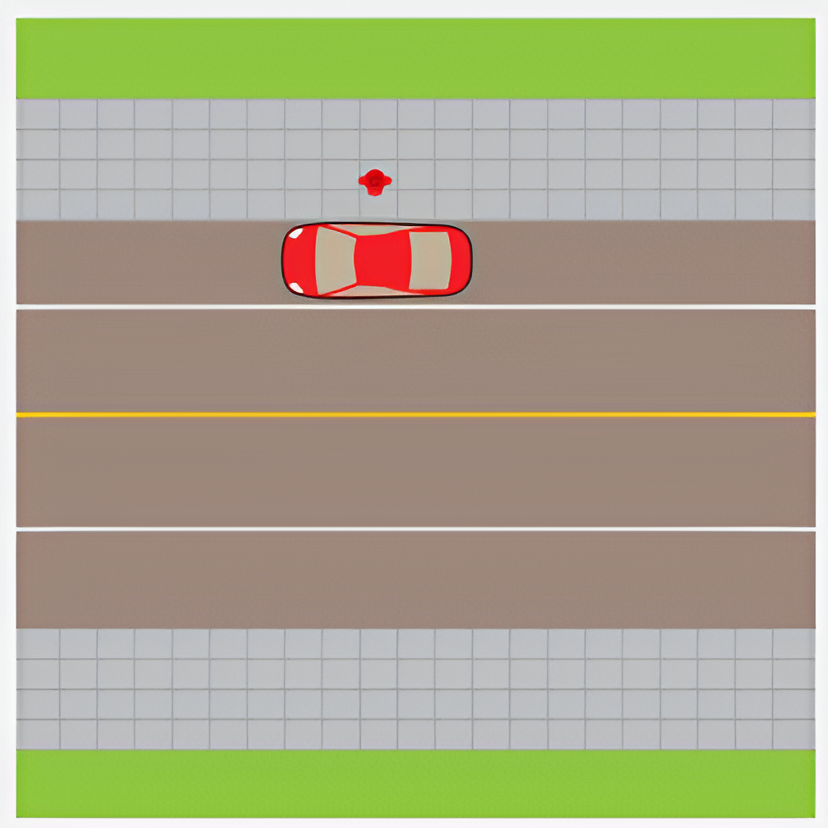 Is this car legally parked?
A
No, vehicles cannot be parked in front of a fire hydrant.
B
Yes, but only if it has parking lights on.
C
Yes, if it is within 15 feet of the fire hydrant.
D
Yes, vehicles can be parked within 10 feet of a fire hydrant.
Answer Explanation
The correct driving rule is: No, vehicles cannot be parked in front of a fire hydrant. Following standard DMV road rules and practicing defensive driving ensures safety for all road users.
The correct driving rule is: No, vehicles cannot be parked in front of a fire hydrant. Following standard DMV road rules and practicing defensive driving ensures safety for all road users.
Question 27:
If you are impatient, you should:
A
speed up to avoid being late.
B
adjust the radio while driving and select some relaxing music.
C
have a beer or two.
D
give yourself extra time for your driving trip.
Answer Explanation
The correct driving rule is: give yourself extra time for your driving trip. Following standard DMV road rules and practicing defensive driving ensures safety for all road users.
The correct driving rule is: give yourself extra time for your driving trip. Following standard DMV road rules and practicing defensive driving ensures safety for all road users.
Question 28:
What is the meaning of blue traffic signs?
A
A blue background indicates a regulatory sign.
B
They give directional information.
C
Blue indicates road user services.
Answer Explanation
The correct driving rule is: Blue indicates road user services. Following standard DMV road rules and practicing defensive driving ensures safety for all road users.
The correct driving rule is: Blue indicates road user services. Following standard DMV road rules and practicing defensive driving ensures safety for all road users.
Question 29:
Total stopping distance is:
A
how far a vehicle will travel, in ideal conditions, while the driver is braking.
B
the sum of perception distance, reaction distance and braking distance.
C
the sum of reaction distance and braking distance, minus perception distance.
D
None of the above.
Answer Explanation
For safe speed and stopping control: the sum of perception distance, reaction distance and braking distance. Adjusting speed to match visibility and road traction prevents loss of steering grip.
For safe speed and stopping control: the sum of perception distance, reaction distance and braking distance. Adjusting speed to match visibility and road traction prevents loss of steering grip.
Question 30:
Leaving the scene of a crash involving a death commits a felony of the ____ degree.
A
second
B
third
C
fourth
D
first
Answer Explanation
The correct driving rule is: first. Following standard DMV road rules and practicing defensive driving ensures safety for all road users.
The correct driving rule is: first. Following standard DMV road rules and practicing defensive driving ensures safety for all road users.
Question 31:
 This sign means:
A
You can only park between 8:30 AM and 5:30 PM.
B
Parking is not allowed at 8:30 AM and at 5:30 PM
C
No parking between 8:30 AM and 5:30 PM.
Answer Explanation
This traffic sign indicates: No parking between 8:30 AM and 5:30 PM. Observing and obeying all roadway signs ensures safe traffic flow and legal driving.
This traffic sign indicates: No parking between 8:30 AM and 5:30 PM. Observing and obeying all roadway signs ensures safe traffic flow and legal driving.
Question 32:
When approached by an emergency vehicle on a roundabout, drivers should:
A
pull to the right and use your emergency flashers to signal that you are about to stop.
B
immediately come to a complete stop.
C
follow the emergency vehicle.
D
continue on and exit the roundabout as normal, then pull to the right.
Answer Explanation
Vehicles entering a roundabout must yield right-of-way to circulating traffic already inside: continue on and exit the roundabout as normal, then pull to the right. Wait for a safe gap before entering.
Vehicles entering a roundabout must yield right-of-way to circulating traffic already inside: continue on and exit the roundabout as normal, then pull to the right. Wait for a safe gap before entering.
Question 33:
____________ happens when a layer of water prevents direct contact between tires and the road, causing a loss of control.
A
Indirect-planing
B
Hydroplaning
C
Tyre-planing
D
Waterloss
Answer Explanation
The correct driving rule is: Hydroplaning. Following standard DMV road rules and practicing defensive driving ensures safety for all road users.
The correct driving rule is: Hydroplaning. Following standard DMV road rules and practicing defensive driving ensures safety for all road users.
Question 34:
Your license can be suspended if:
A
your license was issued in error.
B
you are found guilty of lying about the ownership or operation of motor vehicles.
C
you refuse to take a test to show if you are driving while under the influence of alcohol or drugs.
D
you are found guilty of 3 cases of reckless driving within one year.
Answer Explanation
The correct driving rule is: you refuse to take a test to show if you are driving while under the influence of alcohol or drugs. Following standard DMV road rules and practicing defensive driving ensures safety for all road users.
The correct driving rule is: you refuse to take a test to show if you are driving while under the influence of alcohol or drugs. Following standard DMV road rules and practicing defensive driving ensures safety for all road users.
Question 35:
When the light is green, drivers should:
A
go, but only if the intersection is clear.
B
yield to pedestrians and vehicles still in the intersection.
C
wait for a gap in oncoming traffic to complete a left turn.
D
All of the above.
Answer Explanation
All of the listed points are essential driving requirements: go, but only if the intersection is clear; yield to pedestrians and vehicles still in the intersection; wait for a gap in oncoming traffic to complete a left turn. Practicing each ensures compliance with DMV safety laws.
All of the listed points are essential driving requirements: go, but only if the intersection is clear; yield to pedestrians and vehicles still in the intersection; wait for a gap in oncoming traffic to complete a left turn. Practicing each ensures compliance with DMV safety laws.
Question 36:
Tampering with pollution control devices can cause:
A
reduced air pollution.
B
more maintenance costs.
C
improved vehicle efficiency.
D
higher gas mileage.
Answer Explanation
The correct driving rule is: more maintenance costs. Following standard DMV road rules and practicing defensive driving ensures safety for all road users.
The correct driving rule is: more maintenance costs. Following standard DMV road rules and practicing defensive driving ensures safety for all road users.
Question 37:
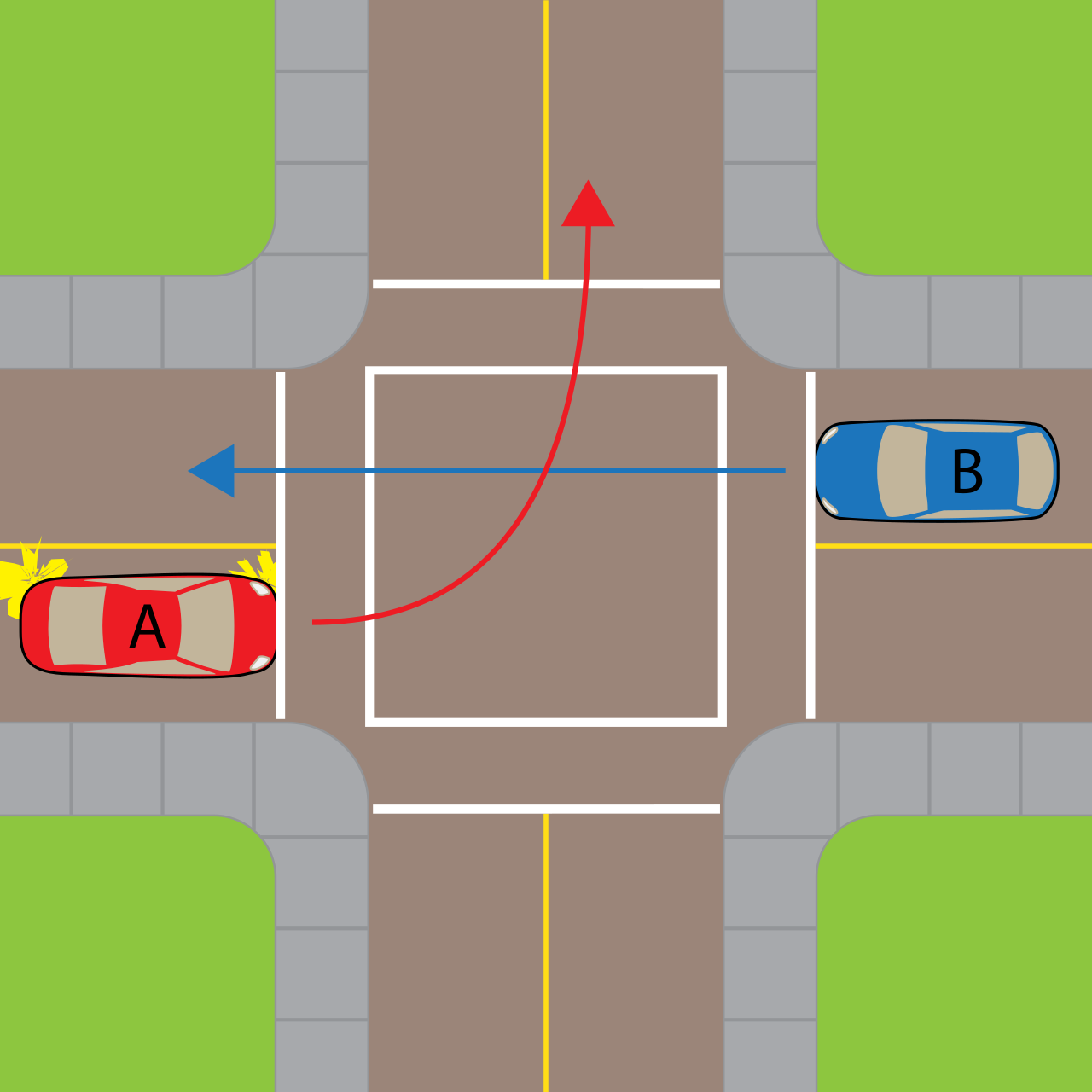 Cars A and B reach the intersection at the same time. Which of the following is correct?
A
Car B must yield.
B
Car A must yield.
C
The vehicle on the right yields to the vehicle on the left.
D
None of the above.
Answer Explanation
According to standard right-of-way regulations: Car A must yield. Yielding appropriately prevents intersection collisions and maintains safe traffic flow.
According to standard right-of-way regulations: Car A must yield. Yielding appropriately prevents intersection collisions and maintains safe traffic flow.
Question 38:
 A 4-way stop sign means:
A
The first vehicle to reach the intersection should move forward first.
B
Traffic from all four directions must stop.
C
There are four stop signs at the intersection.
D
All of the above.
Answer Explanation
This sign alerts drivers to several mandatory requirements: The first vehicle to reach the intersection should move forward first, Traffic from all four directions must stop, There are four stop signs at the intersection. Obeying all posted traffic control instructions is required by law.
This sign alerts drivers to several mandatory requirements: The first vehicle to reach the intersection should move forward first, Traffic from all four directions must stop, There are four stop signs at the intersection. Obeying all posted traffic control instructions is required by law.
Question 39:
Gauging the speed of a motorcycle may be difficult because:
A
motorcycles take up less of your field of vision.
B
motorcycles often slow down by downshifting.
C
many motorcyclists do not activate the brake light.
Answer Explanation
For safe speed and stopping control: motorcycles take up less of your field of vision. Adjusting speed to match visibility and road traction prevents loss of steering grip.
For safe speed and stopping control: motorcycles take up less of your field of vision. Adjusting speed to match visibility and road traction prevents loss of steering grip.
Question 40:
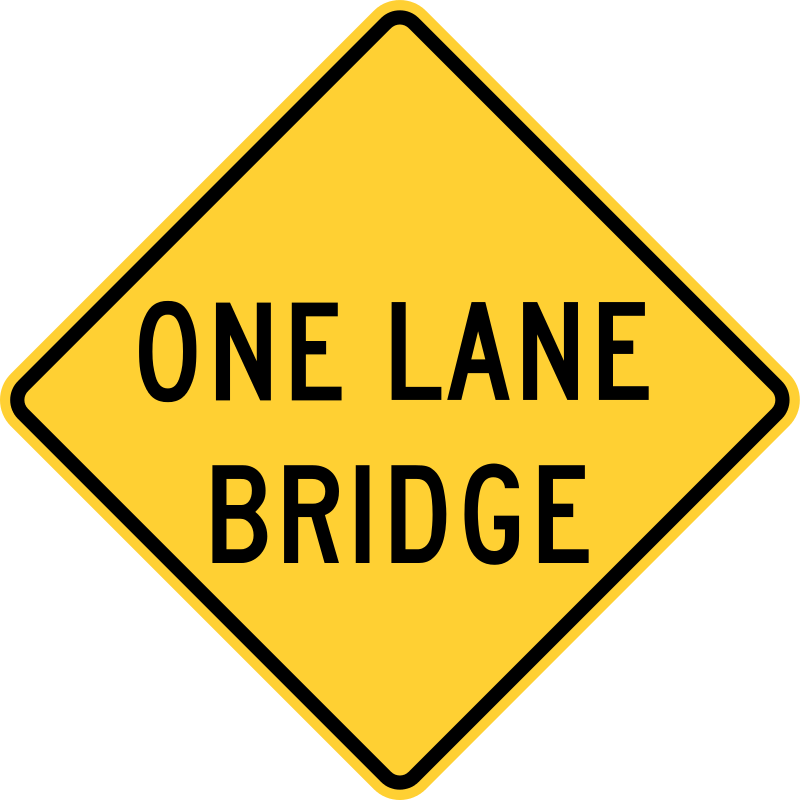 What should drivers do when they see this sign?
A
Make sure the bridge is clear of oncoming traffic before they cross.
B
Look to the left and right for other traffic.
C
Allow others to merge smoothly.
Answer Explanation
This traffic sign indicates: make sure the bridge is clear of oncoming traffic before they cross. Observing and obeying all roadway signs ensures safe traffic flow and legal driving.
This traffic sign indicates: make sure the bridge is clear of oncoming traffic before they cross. Observing and obeying all roadway signs ensures safe traffic flow and legal driving.
Question 41:
You must complete a basic driver improvement course if you want to retain your driver license when:
A
you had two crashes in a 2-year period, resulting in property damage greater than $1,500.
B
you were convicted of racing on highway.
C
you are convicted of running a red light.
D
All of the above.
Answer Explanation
All of the listed points are essential driving requirements: you had two crashes in a 2-year period, resulting in property damage greater than $1,500; you were convicted of racing on highway; you are convicted of running a red light. Practicing each ensures compliance with DMV safety laws.
All of the listed points are essential driving requirements: you had two crashes in a 2-year period, resulting in property damage greater than $1,500; you were convicted of racing on highway; you are convicted of running a red light. Practicing each ensures compliance with DMV safety laws.
Question 42:
Who must obey traffic signals?
A
Drivers and bicycle riders, but not pedestrians.
B
Only law enforcement officers.
C
Drivers, pedestrians, and bicycle riders.
D
Only drivers.
Answer Explanation
The correct driving rule is: Drivers, pedestrians, and bicycle riders. Following standard DMV road rules and practicing defensive driving ensures safety for all road users.
The correct driving rule is: Drivers, pedestrians, and bicycle riders. Following standard DMV road rules and practicing defensive driving ensures safety for all road users.
Question 43:
 Vehicles may travel in lanes beneath the green arrow signal, but drivers must:
A
never change lane.
B
prepare to leave the lane safely.
C
also obey all other signs and signals.
D
turn left if they can.
Answer Explanation
State laws require signaling your intention: also obey all other signs and signals. Signal at least 100 feet before making a turn or changing lanes.
State laws require signaling your intention: also obey all other signs and signals. Signal at least 100 feet before making a turn or changing lanes.
Question 44:
Which of the following is NOT true about roundabouts?
A
They improve traffic flow.
B
Traffic signals found at roundabouts reduce traffic crashes.
C
They slow vehicle speed.
D
All of the above.
Answer Explanation
The correct driving rule is: traffic signals found at roundabouts reduce traffic crashes. Following standard DMV road rules and practicing defensive driving ensures safety for all road users.
The correct driving rule is: traffic signals found at roundabouts reduce traffic crashes. Following standard DMV road rules and practicing defensive driving ensures safety for all road users.
Question 45:
Mature drivers should:
A
drink coffee while driving.
B
tap the horn at least three seconds before a traffic light becomes red.
C
anticipate danger.
D
get power steering to swing wide on turns.
Answer Explanation
The correct driving rule is: anticipate danger. Following standard DMV road rules and practicing defensive driving ensures safety for all road users.
The correct driving rule is: anticipate danger. Following standard DMV road rules and practicing defensive driving ensures safety for all road users.
Question 46:
When leaving an expressway, drivers should:
A
get into the entrance ramp.
B
get into the acceleration lane.
C
get into the exit lane.
D
make a last-minute turn into the exit.
Answer Explanation
The correct driving rule is: get into the exit lane. Following standard DMV road rules and practicing defensive driving ensures safety for all road users.
The correct driving rule is: get into the exit lane. Following standard DMV road rules and practicing defensive driving ensures safety for all road users.
Question 47:
The seat belt law does NOT exempt from the seat belt requirements:
A
Employee of a newspaper home delivery service while delivering newspapers on home delivery routes.
B
Front seat passengers under the age of 18.
C
Farm equipment.
D
All of the above.
Answer Explanation
The correct driving rule is: Front seat passengers under the age of 18. Following standard DMV road rules and practicing defensive driving ensures safety for all road users.
The correct driving rule is: Front seat passengers under the age of 18. Following standard DMV road rules and practicing defensive driving ensures safety for all road users.
Question 48:
What should you do when preparing to turn right on a roadway with a bike lane?
A
Check for and yield to bicyclists coming from the opposite direction.
B
Cross the bike lane and then yield to any bicyclist in the bike lane.
C
Signal your turn and yield to any bicyclist in the bike lane.
Answer Explanation
According to standard right-of-way regulations: signal your turn and yield to any bicyclist in the bike lane. Yielding appropriately prevents intersection collisions and maintains safe traffic flow.
According to standard right-of-way regulations: signal your turn and yield to any bicyclist in the bike lane. Yielding appropriately prevents intersection collisions and maintains safe traffic flow.
Question 49:
If you are in a crash while driving, your responsibilities include:
A
attain vehicle, witness and driver information.
B
helping the injured.
C
sketching the scene.
D
All of the above.
Answer Explanation
All of the listed points are essential driving requirements: attain vehicle, witness and driver information; helping the injured; sketching the scene. Practicing each ensures compliance with DMV safety laws.
All of the listed points are essential driving requirements: attain vehicle, witness and driver information; helping the injured; sketching the scene. Practicing each ensures compliance with DMV safety laws.
Question 50:
 This sign means:
A
Divided highway ahead.
B
Divided highway ends.
C
Drivers will soon be on a roadway with two-way traffic.
Answer Explanation
This traffic sign indicates: Divided highway ahead. Observing and obeying all roadway signs ensures safe traffic flow and legal driving.
This traffic sign indicates: Divided highway ahead. Observing and obeying all roadway signs ensures safe traffic flow and legal driving.