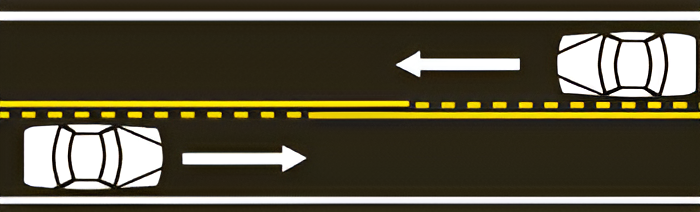
B)Left turns in both directions of travel are not permitted.
C)Vehicles may only turn left.
2.
A solid yellow line to the right of a broken yellow center line means:
A)you are on a shared lane.
B)passing or crossing is prohibited in that lane, except when turning left.
C)drivers are traveling on reversible lanes.
D)vehicles may cross these lines when changing lanes.
3.
When you are stopped by a law enforcement officer you should:
A)pull off to the extreme left.
B)pull off to the extreme right.
C)increase your speed to avoid being arrested.
D)decrease your speed as you may be driving too fast.
4.
If traffic on the other side of an intersection is backed up and you cannot get completely through, you must:
A)enter the intersection and try to avoid blocking it.
B)enter the intersection and proceed with caution.
C)wait until traffic ahead is clear.
5.
The 2 red taillights mounted on the rear of a vehicle must be visible from ____ feet.
A)100
B)2000
C)1000
D)450
6.
Which of the following is NOT a defensive driving tip:
A)It is better to swerve right instead of toward oncoming traffic to prevent a crash.
B)Hitting a row of bushes is better than hitting a tree.
C)It is better to hit a vehicle moving toward you instead of something that is not moving.
D)It is better to drive off the road than skid off when avoiding a crash.
7.
When a pedestrian is crossing a public street and the pedestrian is using a crutch, drivers must:
A)turn off the ignition.
B)shift to a lower gear.
C)show empathy.
D)come to a complete stop.
8.
If a traffic officer signals you to drive through a red light:
A)you must do it.
B)you must wait for the red light to turn green.
C)you must not obey the officer. Signs and signals take precedence over directions given by traffic officers.
9.
If a driver triples the speed of a car, he/she increases its force of impact:
A)4 times.
B)6 times.
C)9 times
D)3 times.
10.
Restricted lanes are usually reserved for:
A)bikes during week-ends.
B)cars in school or work zones.
C)vehicles in one-way streets.
D)car-pool vehicles or buses during rush hour traffic.
11.
When the gas pedal is jammed, drivers should NOT:
A)use their brakes.
B)try to pry the pedal up with the toe of their shoe.
C)turn off the ignition.
D)turn the steering wheel hard in one direction.
12.
Which of the following is NOT a guideline for driving at night:
A)Use headlights between the hours of sunset and sunrise.
B)Don’t look directly at oncoming headlights.
C)Use high beams when you are within 100 feet of the vehicle ahead.
D)If you are leaving a brightly lit place, drive slowly until your eyes adjust to the darkness.
13.
If you double the speed of a car, the amount of kinetic energy in a crash:
A)doubles.
B)stays the same.
C)triples.
D)quadruples.
14.
Which of the following can be dangerous:
A)Driving while adjusting the radio.
B)Driving while calling on a mobile phone.
C)Reading while driving.
D)All of the above.
15.
To lower the risk of someone running into the rear of their vehicle, drivers should NOT:
A)signal in advance for turns and lane changes.
B)stop suddenly.
C)check brake lights often to make sure they are clean.
D)use rearview mirrors.
16.
Perception distance is:
A)how far a vehicle travels, in ideal conditions, from the time the driver sees a hazard until his/her brain recognizes it.
B)how long it takes a driver to physically hit the brakes.
C)how far a drunk person can travel before coming to a complete stop in response to a hazard ahead.
D)how far a driver will continue to travel, in ideal conditions; before he/she physically hits the brakes.
17.
How many feet does a car need to be parked away from an intersection?
A)15
B)30
C)10
D)20
18.
On some interstate roads, diamond signs in the median indicate that:
A)there is a warning sign ahead.
B)there is a railroad crossing ahead.
C)passing is not allowed.
D)the left lane is reserved for car pool vehicles.
19.
If you are driving on a slippery road in a car with anti-lock brakes, how do you make an emergency stop?
A)Press down hard on the brake pedal, hold it down, and steer out of danger.
B)Pump the brakes to turn off the Anti-Locking Brake System.
C)Remove steady pressure from the brake pedal.
D)All of the above.
20.
If you are involved in a crash where you are at fault and do not have the required insurance to comply with the Financial Responsibility Law, your driver license and/or license plates will be suspended for up to:
A)2 years.
B)1 year.
C)3 years.
D)6 months.
21.
High beam headlights can reveal objects up to a distance of ____ feet.
A)150
B)40
C)450
D)2000
22.
When driving in the fog, rain, or smoke in the daytime, what lights should drivers use?
A)Low beam lights.
B)High beam lights.
C)Emergency flashers.
D)None of the other answers are correct.
23.
If a car approaches you with bright headlights, you must _________________ to prevent being temporarily blinded.
A)come to a complete stop
B)double your speed
C)look toward the right edge of the road
D)turn off your lights
24.
How many feet to the rear should a driver be able to see objects through the rearview mirror?
A)100
B)500
C)200
D)50
25.
Where are yield signs usually placed?
A)At intersections, if there is no marked stop line.
B)Where auxiliary roads lead into major roads.
C)Where major roads lead into auxiliary roads.
26.
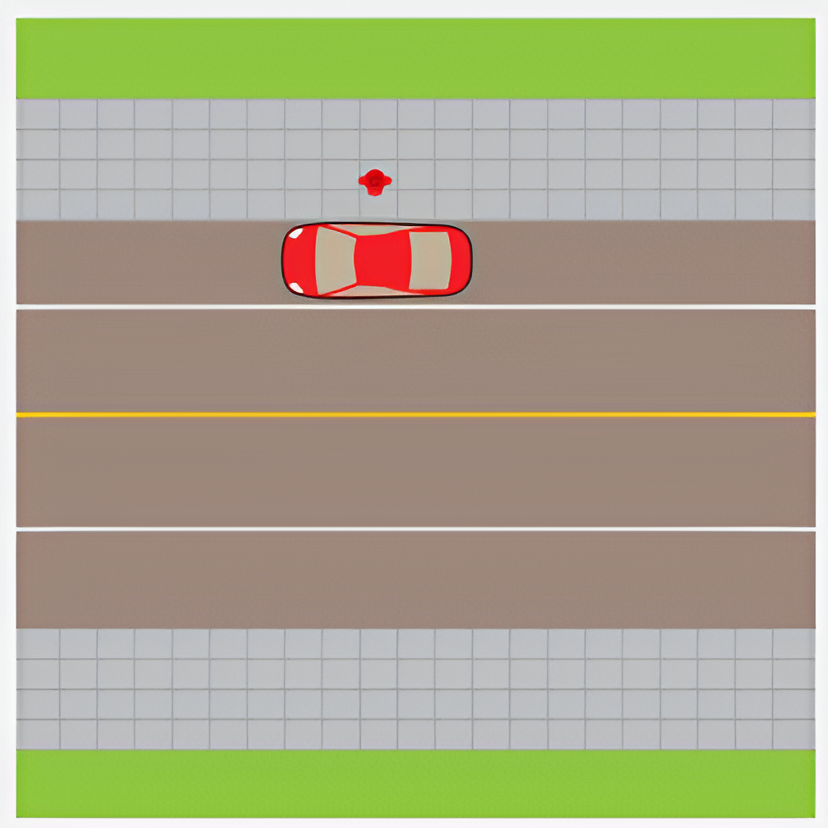
Is this car legally parked?
A)No, vehicles cannot be parked in front of a fire hydrant.
B)Yes, but only if it has parking lights on.
C)Yes, if it is within 15 feet of the fire hydrant.
D)Yes, vehicles can be parked within 10 feet of a fire hydrant.
27.
If you are impatient, you should:
A)speed up to avoid being late.
B)adjust the radio while driving and select some relaxing music.
C)have a beer or two.
D)give yourself extra time for your driving trip.
28.
What is the meaning of blue traffic signs?
A)A blue background indicates a regulatory sign.
B)They give directional information.
C)Blue indicates road user services.
29.
Total stopping distance is:
A)how far a vehicle will travel, in ideal conditions, while the driver is braking.
B)the sum of perception distance, reaction distance and braking distance.
C)the sum of reaction distance and braking distance, minus perception distance.
D)None of the above.
30.
Leaving the scene of a crash involving a death commits a felony of the ____ degree.
A)second
B)third
C)fourth
D)first
31.
This sign means:
A)You can only park between 8:30 AM and 5:30 PM.
B)Parking is not allowed at 8:30 AM and at 5:30 PM
C)No parking between 8:30 AM and 5:30 PM.
32.
When approached by an emergency vehicle on a roundabout, drivers should:
A)pull to the right and use your emergency flashers to signal that you are about to stop.
B)immediately come to a complete stop.
C)follow the emergency vehicle.
D)continue on and exit the roundabout as normal, then pull to the right.
33.
____________ happens when a layer of water prevents direct contact between tires and the road, causing a loss of control.
A)Indirect-planing
B)Hydroplaning
C)Tyre-planing
D)Waterloss
34.
Your license can be suspended if:
A)your license was issued in error.
B)you are found guilty of lying about the ownership or operation of motor vehicles.
C)you refuse to take a test to show if you are driving while under the influence of alcohol or drugs.
D)you are found guilty of 3 cases of reckless driving within one year.
35.
When the light is green, drivers should:
A)go, but only if the intersection is clear.
B)yield to pedestrians and vehicles still in the intersection.
C)wait for a gap in oncoming traffic to complete a left turn.
D)All of the above.
36.
Tampering with pollution control devices can cause:
A)reduced air pollution.
B)more maintenance costs.
C)improved vehicle efficiency.
D)higher gas mileage.
37.
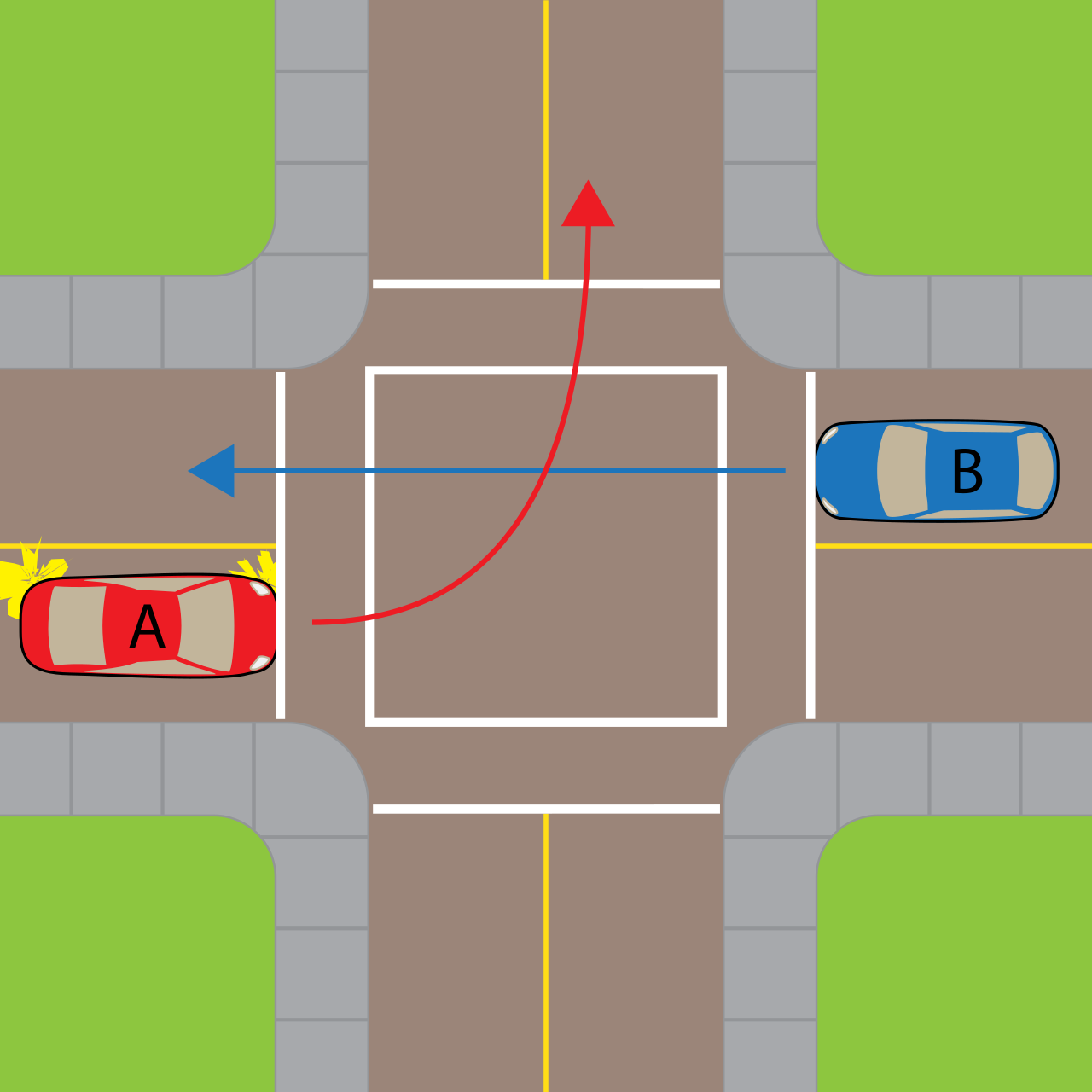
Cars A and B reach the intersection at the same time. Which of the following is correct?
A)Car B must yield.
B)Car A must yield.
C)The vehicle on the right yields to the vehicle on the left.
D)None of the above.
38.
A 4-way stop sign means:
A)The first vehicle to reach the intersection should move forward first.
B)Traffic from all four directions must stop.
C)There are four stop signs at the intersection.
D)All of the above.
39.
Gauging the speed of a motorcycle may be difficult because:
A)motorcycles take up less of your field of vision.
B)motorcycles often slow down by downshifting.
C)many motorcyclists do not activate the brake light.
40.
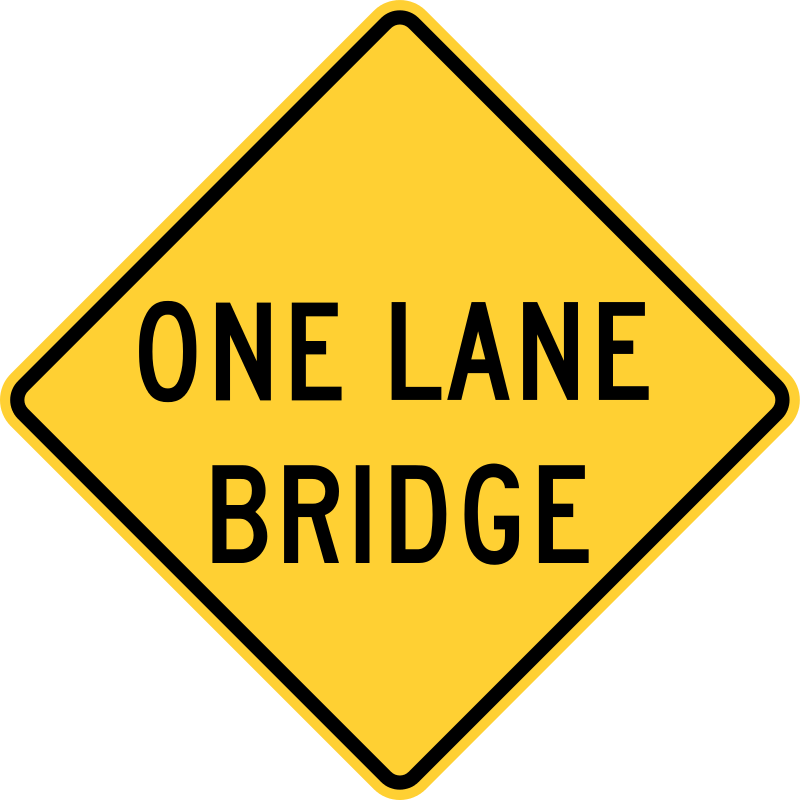
What should drivers do when they see this sign?
A)Make sure the bridge is clear of oncoming traffic before they cross.
B)Look to the left and right for other traffic.
C)Allow others to merge smoothly.
41.
You must complete a basic driver improvement course if you want to retain your driver license when:
A)you had two crashes in a 2-year period, resulting in property damage greater than $1,500.
B)you were convicted of racing on highway.
C)you are convicted of running a red light.
D)All of the above.
42.
Who must obey traffic signals?
A)Drivers and bicycle riders, but not pedestrians.
B)Only law enforcement officers.
C)Drivers, pedestrians, and bicycle riders.
D)Only drivers.
43.
Vehicles may travel in lanes beneath the green arrow signal, but drivers must:
A)never change lane.
B)prepare to leave the lane safely.
C)also obey all other signs and signals.
D)turn left if they can.
44.
Which of the following is NOT true about roundabouts?
A)They improve traffic flow.
B)Traffic signals found at roundabouts reduce traffic crashes.
C)They slow vehicle speed.
D)All of the above.
45.
Mature drivers should:
A)drink coffee while driving.
B)tap the horn at least three seconds before a traffic light becomes red.
C)anticipate danger.
D)get power steering to swing wide on turns.
46.
When leaving an expressway, drivers should:
A)get into the entrance ramp.
B)get into the acceleration lane.
C)get into the exit lane.
D)make a last-minute turn into the exit.
47.
The seat belt law does NOT exempt from the seat belt requirements:
A)Employee of a newspaper home delivery service while delivering newspapers on home delivery routes.
B)Front seat passengers under the age of 18.
C)Farm equipment.
D)All of the above.
48.
What should you do when preparing to turn right on a roadway with a bike lane?
A)Check for and yield to bicyclists coming from the opposite direction.
B)Cross the bike lane and then yield to any bicyclist in the bike lane.
C)Signal your turn and yield to any bicyclist in the bike lane.
49.
If you are in a crash while driving, your responsibilities include:
A)attain vehicle, witness and driver information.
B)helping the injured.
C)sketching the scene.
D)All of the above.
50.
This sign means:
A)Divided highway ahead.
B)Divided highway ends.
C)Drivers will soon be on a roadway with two-way traffic.
ANSWER KEYCheck answers after completing the test.