Question 1:
Lanes of traffic moving in the same direction are divided by ____ lines.
A
orange
B
yellow
C
black
D
white
Answer Explanation
The correct driving rule is: white. Following standard DMV road rules and practicing defensive driving ensures safety for all road users.
The correct driving rule is: white. Following standard DMV road rules and practicing defensive driving ensures safety for all road users.
Question 2:
 What should drivers do when they see this road sign?
A
come to a complete stop and wait for a train to cross.
B
slow down, look for a train, and be prepared to stop.
C
look for a human flagger.
Answer Explanation
This traffic sign indicates: slow down, look for a train, and be prepared to stop. Observing and obeying all roadway signs ensures safe traffic flow and legal driving.
This traffic sign indicates: slow down, look for a train, and be prepared to stop. Observing and obeying all roadway signs ensures safe traffic flow and legal driving.
Question 3:
Before you change lanes, you should:
A
look for other traffic by turning your head and looking behind you for oncoming traffic.
B
check your left mirror.
C
keep other vehicles out of your blind spots.
Answer Explanation
The correct driving rule is: look for other traffic by turning your head and looking behind you for oncoming traffic. Following standard DMV road rules and practicing defensive driving ensures safety for all road users.
The correct driving rule is: look for other traffic by turning your head and looking behind you for oncoming traffic. Following standard DMV road rules and practicing defensive driving ensures safety for all road users.
Question 4:
To drive defensively, you must:
A
anticipate errors by other drivers.
B
assume that a driver who approaches a STOP sign on a side road is actually going to stop.
C
not check behind you through your mirrors.
Answer Explanation
The correct driving rule is: anticipate errors by other drivers. Following standard DMV road rules and practicing defensive driving ensures safety for all road users.
The correct driving rule is: anticipate errors by other drivers. Following standard DMV road rules and practicing defensive driving ensures safety for all road users.
Question 5:
When a hazard is seen ahead, reaction distance:
A
is the sum of perception distance and braking distance.
B
equals total stopping distance minus perception distance.
C
is how far a vehicle will continue to travel, in ideal conditions, before the driver hits the brakes.
Answer Explanation
For safe speed and stopping control: is how far a vehicle will continue to travel, in ideal conditions, before the driver hits the brakes. Adjusting speed to match visibility and road traction prevents loss of steering grip.
For safe speed and stopping control: is how far a vehicle will continue to travel, in ideal conditions, before the driver hits the brakes. Adjusting speed to match visibility and road traction prevents loss of steering grip.
Question 6:
Vertical panels, barricades, drums and cones are the most commonly used devices to guide drivers safely through work zones.
A
True
B
False
Answer Explanation
The correct driving rule is: True. Following standard DMV road rules and practicing defensive driving ensures safety for all road users.
The correct driving rule is: True. Following standard DMV road rules and practicing defensive driving ensures safety for all road users.
Question 7:
Traffic signs and pavement markings must be:
A
followed only when a police officer is present.
B
followed only when other vehicles are present.
C
used as a guide only.
D
always obeyed.
Answer Explanation
The correct driving rule is: always obeyed. Following standard DMV road rules and practicing defensive driving ensures safety for all road users.
The correct driving rule is: always obeyed. Following standard DMV road rules and practicing defensive driving ensures safety for all road users.
Question 8:
If the entrance lane is too short to allow acceleration to highway speed, you should:
A
go to the next entrance ramp.
B
stop and wait for a large gap in traffic, then enter the highway and accelerate quickly.
C
merge into highway traffic as soon as possible.
Answer Explanation
For safe speed and stopping control: stop and wait for a large gap in traffic, then enter the highway and accelerate quickly. Adjusting speed to match visibility and road traction prevents loss of steering grip.
For safe speed and stopping control: stop and wait for a large gap in traffic, then enter the highway and accelerate quickly. Adjusting speed to match visibility and road traction prevents loss of steering grip.
Question 9:
If an approaching driver does not dim the headlights, you should:
A
move your eyes to the left to help avoid the glare of approaching high beams.
B
move your eyes to the right and avoid looking directly at the bright lights.
C
flash your headlights to low beam for a second, then return to high beam.
Answer Explanation
The correct driving rule is: move your eyes to the right and avoid looking directly at the bright lights. Following standard DMV road rules and practicing defensive driving ensures safety for all road users.
The correct driving rule is: move your eyes to the right and avoid looking directly at the bright lights. Following standard DMV road rules and practicing defensive driving ensures safety for all road users.
Question 10:
Alcohol:
A
increases reaction time.
B
makes drivers more prone to take chances.
C
makes it difficult for drivers to judge their condition.
D
All of the ab
Answer Explanation
Under state DUI and traffic safety laws: All of the ab. Alcohol degrades judgment, slows reaction times, and distorts depth perception.
Under state DUI and traffic safety laws: All of the ab. Alcohol degrades judgment, slows reaction times, and distorts depth perception.
Question 11:
When driving in heavy rain, drivers should use:
A
parking lights.
B
low beam headlights.
C
high beam headlights.
Answer Explanation
For safe speed and stopping control: low beam headlights. Adjusting speed to match visibility and road traction prevents loss of steering grip.
For safe speed and stopping control: low beam headlights. Adjusting speed to match visibility and road traction prevents loss of steering grip.
Question 12:
A steady yellow light means:
A
Be prepared to stop for the red light.
B
Drive with caution.
C
Be prepared to go. The light will soon be green.
Answer Explanation
According to standard right-of-way regulations: Be prepared to stop for the red light. Yielding appropriately prevents intersection collisions and maintains safe traffic flow.
According to standard right-of-way regulations: Be prepared to stop for the red light. Yielding appropriately prevents intersection collisions and maintains safe traffic flow.
Question 13:
 This road sign means:
A
Slow down or stop
B
Stop
C
Road narrows ahead
Answer Explanation
This traffic sign indicates: stop. Observing and obeying all roadway signs ensures safe traffic flow and legal driving.
This traffic sign indicates: stop. Observing and obeying all roadway signs ensures safe traffic flow and legal driving.
Question 14:
When you leave your vehicle unattended, you must:
A
lock the ignition and remove the ignition key.
B
set the parking brake.
C
turn off the engine.
D
All of the above.
Answer Explanation
All of the listed points are essential driving requirements: lock the ignition and remove the ignition key; set the parking brake; turn off the engine. Practicing each ensures compliance with DMV safety laws.
All of the listed points are essential driving requirements: lock the ignition and remove the ignition key; set the parking brake; turn off the engine. Practicing each ensures compliance with DMV safety laws.
Question 15:
When other vehicles are approaching an uncontrolled intersection at approximately the same time, you should:
A
maintain your speed and proceed through the intersection.
B
come to a complete stop and wait until there are no vehicles at the intersection.
C
watch for vehicles coming from the right and yield the right-of-way, then proceed when safe.
D
increase your speed and get through the intersection.
Answer Explanation
At an uncontrolled intersection or 4-way stop where vehicles arrive at the same time: watch for vehicles coming from the right and yield the right-of-way, then proceed when safe. The driver on the left must always yield to the driver on the right.
At an uncontrolled intersection or 4-way stop where vehicles arrive at the same time: watch for vehicles coming from the right and yield the right-of-way, then proceed when safe. The driver on the left must always yield to the driver on the right.
Question 16:
Your red traffic signal changes to green while a pedestrian is crossing in your traffic lane. The right of way should be given:
A
by the pedestrian, but only when vehicles are turning left.
B
by the pedestrian.
C
to the pedestrian.
Answer Explanation
Circular signs with an 'X' and 'RR' designate a Railroad Advance Warning: to the pedestrian. Drivers must slow down, look both ways, listen for trains, and be prepared to stop.
Circular signs with an 'X' and 'RR' designate a Railroad Advance Warning: to the pedestrian. Drivers must slow down, look both ways, listen for trains, and be prepared to stop.
Question 17:
 This road sign means:
A
Church ahead
B
Intersection ahead
C
Do not enter
D
Side road
Answer Explanation
This traffic sign indicates: Intersection ahead. Observing and obeying all roadway signs ensures safe traffic flow and legal driving.
This traffic sign indicates: Intersection ahead. Observing and obeying all roadway signs ensures safe traffic flow and legal driving.
Question 18:
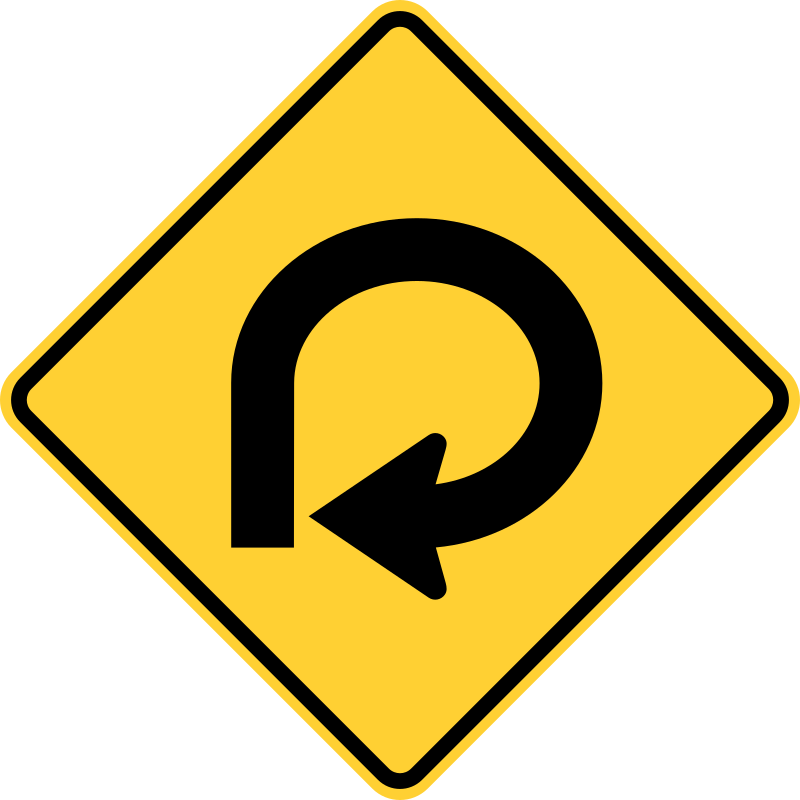 This sign means:
A
Roundabout ahead.
B
270 degree turn ahead.
C
Wrong way; Turn around immediately.
Answer Explanation
This traffic sign indicates: 270 degree turn ahead. Observing and obeying all roadway signs ensures safe traffic flow and legal driving.
This traffic sign indicates: 270 degree turn ahead. Observing and obeying all roadway signs ensures safe traffic flow and legal driving.
Question 19:
When dust is blowing across the roadway making it difficult to see other vehicles, you should drive slower and turn on your:
A
headlights.
B
parking lights.
C
emergency flashers.
Answer Explanation
The correct driving rule is: headlights. Following standard DMV road rules and practicing defensive driving ensures safety for all road users.
The correct driving rule is: headlights. Following standard DMV road rules and practicing defensive driving ensures safety for all road users.
Question 20:
Before making a left turn from a one-way street, you must:
A
be in the lane closest to the left curb.
B
be in the lane closest to the right curb.
C
be in the lane closest to the center of the street.
Answer Explanation
The correct driving rule is: be in the lane closest to the left curb. Following standard DMV road rules and practicing defensive driving ensures safety for all road users.
The correct driving rule is: be in the lane closest to the left curb. Following standard DMV road rules and practicing defensive driving ensures safety for all road users.
Question 21:
What happens if two vehicles reach at the same time an intersection with four-way stop signs?
A
The driver on the right yields to the driver on the left.
B
The driver on the left yields to the driver on the right.
C
The first vehicle to reach the intersection must yield.
Answer Explanation
At an uncontrolled intersection or 4-way stop where vehicles arrive at the same time: The driver on the left yields to the driver on the right. The driver on the left must always yield to the driver on the right.
At an uncontrolled intersection or 4-way stop where vehicles arrive at the same time: The driver on the left yields to the driver on the right. The driver on the left must always yield to the driver on the right.
Question 22:
 This road sign means:
A
Pedestrian crossing
B
School zone
C
School crossing
Answer Explanation
This traffic sign indicates: Pedestrian crossing. Observing and obeying all roadway signs ensures safe traffic flow and legal driving.
This traffic sign indicates: Pedestrian crossing. Observing and obeying all roadway signs ensures safe traffic flow and legal driving.
Question 23:
When approaching any intersection or driveway, drivers should:
A
look both ways and be ready to stop.
B
pass other vehicles and then stop.
C
drive at the fastest speed just before entering the intersection.
Answer Explanation
According to standard right-of-way regulations: look both ways and be ready to stop. Yielding appropriately prevents intersection collisions and maintains safe traffic flow.
According to standard right-of-way regulations: look both ways and be ready to stop. Yielding appropriately prevents intersection collisions and maintains safe traffic flow.
Question 24:
Which statement about drinking alcohol and driving is true?
A
Alcohol affects judgement and coordination, which are needed to drive safely.
B
After drinking, a cold shower will sober you up.
C
If you are under the legal BAC limit, your driving is not affected.
Answer Explanation
Under state DUI and traffic safety laws: Alcohol affects judgement and coordination, which are needed to drive safely. Alcohol degrades judgment, slows reaction times, and distorts depth perception.
Under state DUI and traffic safety laws: Alcohol affects judgement and coordination, which are needed to drive safely. Alcohol degrades judgment, slows reaction times, and distorts depth perception.
Question 25:
As long as you don’t leave the road, you may legally pass a vehicle on the right:
A
if you are on a two-lane, two-way road and the other vehicle is turning left.
B
when you are turning into a one-way street with no oncoming traffic.
C
Never.
D
Only during daylight hours.
Answer Explanation
The correct driving rule is: if you are on a two-lane, two-way road and the other vehicle is turning left. Following standard DMV road rules and practicing defensive driving ensures safety for all road users.
The correct driving rule is: if you are on a two-lane, two-way road and the other vehicle is turning left. Following standard DMV road rules and practicing defensive driving ensures safety for all road users.