Question 1:
 This sign indicates:
A
Warning: drunk drivers.
B
Winding road. Drive with caution.
C
The road may be slippery when wet. Drive slowly.
Answer Explanation
This traffic sign indicates: The road may be slippery when wet. Drive slowly. Observing and obeying all roadway signs ensures safe traffic flow and legal driving.
This traffic sign indicates: The road may be slippery when wet. Drive slowly. Observing and obeying all roadway signs ensures safe traffic flow and legal driving.
Question 2:
Large trucks:
A
have high-tech air brakes which allow them to stop quickly.
B
take longer to stop than passenger vehicles.
C
are more maneuverable than passenger vehicles.
Answer Explanation
The correct driving rule is: take longer to stop than passenger vehicles. Following standard DMV road rules and practicing defensive driving ensures safety for all road users.
The correct driving rule is: take longer to stop than passenger vehicles. Following standard DMV road rules and practicing defensive driving ensures safety for all road users.
Question 3:
Drinking alcohol:
A
has no effect on either judgement or driving ability.
B
has no effect on driving ability but affects your judgement.
C
harms both judgement and driving skills.
Answer Explanation
Under state DUI and traffic safety laws: harms both judgement and driving skills. Alcohol degrades judgment, slows reaction times, and distorts depth perception.
Under state DUI and traffic safety laws: harms both judgement and driving skills. Alcohol degrades judgment, slows reaction times, and distorts depth perception.
Question 4:
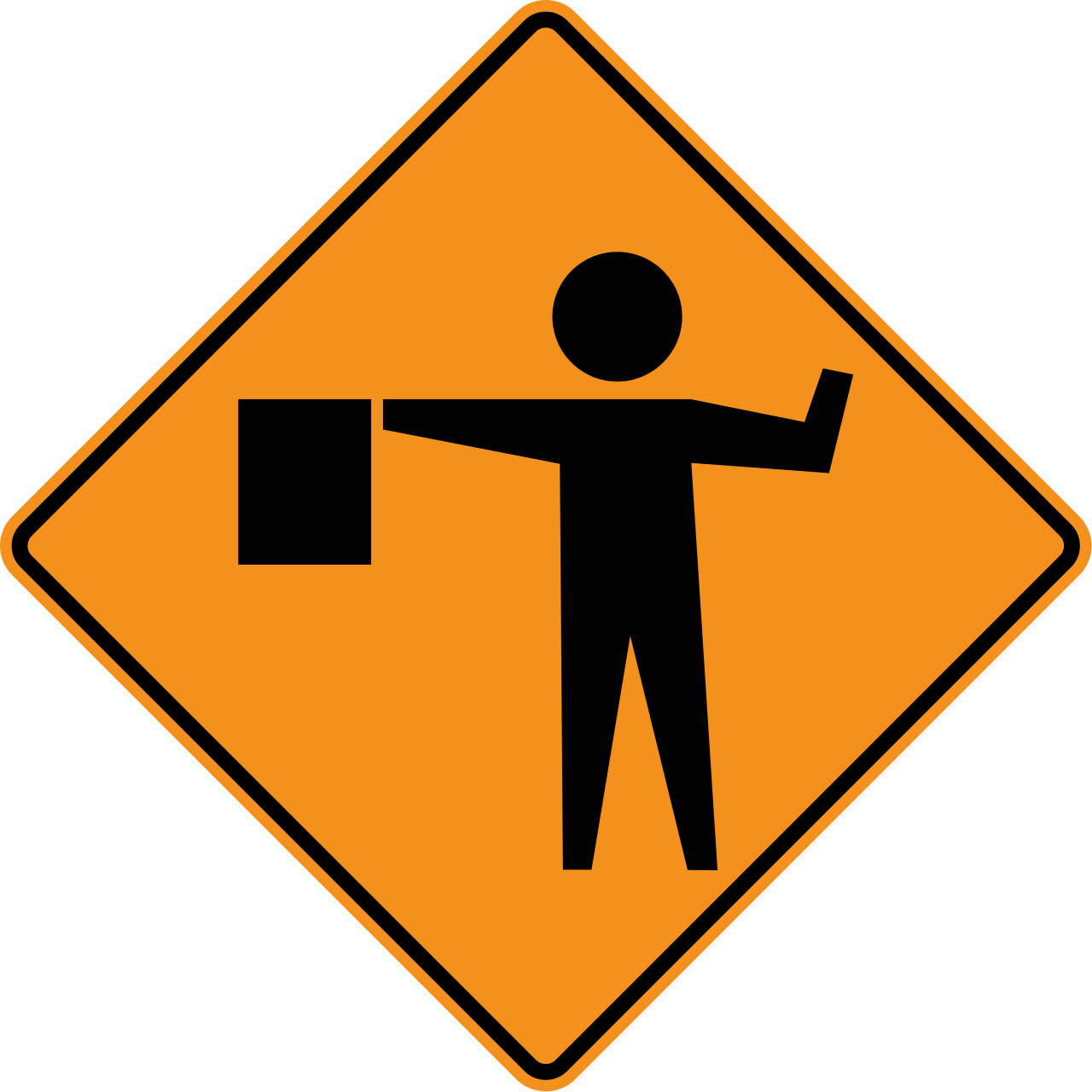 This road sign means:
A
Right lane closed
B
Do not block intersection
C
Flagger ahead
Answer Explanation
This traffic sign indicates: Flagger ahead. Observing and obeying all roadway signs ensures safe traffic flow and legal driving.
This traffic sign indicates: Flagger ahead. Observing and obeying all roadway signs ensures safe traffic flow and legal driving.
Question 5:
To avoid merging traffic from the right, drivers should:
A
change lanes to the left.
B
slow down.
C
maintain speed and position.
Answer Explanation
The correct driving rule is: change lanes to the left. Following standard DMV road rules and practicing defensive driving ensures safety for all road users.
The correct driving rule is: change lanes to the left. Following standard DMV road rules and practicing defensive driving ensures safety for all road users.
Question 6:
A broken yellow line between two lanes of traffic means:
A
Passing is permitted when safe.
B
Passing is not permitted.
C
Passing on the right is permitted in either direction
Answer Explanation
The correct driving rule is: Passing is permitted when safe. Following standard DMV road rules and practicing defensive driving ensures safety for all road users.
The correct driving rule is: Passing is permitted when safe. Following standard DMV road rules and practicing defensive driving ensures safety for all road users.
Question 7:
Parking is not allowed:
A
on the road side of a parked vehicle.
B
in a tunnel.
C
All of the above.
Answer Explanation
Under standard parking and curb regulations: All of the above. Following parking distance clearances keeps roadways unobstructed and emergency lanes accessible.
Under standard parking and curb regulations: All of the above. Following parking distance clearances keeps roadways unobstructed and emergency lanes accessible.
Question 8:
 This sign warns drivers that:
A
they cannot go straight ahead.
B
they will soon be facing oncoming traffic.
C
a shared lane starts ahead.
Answer Explanation
This traffic sign indicates: they will soon be facing oncoming traffic. Observing and obeying all roadway signs ensures safe traffic flow and legal driving.
This traffic sign indicates: they will soon be facing oncoming traffic. Observing and obeying all roadway signs ensures safe traffic flow and legal driving.
Question 9:
Drivers may legally block an intersection:
A
under no circumstances.
B
only during rush hour traffic.
C
only after entering the intersection on a green light.
Answer Explanation
According to standard right-of-way regulations: under no circumstances. Yielding appropriately prevents intersection collisions and maintains safe traffic flow.
According to standard right-of-way regulations: under no circumstances. Yielding appropriately prevents intersection collisions and maintains safe traffic flow.
Question 10:
Drivers can not pass a vehicle on the left if:
A
they approach the top of a hill on a two-way road and can not see over it.
B
they can not safely return to the right lane before they reach a solid yellow center line for the right lane.
C
All of the above.
Answer Explanation
All of the listed points are essential driving requirements: they approach the top of a hill on a two-way road and can not see over it; they can not safely return to the right lane before they reach a solid yellow center line for the right lane. Practicing each ensures compliance with DMV safety laws.
All of the listed points are essential driving requirements: they approach the top of a hill on a two-way road and can not see over it; they can not safely return to the right lane before they reach a solid yellow center line for the right lane. Practicing each ensures compliance with DMV safety laws.
Question 11:
To avoid becoming an aggressive driver, you should:
A
drive above the posted speed limit.
B
tailgate the driver in front of you.
C
relax and concentrate on driving.
Answer Explanation
The correct driving rule is: relax and concentrate on driving. Following standard DMV road rules and practicing defensive driving ensures safety for all road users.
The correct driving rule is: relax and concentrate on driving. Following standard DMV road rules and practicing defensive driving ensures safety for all road users.
Question 12:
You are considered to be driving under the influence when your blood alcohol concentration (BAC) is ____ or more.
A
0.05%
B
0.08%
C
0.8%
Answer Explanation
In nearly all US states, drivers age 21 and older are legally intoxicated with a Blood Alcohol Concentration (BAC) of 0.08% or higher.
In nearly all US states, drivers age 21 and older are legally intoxicated with a Blood Alcohol Concentration (BAC) of 0.08% or higher.
Question 13:
The shape of a route sign tells you:
A
the type of route you are on.
B
the speed limit on that route.
C
that the route you are on might be dangerous.
Answer Explanation
This traffic sign indicates: the type of route you are on. Observing and obeying all roadway signs ensures safe traffic flow and legal driving.
This traffic sign indicates: the type of route you are on. Observing and obeying all roadway signs ensures safe traffic flow and legal driving.
Question 14:
To see vehicles in your blind spots, you must look:
A
in your outside rearview mirror.
B
over your shoulders.
C
in your side mirrors.
Answer Explanation
The correct driving rule is: over your shoulders. Following standard DMV road rules and practicing defensive driving ensures safety for all road users.
The correct driving rule is: over your shoulders. Following standard DMV road rules and practicing defensive driving ensures safety for all road users.
Question 15:
What do warning signs mean?
A
Danger ahead.
B
Drivers are approaching a location where there is a special rule.
C
All of the above.
Answer Explanation
All of the listed points are essential driving requirements: Danger ahead; Drivers are approaching a location where there is a special rule. Practicing each ensures compliance with DMV safety laws.
All of the listed points are essential driving requirements: Danger ahead; Drivers are approaching a location where there is a special rule. Practicing each ensures compliance with DMV safety laws.
Question 16:
 This sign means:
A
Not enter
B
Detour to the right
C
The road to the right is for one-way traffic only
Answer Explanation
This traffic sign indicates: Detour to the right. Observing and obeying all roadway signs ensures safe traffic flow and legal driving.
This traffic sign indicates: Detour to the right. Observing and obeying all roadway signs ensures safe traffic flow and legal driving.
Question 17:
An approved rear-facing child restraint system is required for any child:
A
under 1 year of age weighing 20 pounds or less.
B
weighing 30 pounds or less.
C
under 2 years of age weighing 35 pounds or less.
Answer Explanation
The correct driving rule is: under 1 year of age weighing 20 pounds or less. Following standard DMV road rules and practicing defensive driving ensures safety for all road users.
The correct driving rule is: under 1 year of age weighing 20 pounds or less. Following standard DMV road rules and practicing defensive driving ensures safety for all road users.
Question 18:
Regardless of age, if you refuse to take a blood alcohol test, your operator’s license will be suspended for at least:
A
45 days.
B
9 months.
C
6 months.
Answer Explanation
Under state DUI and traffic safety laws: 45 days. Alcohol degrades judgment, slows reaction times, and distorts depth perception.
Under state DUI and traffic safety laws: 45 days. Alcohol degrades judgment, slows reaction times, and distorts depth perception.
Question 19:
If you see a distracted driver, you should maintain a safe following distance of:
A
1-2 seconds.
B
2-3 seconds.
C
3-4 seconds.
Answer Explanation
The 3-second following distance rule provides a safe reaction cushion under ideal conditions: 3-4 seconds. Increase distance in bad weather or behind large vehicles.
The 3-second following distance rule provides a safe reaction cushion under ideal conditions: 3-4 seconds. Increase distance in bad weather or behind large vehicles.
Question 20:
More than one vehicle is approaching a four-way stop sign. Who has the right of way?
A
The first driver to reach the intersection and stop.
B
The driver on the left.
C
The last driver to reach the intersection.
Answer Explanation
At an uncontrolled intersection or 4-way stop where vehicles arrive at the same time: The first driver to reach the intersection and stop. The driver on the left must always yield to the driver on the right.
At an uncontrolled intersection or 4-way stop where vehicles arrive at the same time: The first driver to reach the intersection and stop. The driver on the left must always yield to the driver on the right.
Question 21:
 This road sign means:
A
Crossroad
B
Hospital parking ahead
C
Merge
Answer Explanation
This traffic sign indicates: Crossroad. Observing and obeying all roadway signs ensures safe traffic flow and legal driving.
This traffic sign indicates: Crossroad. Observing and obeying all roadway signs ensures safe traffic flow and legal driving.
Question 22:
Which of the following is a defensive driving skill/technique?
A
Maintain the correct speed.
B
Do not drive if you are very weary.
C
All of the above.
Answer Explanation
All of the listed points are essential driving requirements: Maintain the correct speed; Do not drive if you are very weary. Practicing each ensures compliance with DMV safety laws.
All of the listed points are essential driving requirements: Maintain the correct speed; Do not drive if you are very weary. Practicing each ensures compliance with DMV safety laws.
Question 23:
Speed limit signs are:
A
service signs
B
regulation signs (regulatory signs)
C
warning signs
Answer Explanation
For safe speed and stopping control: regulation signs (regulatory signs). Adjusting speed to match visibility and road traction prevents loss of steering grip.
For safe speed and stopping control: regulation signs (regulatory signs). Adjusting speed to match visibility and road traction prevents loss of steering grip.
Question 24:
At intersections, crosswalks, and railroad crossings, drivers should always:
A
look to the sides of their vehicle to see what is coming.
B
slowly pass vehicles the vehicles ahead.
C
stop, listen for oncoming traffic, and proceed with caution.
Answer Explanation
The correct driving rule is: look to the sides of their vehicle to see what is coming. Following standard DMV road rules and practicing defensive driving ensures safety for all road users.
The correct driving rule is: look to the sides of their vehicle to see what is coming. Following standard DMV road rules and practicing defensive driving ensures safety for all road users.
Question 25:
In work zones, barriers such as drums, panels and cones are used to:
A
reduce the flow of traffic.
B
keep traffic out of hazardous work zones.
C
keep workers out of the work zone.
Answer Explanation
The correct driving rule is: keep traffic out of hazardous work zones. Following standard DMV road rules and practicing defensive driving ensures safety for all road users.
The correct driving rule is: keep traffic out of hazardous work zones. Following standard DMV road rules and practicing defensive driving ensures safety for all road users.