Question 1:
To avoid the risk of being involved in an alcohol-related crash, you should:
A
decide before you start drinking that you are not going to drive.
B
say 'No, thanks' if someone offers you alcohol.
C
call a taxi if you've been drinking.
D
All of the above.
Answer Explanation
Alcohol and impairing substances degrade all critical driving functions: decide before you start drinking that you are not going to drive; say 'No, thanks' if someone offers you alcohol; call a taxi if you've been drinking. Driving while impaired carries severe criminal and safety penalties.
Alcohol and impairing substances degrade all critical driving functions: decide before you start drinking that you are not going to drive; say 'No, thanks' if someone offers you alcohol; call a taxi if you've been drinking. Driving while impaired carries severe criminal and safety penalties.
Question 2:
 This road sign warns drivers that:
A
they are coming to a point where another traffic lane joins the one they are on.
B
a divided highway is ahead.
C
the one-way street or roadway is about to change to two-way traffic.
Answer Explanation
This traffic sign indicates: the one-way street or roadway is about to change to two-way traffic. Observing and obeying all roadway signs ensures safe traffic flow and legal driving.
This traffic sign indicates: the one-way street or roadway is about to change to two-way traffic. Observing and obeying all roadway signs ensures safe traffic flow and legal driving.
Question 3:
What does it mean If an oncoming driver flashes headlights at you during a period of low visibility?
A
Your headlights are too bright. You should turn them off.
B
Your vehicle was difficult to see. You should turn on your headlights.
C
Your headlights are too bright. You should use parking lights instead.
Answer Explanation
The correct driving rule is: Your vehicle was difficult to see. You should turn on your headlights. Following standard DMV road rules and practicing defensive driving ensures safety for all road users.
The correct driving rule is: Your vehicle was difficult to see. You should turn on your headlights. Following standard DMV road rules and practicing defensive driving ensures safety for all road users.
Question 4:
When an aggressive driver confronts you, you should:
A
Try to move away safely.
B
Remain calm and relaxed.
C
All of the above.
Answer Explanation
All of the listed points are essential driving requirements: Try to move away safely; Remain calm and relaxed. Practicing each ensures compliance with DMV safety laws.
All of the listed points are essential driving requirements: Try to move away safely; Remain calm and relaxed. Practicing each ensures compliance with DMV safety laws.
Question 5:
If an aggressive driver cuts you off, you should:
A
sound your horn.
B
look towards the left side of the road.
C
stay calm and get out of the aggressive driver's way.
D
call the police immediately.
Answer Explanation
The correct driving rule is: stay calm and get out of the aggressive driver's way. Following standard DMV road rules and practicing defensive driving ensures safety for all road users.
The correct driving rule is: stay calm and get out of the aggressive driver's way. Following standard DMV road rules and practicing defensive driving ensures safety for all road users.
Question 6:
 The picture shows:
A
a railroad advance warning sign.
B
a speeding fines doubled sign.
C
a reversible road sign.
Answer Explanation
The correct driving rule is: a railroad advance warning sign. Following standard DMV road rules and practicing defensive driving ensures safety for all road users.
The correct driving rule is: a railroad advance warning sign. Following standard DMV road rules and practicing defensive driving ensures safety for all road users.
Question 7:
If you need to slow down while driving on a slippery road, you should first:
A
pump your brakes.
B
take your foot off the gas pedal.
C
apply your parking brake.
D
firmly apply your brakes.
Answer Explanation
For safe speed and stopping control: take your foot off the gas pedal. Adjusting speed to match visibility and road traction prevents loss of steering grip.
For safe speed and stopping control: take your foot off the gas pedal. Adjusting speed to match visibility and road traction prevents loss of steering grip.
Question 8:
If you drive much slower than the posted speed limit you:
A
might cause a crash.
B
always have the right of way.
C
are driving safely and can avoid tailgaters.
D
are a defensive driver.
Answer Explanation
For safe speed and stopping control: always have the right of way. Adjusting speed to match visibility and road traction prevents loss of steering grip.
For safe speed and stopping control: always have the right of way. Adjusting speed to match visibility and road traction prevents loss of steering grip.
Question 9:
To keep your vehicle from rolling into traffic when parked on a hill, if you are facing uphill you should:
A
turn the front wheels away from the curb or edge of the road.
B
turn the back wheels towards the curb or edge of the road.
C
set the parking brake and keep the front wheels straight.
D
turn the front wheels towards the curb or edge of the road.
Answer Explanation
Under standard parking and curb regulations: turn the front wheels away from the curb or edge of the road. Following parking distance clearances keeps roadways unobstructed and emergency lanes accessible.
Under standard parking and curb regulations: turn the front wheels away from the curb or edge of the road. Following parking distance clearances keeps roadways unobstructed and emergency lanes accessible.
Question 10:
 This sign is a:
A
regulatory sign.
B
warning sign.
C
guide sign.
Answer Explanation
This traffic sign indicates: warning sign. Observing and obeying all roadway signs ensures safe traffic flow and legal driving.
This traffic sign indicates: warning sign. Observing and obeying all roadway signs ensures safe traffic flow and legal driving.
Question 11:
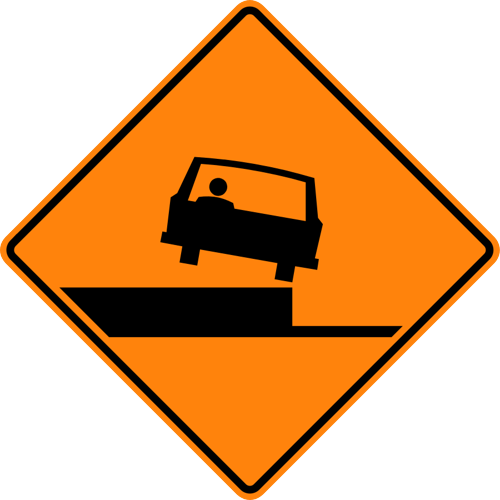 This road sign means:
A
Low shoulder
B
Stop ahead
C
Tow away zone
D
Buggy warning
Answer Explanation
This traffic sign indicates: Low shoulder. Observing and obeying all roadway signs ensures safe traffic flow and legal driving.
This traffic sign indicates: Low shoulder. Observing and obeying all roadway signs ensures safe traffic flow and legal driving.
Question 12:
Double solid lines on the roadway mean:
A
you cannot pass.
B
you can not go across the lines except to turn left to enter or leave the highway.
C
All of the above.
Answer Explanation
All of the listed points are essential driving requirements: you cannot pass; you can not go across the lines except to turn left to enter or leave the highway. Practicing each ensures compliance with DMV safety laws.
All of the listed points are essential driving requirements: you cannot pass; you can not go across the lines except to turn left to enter or leave the highway. Practicing each ensures compliance with DMV safety laws.
Question 13:
Directions given by traffic officers ___________ signs, signals or pavement markings.
A
take precedence over
B
are less important than
C
must obey
Answer Explanation
The correct driving rule is: take precedence over. Following standard DMV road rules and practicing defensive driving ensures safety for all road users.
The correct driving rule is: take precedence over. Following standard DMV road rules and practicing defensive driving ensures safety for all road users.
Question 14:
High beam headlights should be used at night:
A
when driving in foggy areas.
B
when following other vehicles.
C
when there are no oncoming vehicles.
D
when meeting other vehicles.
Answer Explanation
The correct driving rule is: when there are no oncoming vehicles. Following standard DMV road rules and practicing defensive driving ensures safety for all road users.
The correct driving rule is: when there are no oncoming vehicles. Following standard DMV road rules and practicing defensive driving ensures safety for all road users.
Question 15:
A traffic sign with a red circle around and a slash over a symbol means:
A
the maneuver shown by the symbol is not allowed.
B
Do not drive faster than the posted speed limit.
C
the maneuver shown on the sign should be executed with extreme caution.
Answer Explanation
This traffic sign indicates: the maneuver shown by the symbol is not allowed. Observing and obeying all roadway signs ensures safe traffic flow and legal driving.
This traffic sign indicates: the maneuver shown by the symbol is not allowed. Observing and obeying all roadway signs ensures safe traffic flow and legal driving.
Question 16:
What should you do when an aggressive driver confronts you?
A
Avoid eye contact with the aggressive driver.
B
Make eye contact.
C
Challenge the aggressive driver with increased speed.
Answer Explanation
The correct driving rule is: avoid eye contact with the aggressive driver. Following standard DMV road rules and practicing defensive driving ensures safety for all road users.
The correct driving rule is: avoid eye contact with the aggressive driver. Following standard DMV road rules and practicing defensive driving ensures safety for all road users.
Question 17:
To drive defensively, you must:
A
anticipate errors by other drivers.
B
assume that a driver who approaches a STOP sign on a side road is actually going to stop.
C
not check behind you through your mirrors.
Answer Explanation
The correct driving rule is: anticipate errors by other drivers. Following standard DMV road rules and practicing defensive driving ensures safety for all road users.
The correct driving rule is: anticipate errors by other drivers. Following standard DMV road rules and practicing defensive driving ensures safety for all road users.
Question 18:
The following symptoms are associated with drowsy driving:
A
You continue to yawn.
B
You don’t remember driving the last few miles.
C
All of the above.
Answer Explanation
Alcohol and impairing substances degrade all critical driving functions: You continue to yawn; You don’t remember driving the last few miles. Driving while impaired carries severe criminal and safety penalties.
Alcohol and impairing substances degrade all critical driving functions: You continue to yawn; You don’t remember driving the last few miles. Driving while impaired carries severe criminal and safety penalties.
Question 19:
 This road sign means:
A
The left lane ends soon
B
one-way street ahead.
C
The right lane ends soon
D
Highway entrance ramp ahead
Answer Explanation
This traffic sign indicates: The right lane ends soon. Observing and obeying all roadway signs ensures safe traffic flow and legal driving.
This traffic sign indicates: The right lane ends soon. Observing and obeying all roadway signs ensures safe traffic flow and legal driving.
Question 20:
What is the purpose of minimum speed limits?
A
To keep a smooth traffic flow.
B
To halt the traffic flow.
C
To allow emergency vehicles with red flashing lights to safely pass other vehicles.
Answer Explanation
For safe speed and stopping control: To keep a smooth traffic flow. Adjusting speed to match visibility and road traction prevents loss of steering grip.
For safe speed and stopping control: To keep a smooth traffic flow. Adjusting speed to match visibility and road traction prevents loss of steering grip.