←
Back to Test
Hide Answer Key
Print / Save as PDF
Print / PDF
drive
quiz
.com
RANDOM PRACTİCE EXAM
Special Tests
Duration: 45 min
|
Questions: 50
Student Name:
Date:
Correct:
Incorrect:
Score:
1.
Cars entering an expressway:
A)
have the right-of-way over trucks.
B)
must yield the right-of-way to traffic on the expressway.
C)
have the right-of-way over other vehicles.
D)
must stop at traffic lights.
2.
When driving in dense fog or heavy snow, which headlights should you use?
A)
High-beam headlights for maximum range
B)
Low-beam headlights or fog lights
C)
Parking lights only
D)
Hazard warning flashers while driving at highway speed
3.
In heavy rain, tires can ride on a thin film of water, without touching the road. This is called:
A)
waterplaning.
B)
risk-planning
C)
hydroplaning.
D)
rainplaning.
4.
A 4-way stop sign means:
A)
The first vehicle to reach the intersection should move forward first.
B)
Traffic from all four directions must stop.
C)
There are four stop signs at the intersection.
D)
All of the above.
5.
It is extremely foggy. Based on the Basic Speed Law, if you are driving 45 MPH in a 55 MPH speed, you could be cited for:
A)
driving “too fast for conditions.”
B)
driving below the posted Basic Speed Limit.
C)
driving too slow.
6.
Which of the following does alcohol affect?
A)
Alertness.
B)
Reaction time.
C)
All of the above.
7.
Bicyclists making a left hand turn:
A)
must cut through all lanes.
B)
should wait on the right side of the road.
C)
may use the left lane.
8.
How far from a railroad crossing must you stop or park your vehicle?
A)
At least 50 feet
B)
At least 10 feet
C)
No closer than 100 feet
D)
Directly between the tracks
9.
When should you use hand-over-hand steering?
A)
When performing sharp right turns.
B)
When parking.
C)
All of the above.
10.
What does this sign indicate?
A)
The highway ahead is divided into two one-way roadways.
B)
Winding road ahead. Drive with caution.
C)
Drivers will soon be on a roadway with two-way traffic.
11.
If you see orange construction signs and cones on a freeway, you must:
A)
be prepared for workers and equipment ahead.
B)
make a U-turn because the lane ends ahead.
C)
maintain your current speed while changing lanes.
12.
When driving at night, drivers should NOT:
A)
use lane lines as visual guides and look quickly to check the other vehicle’s position every few seconds.
B)
use headlights between the hours of sunset and sunrise.
C)
use high-beam headlights within 500 feet of oncoming vehicles.
D)
All of the above.
13.
You are approaching a green traffic light, but traffic is blocking the intersection. What is the best thing to do?
A)
Partially enter the intersection to establish your right-of-way.
B)
Continue into the intersection and wait for traffic to clear.
C)
Don’t enter the intersection until you can get completely across.
14.
When you prepare to make a left turn from a one-way road into a one-way road, you must:
A)
move into the right lane, or to the left side of a single lane.
B)
move into the right lane, or to the right side of a single lane.
C)
move into the left lane, or to the left side of a single lane.
15.
All New Jersey driver license applicants must complete 6 Point ID Verification by presenting documents that prove:
A)
legal presence in the U.S.
B)
their age.
C)
their identity.
D)
All of the above.
16.
The maximum speed limit in this state is ____ MPH.
A)
70
B)
55
C)
60
D)
50
17.
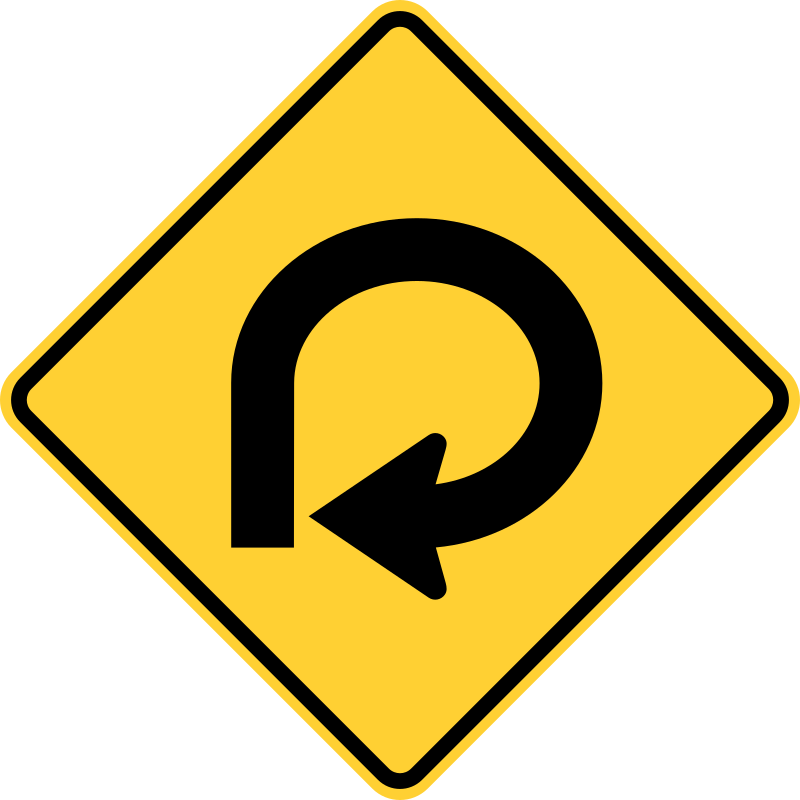
This sign means:
A)
Roundabout ahead.
B)
270 degree turn ahead.
C)
Wrong way; Turn around immediately.
18.
What does a solid double white line separating lanes of traffic mean?
A)
Lane changing is strictly prohibited
B)
Passing is allowed at any time
C)
The left lane is for parking
D)
Opposing traffic is present
19.
This sign means:
A)
A road crosses the main highway ahead.
B)
The divided highway on which drivers are traveling ends ahead.
C)
Drivers are coming to a point where another traffic lane joins the one they are on.
20.
If moving to the curb to stop your vehicle, you should:
A)
check mirrors for traffic to the rear and signal your intention.
B)
use your ABS system.
C)
stop suddenly and move to within 12 inches of the curb.
D)
stop at the next gas station.
21.
When a school bus is picking up or dropping off children, you must:
A)
slow down and pass the bus with caution.
B)
stop if you are driving in the same direction.
C)
stop regardless of your direction of travel.
22.
If you missed your exit on a freeway, you should:
A)
use the right turn signal, check your mirrors and move to the right.
B)
None of the above.
C)
go to the next exit and come back to the exit you missed.
D)
make a quick U-turn from your lane of travel.
23.
In Wisconsin, if you have an instruction permit or probationary license using a cell phone while driving is against the law in Wisconsin except:
A)
to report an emergency.
B)
to send a text message.
C)
to answer an important call.
D)
All of the above.
24.
Which of the following is a defensive driving skill/technique?
A)
Maintain the correct speed.
B)
Do not drive if you are very weary.
C)
All of the above.
25.
To avoid being struck from behind, you should:
A)
drive faster than the flow of traffic to create a gap between you and the vehicle behind you.
B)
pump your brakes often.
C)
drive slower than the rest of the traffic to create a space cushion around you.
D)
keep pace with the traffic.
26.
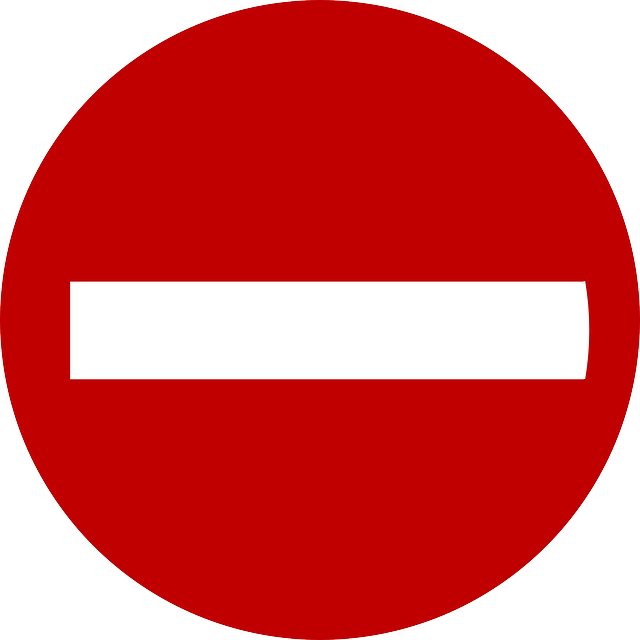
The picture represents a _________ sign:
A)
Do Not Pass
B)
Do Not Enter
C)
Wrong Way
27.
Turning motorists must _____________ at intersections and driveways:
A)
make U-turns
B)
block the crosswalk when stopped at a red light
C)
stop for pedestrians
D)
make a turn that causes pedestrians to stop
28.
You are approaching an intersection with a flashing red traffic light. You must:
A)
Slow down and proceed with caution
B)
Come to a complete stop and proceed only when it is safe
C)
Stop only if other vehicles are present
D)
Speed up before cross traffic arrives
29.
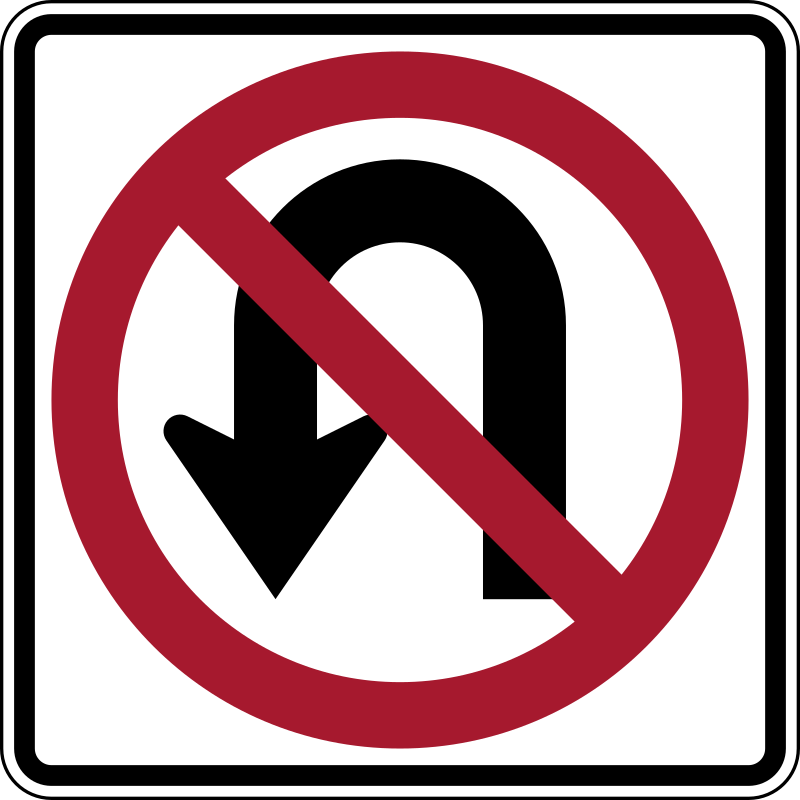
This road sign means:
A)
No left turn
B)
No U-turn
C)
Detour ahead
30.
You want to turn left at an intersection ahead. A car reaches the intersection from the opposite direction and moves straight ahead. You:
A)
can turn left. You have the right of way.
B)
must wait for the car to go through before you turn.
C)
may not enter the intersection to prepare for your left turn if the light is green.
31.
When stopping on a road to perform a straight line backing maneuver:
A)
the vehicle must be backed as fast as possible.
B)
drivers should give a hand signal to warn approaching traffic from the rear that they intend to stop.
C)
drivers should look straight ahead while backing.
32.
Use of cell phones while driving:
A)
is allowed when driving at 25 MPH or slower.
B)
requires an upgraded driving license.
C)
can distract you and cause a crash.
D)
is permitted in Idaho.
33.
If you encounter a severe dust storm while driving you must, you should:
A)
maintain your speed and don’t change lanes.
B)
slow down and pull off the road.
C)
turn on your high beams.
34.
Orange-colored road signs warn you of:
A)
a school zone ahead.
B)
road workers or road equipment ahead.
C)
a traffic signal ahead.
35.
When a school bus stops on a two-lane road with its red lights flashing and stop arm extended, who must stop?
A)
Only vehicles traveling in the same direction as the bus
B)
Vehicles traveling in both directions must come to a complete stop
C)
Only commercial trucks
D)
No vehicles must stop if there is no crosswalk
36.
When children or school crossing guards are present in a crosswalk, what should drivers do?
A)
Stop in the crosswalk.
B)
Yield or stop at the marked stop line and without stopping in the crosswalk.
C)
Enter the crosswalk while the school crossing guard is in the roadway.
D)
Stop after the marked stop line.
37.
A flashing yellow light:
A)
warns drivers to proceed with caution.
B)
is used at dangerous intersections.
C)
All of the above.
38.
As the percentage of alcohol in your blood (BAC) increases, you become:
A)
more reactive.
B)
more intoxicated.
C)
more sober.
39.
As you drive on the freeway, make sure:
A)
your directional signal goes off before you change lanes.
B)
to signal all lane changes.
C)
you cut off vehicles behind you when you change lanes.
40.
A broken yellow line between two lanes of traffic means:
A)
Passing is permitted when safe.
B)
Passing is not permitted.
C)
Passing on the right is permitted in either direction
41.
Do not park a vehicle:
A)
within 20 feet of a crosswalk at an intersection.
B)
in front of a public or private driveway.
C)
on a roadway directly beside stopped or parked vehicles.
D)
All of the above.
42.
The picture shows:
A)
a sign alerting drivers that bicycles may be ahead.
B)
a bike lane.
C)
a pavement marking telling bicyclists that they must go straight.
D)
a motorcyle lane.
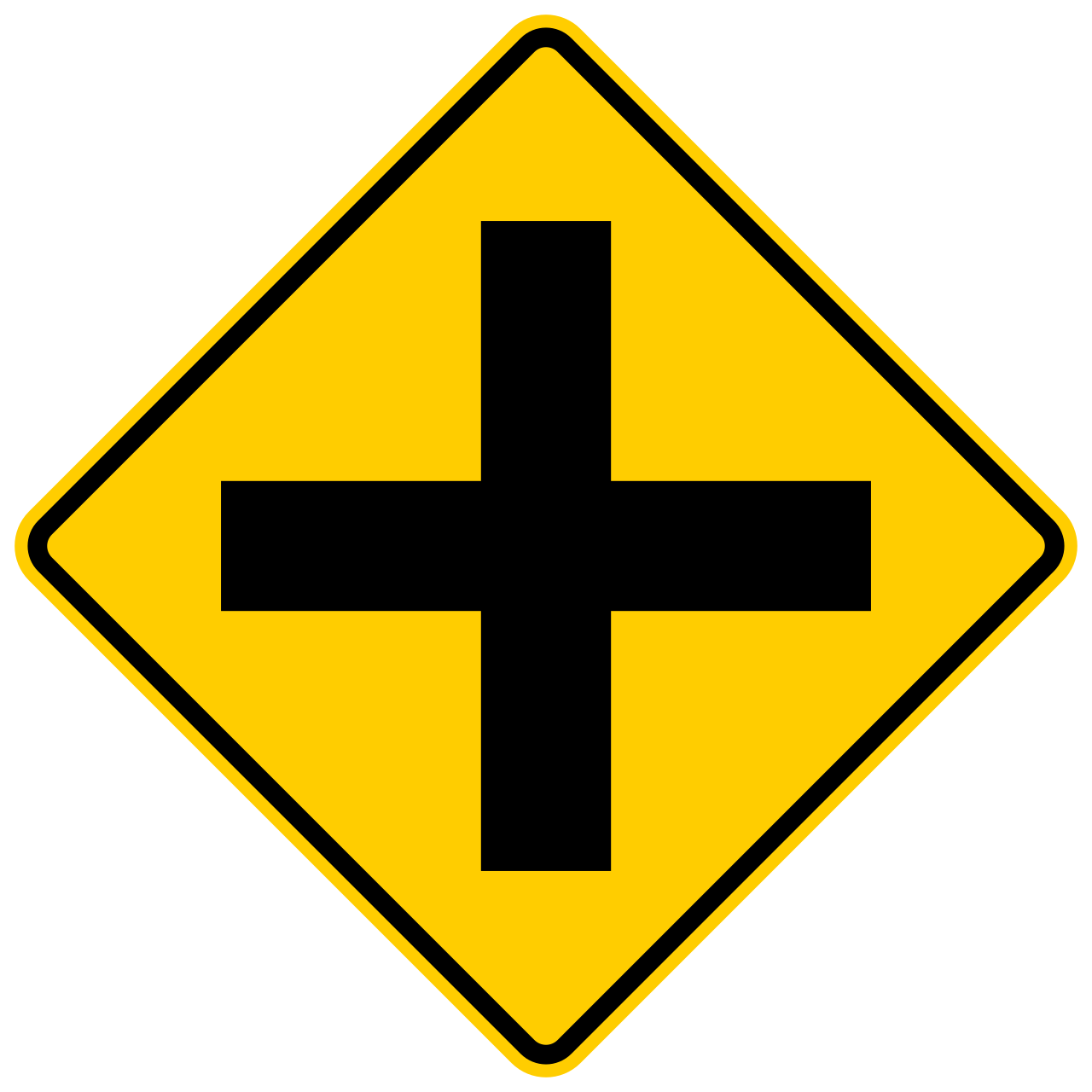
43.
This road sign means:
A)
A four-way intersection is ahead
B)
Do not pass
C)
A steep grade is ahead
44.
It is illegal for any person under age 21 to operate e vehicle with any trace of alcohol or drugs in their system.
A)
False
B)
True
45.
When a stopped school bus flashes its red lights, drivers should stop at least ___ feet away from the bus.
A)
50
B)
30
C)
20
D)
5
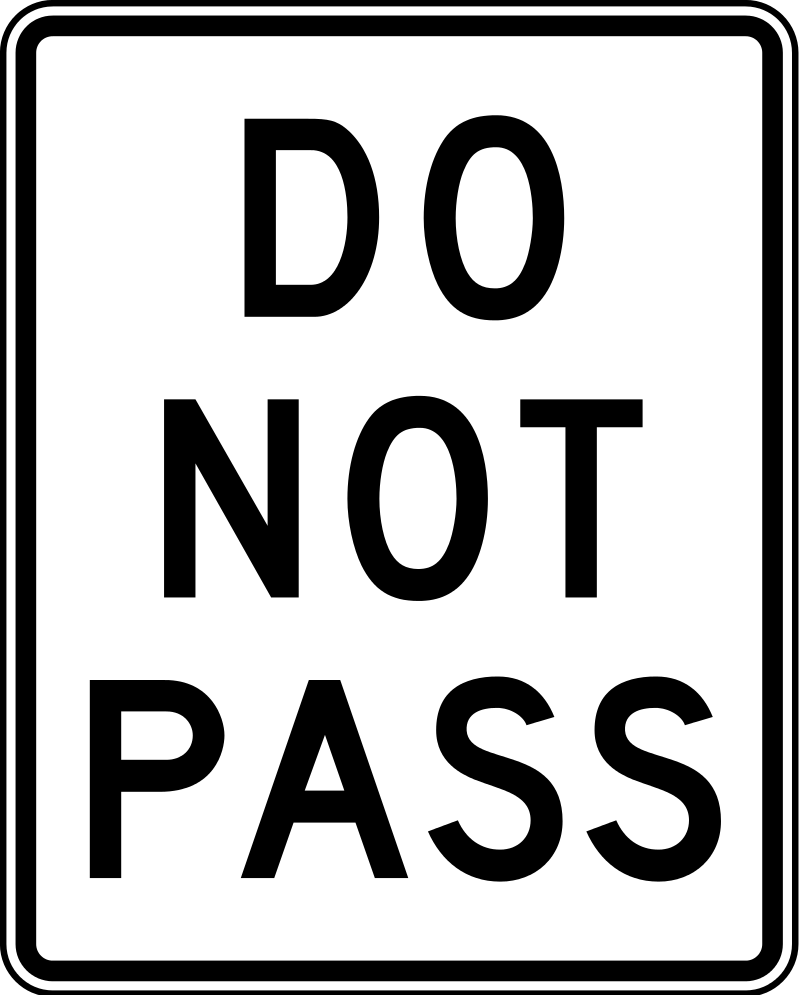
46.
This white sign means don’t pass:
A)
unless it is safe to do so.
B)
other vehicles for any reason.
C)
until after you pass the sign.
47.
Hydroplaning is when:
A)
your tires start to ride up on the water and lose all contact with the road.
B)
splash and spray from large trucks reduces visibility.
C)
heavy rain forces you to move to the right side of the road and stop.
48.
Green and white signs:
A)
give information about directions and distances.
B)
are mainly used at intersections and driveways.
C)
warn drivers of unexpected road conditions.
49.
Which of the following roadways freezes first when wet?
A)
Tunnels
B)
Intersections
C)
Bridges and over-passes
50.
Roads are most slippery during the first rain.
A)
False.
B)
True.
ANSWER KEY
Check answers after completing the test.
1
B
2
B
3
C
4
D
5
A
6
C
7
C
8
A
9
C
10
C
11
A
12
C
13
C
14
C
15
D
16
A
17
B
18
A
19
C
20
A
21
C
22
C
23
A
24
C
25
D
26
B
27
C
28
B
29
B
30
B
31
B
32
C
33
B
34
B
35
B
36
B
37
C
38
B
39
B
40
A
41
D
42
B
43
A
44
B
45
C
46
B
47
A
48
A
49
C
50
B