Question 1:
If a driver follows you too closely, you should:
A
move to another lane if possible.
B
activate your stop lights.
C
brake suddenly.
Answer Explanation
The correct driving rule is: move to another lane if possible. Following standard DMV road rules and practicing defensive driving ensures safety for all road users.
The correct driving rule is: move to another lane if possible. Following standard DMV road rules and practicing defensive driving ensures safety for all road users.
Question 2:
 The octagonal shape is used:
A
for stop signs and railroad advance warning signs.
B
exclusively for stop signs.
C
to warn drivers of existing or possible hazards on roadways.
Answer Explanation
An octagonal Stop sign requires a full and complete stop before the stop line or crosswalk: exclusively for stop signs. Proceed only after yielding to all cross traffic and pedestrians.
An octagonal Stop sign requires a full and complete stop before the stop line or crosswalk: exclusively for stop signs. Proceed only after yielding to all cross traffic and pedestrians.
Question 3:
 This road sign means:
A
Divided highway ahead
B
Two-way traffic ahead
C
Four-lane traffic ahead
Answer Explanation
This traffic sign indicates: Two-way traffic ahead. Observing and obeying all roadway signs ensures safe traffic flow and legal driving.
This traffic sign indicates: Two-way traffic ahead. Observing and obeying all roadway signs ensures safe traffic flow and legal driving.
Question 4:
A flashing yellow traffic signal means:
A
Slow down and be alert at the upcoming intersection.
B
The same thing as a stop sign.
C
Stop and proceed when a green light appears.
D
No right turn.
Answer Explanation
This traffic sign indicates: slow down and be alert at the upcoming intersection. Observing and obeying all roadway signs ensures safe traffic flow and legal driving.
This traffic sign indicates: slow down and be alert at the upcoming intersection. Observing and obeying all roadway signs ensures safe traffic flow and legal driving.
Question 5:
When approaching a curve, remember to:
A
accelerate slightly before entering the curve.
B
drive at the posted speed limit throughout the curve.
C
slow down before entering the curve.
D
drive at the posted speed limit as you enter the curve, then slow down gradually.
Answer Explanation
The correct driving rule is: slow down before entering the curve. Following standard DMV road rules and practicing defensive driving ensures safety for all road users.
The correct driving rule is: slow down before entering the curve. Following standard DMV road rules and practicing defensive driving ensures safety for all road users.
Question 6:
You are entering a roadway from a private road, and you need to turn left. You have to yield to:
A
vehicles from the right.
B
vehicles from the left.
C
vehicles from both directions.
Answer Explanation
According to standard right-of-way regulations: vehicles from both directions. Yielding appropriately prevents intersection collisions and maintains safe traffic flow.
According to standard right-of-way regulations: vehicles from both directions. Yielding appropriately prevents intersection collisions and maintains safe traffic flow.
Question 7:
To avoid being in a truck driver’s blind spot, you should:
A
never pass the truck and put your headlights on.
B
avoid driving on either side of the truck and don’t tailgate.
C
flash your lights.
D
sound your horn.
Answer Explanation
Large commercial trucks have extensive blind spots on all four sides called the 'No-Zone': avoid driving on either side of the truck and don’t tailgate. If you cannot see the truck driver in their side mirrors, they cannot see you.
Large commercial trucks have extensive blind spots on all four sides called the 'No-Zone': avoid driving on either side of the truck and don’t tailgate. If you cannot see the truck driver in their side mirrors, they cannot see you.
Question 8:
On what three conditions does your blood alcohol content (BAC) depend?
A
Your weight. How much alcohol you drink. How much time passes between drinks.
B
Your weight. The type of beverage you drink. How fit you are.
C
Your height. How much alcohol you drink. The type of beverage you drink.
Answer Explanation
Under state DUI and traffic safety laws: Your weight. How much alcohol you drink. How much time passes between drinks. Alcohol degrades judgment, slows reaction times, and distorts depth perception.
Under state DUI and traffic safety laws: Your weight. How much alcohol you drink. How much time passes between drinks. Alcohol degrades judgment, slows reaction times, and distorts depth perception.
Question 9:
To check your blind spot before changing lanes:
A
look into the right side mirror.
B
look into the rearview mirror.
C
look over your shoulder in the direction you plan to move.
D
look into the left side mirror.
Answer Explanation
Large commercial trucks have extensive blind spots on all four sides called the 'No-Zone': look over your shoulder in the direction you plan to move. If you cannot see the truck driver in their side mirrors, they cannot see you.
Large commercial trucks have extensive blind spots on all four sides called the 'No-Zone': look over your shoulder in the direction you plan to move. If you cannot see the truck driver in their side mirrors, they cannot see you.
Question 10:
A steady yellow light means that a ______ light will soon appear.
A
steady green
B
steady red
C
flashing yellow
D
flashing green
Answer Explanation
According to standard right-of-way regulations: steady red. Yielding appropriately prevents intersection collisions and maintains safe traffic flow.
According to standard right-of-way regulations: steady red. Yielding appropriately prevents intersection collisions and maintains safe traffic flow.
Question 11:
Drivers can not pass a vehicle on the left if:
A
they approach the top of a hill on a two-way road and can not see over it.
B
they can not safely return to the right lane before they reach a solid yellow center line for the right lane.
C
All of the above.
Answer Explanation
All of the listed points are essential driving requirements: they approach the top of a hill on a two-way road and can not see over it; they can not safely return to the right lane before they reach a solid yellow center line for the right lane. Practicing each ensures compliance with DMV safety laws.
All of the listed points are essential driving requirements: they approach the top of a hill on a two-way road and can not see over it; they can not safely return to the right lane before they reach a solid yellow center line for the right lane. Practicing each ensures compliance with DMV safety laws.
Question 12:
 This sign warns drivers that:
A
the road will make a sharp turn to the right.
B
right turns are not allowed.
C
another road enters the highway from the direction shown.
Answer Explanation
This traffic sign indicates: the road will make a sharp turn to the right. Observing and obeying all roadway signs ensures safe traffic flow and legal driving.
This traffic sign indicates: the road will make a sharp turn to the right. Observing and obeying all roadway signs ensures safe traffic flow and legal driving.
Question 13:
 This road sign warns drivers that:
A
left turns are not allowed at the intersection.
B
the road will make a sharp turn to the right.
C
another road enters the highway from the direction shown.
Answer Explanation
This traffic sign indicates: another road enters the highway from the direction shown. Observing and obeying all roadway signs ensures safe traffic flow and legal driving.
This traffic sign indicates: another road enters the highway from the direction shown. Observing and obeying all roadway signs ensures safe traffic flow and legal driving.
Question 14:
 This sign means drivers should:
A
not drive in this lane.
B
give the right-of-way to traffic on the road they wish to enter.
C
proceed at normal speed through the upcoming intersection.
D
come to a complete stop and check for oncoming traffic before proceeding.
Answer Explanation
This traffic sign indicates: give the right-of-way to traffic on the road they wish to enter. Observing and obeying all roadway signs ensures safe traffic flow and legal driving.
This traffic sign indicates: give the right-of-way to traffic on the road they wish to enter. Observing and obeying all roadway signs ensures safe traffic flow and legal driving.
Question 15:
 This road sign means:
A
Pedestrian crossing
B
School zone
C
School crossing
Answer Explanation
This traffic sign indicates: Pedestrian crossing. Observing and obeying all roadway signs ensures safe traffic flow and legal driving.
This traffic sign indicates: Pedestrian crossing. Observing and obeying all roadway signs ensures safe traffic flow and legal driving.
Question 16:
When driving in fog, drivers should:
A
not use high beam headlights.
B
use low beam headlights to better illuminate the road ahead.
C
slow down and drive cautiously.
D
All of the above.
Answer Explanation
Hazardous road and weather conditions require extra caution: not use high beam headlights; use low beam headlights to better illuminate the road ahead; slow down and drive cautiously. Reducing speed and expanding following distance preserves control.
Hazardous road and weather conditions require extra caution: not use high beam headlights; use low beam headlights to better illuminate the road ahead; slow down and drive cautiously. Reducing speed and expanding following distance preserves control.
Question 17:
Emergency vehicles:
A
may follow each other.
B
may use a loudspeaker to give instructions.
C
have the right-of-way when using siren and red/blue lights.
D
All of the above.
Answer Explanation
All of the listed points are essential driving requirements: may follow each other; may use a loudspeaker to give instructions; have the right-of-way when using siren and red/blue lights. Practicing each ensures compliance with DMV safety laws.
All of the listed points are essential driving requirements: may follow each other; may use a loudspeaker to give instructions; have the right-of-way when using siren and red/blue lights. Practicing each ensures compliance with DMV safety laws.
Question 18:
 What does a flashing yellow light mean?
A
The same thing as a stop sign.
B
Drivers may move forward with caution.
C
All of the above.
Answer Explanation
According to standard right-of-way regulations: drivers may move forward with caution. Yielding appropriately prevents intersection collisions and maintains safe traffic flow.
According to standard right-of-way regulations: drivers may move forward with caution. Yielding appropriately prevents intersection collisions and maintains safe traffic flow.
Question 19:
What is the purpose of minimum speed limits?
A
To keep a smooth traffic flow.
B
To halt the traffic flow.
C
To allow emergency vehicles with red flashing lights to safely pass other vehicles.
Answer Explanation
For safe speed and stopping control: To keep a smooth traffic flow. Adjusting speed to match visibility and road traction prevents loss of steering grip.
For safe speed and stopping control: To keep a smooth traffic flow. Adjusting speed to match visibility and road traction prevents loss of steering grip.
Question 20:
If you stop along the road at night:
A
turn on your emergency flashers and leave your low beams on.
B
turn off your emergency lights and leave your high beams on.
C
turn on your headlights only.
D
turn off all your lights.
Answer Explanation
The correct driving rule is: turn on your emergency flashers and leave your low beams on. Following standard DMV road rules and practicing defensive driving ensures safety for all road users.
The correct driving rule is: turn on your emergency flashers and leave your low beams on. Following standard DMV road rules and practicing defensive driving ensures safety for all road users.
Question 21:
 What should drivers do when they see this road sign?
A
come to a complete stop and wait for a train to cross.
B
slow down, look for a train, and be prepared to stop.
C
look for a human flagger.
Answer Explanation
This traffic sign indicates: slow down, look for a train, and be prepared to stop. Observing and obeying all roadway signs ensures safe traffic flow and legal driving.
This traffic sign indicates: slow down, look for a train, and be prepared to stop. Observing and obeying all roadway signs ensures safe traffic flow and legal driving.
Question 22:
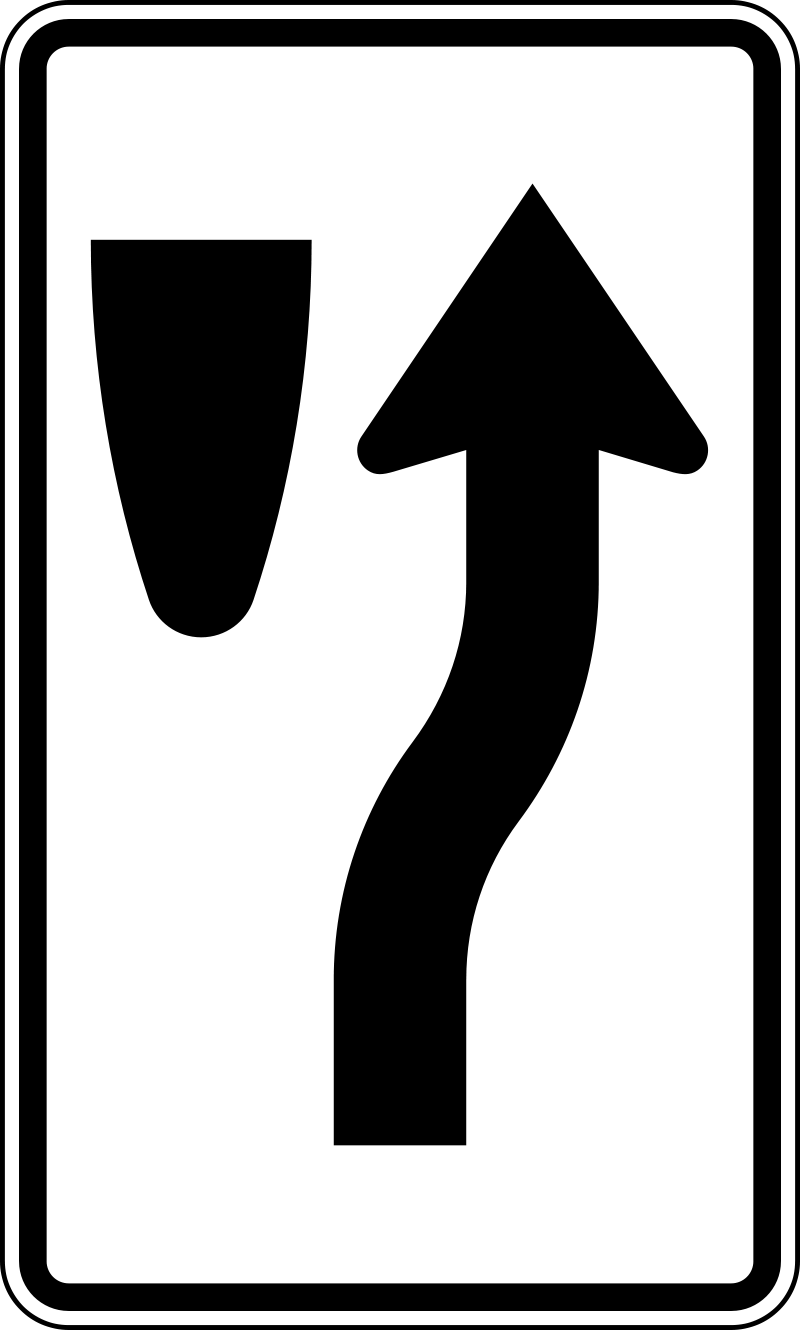 This road sign means:
A
Stop sign ahead
B
Keep to the side indicated by the arrow
C
Side road
D
Low shoulder
Answer Explanation
This traffic sign indicates: keep to the side indicated by the arrow. Observing and obeying all roadway signs ensures safe traffic flow and legal driving.
This traffic sign indicates: keep to the side indicated by the arrow. Observing and obeying all roadway signs ensures safe traffic flow and legal driving.
Question 23:
Following another vehicle too closely is known as:
A
speedgating.
B
closetailing.
C
tailgating.
Answer Explanation
The correct driving rule is: tailgating. Following standard DMV road rules and practicing defensive driving ensures safety for all road users.
The correct driving rule is: tailgating. Following standard DMV road rules and practicing defensive driving ensures safety for all road users.
Question 24:
 A pedestrian in the crosswalk when the 'DON’T WALK' signal begins flashing must:
A
stop immediately.
B
go back and wait the “WALK” light
C
finish crossing the street.
Answer Explanation
Drivers must always yield the right-of-way to pedestrians crossing at intersections and crosswalks: finish crossing the street. Stop and allow them to clear the lane safely.
Drivers must always yield the right-of-way to pedestrians crossing at intersections and crosswalks: finish crossing the street. Stop and allow them to clear the lane safely.
Question 25:
Drivers under 21 years of age are considered to be driving under the influence if their blood alcohol concentration (BAC) is:
A
.10% or higher.
B
.05% or higher.
C
.08% or higher.
D
.02% or higher.
Answer Explanation
Under state DUI and traffic safety laws: .02% or higher. Alcohol degrades judgment, slows reaction times, and distorts depth perception.
Under state DUI and traffic safety laws: .02% or higher. Alcohol degrades judgment, slows reaction times, and distorts depth perception.
Question 26:
If the entrance lane is too short to allow acceleration to expressway speed, you should:
A
stop and wait for a large space in traffic.
B
enter the expressway and accelerate quickly.
C
reduce your speed to 15 MPH or less and blend with traffic.
Answer Explanation
For safe speed and stopping control: stop and wait for a large space in traffic. Adjusting speed to match visibility and road traction prevents loss of steering grip.
For safe speed and stopping control: stop and wait for a large space in traffic. Adjusting speed to match visibility and road traction prevents loss of steering grip.
Question 27:
As you drive on the expressway, make sure:
A
you cut off vehicles behind you when you change lanes.
B
to signal all lane changes.
C
your directional signal goes off before you change lanes.
Answer Explanation
The correct driving rule is: to signal all lane changes. Following standard DMV road rules and practicing defensive driving ensures safety for all road users.
The correct driving rule is: to signal all lane changes. Following standard DMV road rules and practicing defensive driving ensures safety for all road users.
Question 28:
If you miss your exit from an interstate expressway, you should:
A
go to the next exit and come back to the exit you missed.
B
use the right turn signal, check your mirrors and move to the right.
C
pull over to the right and back up with caution until you reach the exit ramp.
D
make a quick U-turn from your lane of travel.
Answer Explanation
Defensive driving guidelines state that: go to the next exit and come back to the exit you missed. Anticipating road hazards and communicating maneuvers keeps traffic predictable and safe.
Defensive driving guidelines state that: go to the next exit and come back to the exit you missed. Anticipating road hazards and communicating maneuvers keeps traffic predictable and safe.
Question 29:
After parking, are you allowed to open a door on the road side of your vehicle?
A
Yes, always.
B
Yes, but only if it does not interfere with bicyclists and other traffic.
C
No, never.
Answer Explanation
Under standard parking and curb regulations: Yes, but only if it does not interfere with bicyclists and other traffic. Following parking distance clearances keeps roadways unobstructed and emergency lanes accessible.
Under standard parking and curb regulations: Yes, but only if it does not interfere with bicyclists and other traffic. Following parking distance clearances keeps roadways unobstructed and emergency lanes accessible.
Question 30:
When you make a left turn from a one-way road into a two-way road, you must:
A
enter the two-way road to the left of its center line.
B
make a U-turn into the two-way road.
C
enter the two-way road to the right of its center line.
Answer Explanation
The correct driving rule is: enter the two-way road to the right of its center line. Following standard DMV road rules and practicing defensive driving ensures safety for all road users.
The correct driving rule is: enter the two-way road to the right of its center line. Following standard DMV road rules and practicing defensive driving ensures safety for all road users.
Question 31:
Drivers must be prepared for anything coming up in the road ahead. They should:
A
scan the road for traffic conditions and possible hazards.
B
drive with the right foot resting lightly on the brake pedal.
C
stare straight ahead at all times.
D
maintain focus toward the left of the road.
Answer Explanation
The correct driving rule is: scan the road for traffic conditions and possible hazards. Following standard DMV road rules and practicing defensive driving ensures safety for all road users.
The correct driving rule is: scan the road for traffic conditions and possible hazards. Following standard DMV road rules and practicing defensive driving ensures safety for all road users.
Question 32:
 This sign means:
A
Hairpin corner ahead.
B
Warning: U-turn ahead.
C
Sharp right turn ahead.
Answer Explanation
This traffic sign indicates: Hairpin corner ahead. Observing and obeying all roadway signs ensures safe traffic flow and legal driving.
This traffic sign indicates: Hairpin corner ahead. Observing and obeying all roadway signs ensures safe traffic flow and legal driving.
Question 33:
When the road is slippery, you should:
A
brake suddenly carefully.
B
pump your brakes.
C
press your brakes in slow, steady strokes.
Answer Explanation
For safe speed and stopping control: press your brakes in slow, steady strokes. Adjusting speed to match visibility and road traction prevents loss of steering grip.
For safe speed and stopping control: press your brakes in slow, steady strokes. Adjusting speed to match visibility and road traction prevents loss of steering grip.
Question 34:
When a traffic signal light turns green, you should:
A
back up slowly.
B
yield the right-of-way to pedestrians.
C
yield the right-of-way to larger vehicles.
D
wait 5 seconds before proceeding.
Answer Explanation
A triangular Yield sign requires drivers to slow down and give right-of-way to other traffic: yield the right-of-way to pedestrians. Proceed only when there is a safe opening.
A triangular Yield sign requires drivers to slow down and give right-of-way to other traffic: yield the right-of-way to pedestrians. Proceed only when there is a safe opening.
Question 35:
When two cars arrive at an intersection with no signs or signals at the same time, which car has the right-of-way?
A
The car that is traveling faster.
B
The car approaching from the right.
C
The car approaching from the left.
D
The car in which the driver sounds the horn.
Answer Explanation
According to standard right-of-way regulations: The car approaching from the right. Yielding appropriately prevents intersection collisions and maintains safe traffic flow.
According to standard right-of-way regulations: The car approaching from the right. Yielding appropriately prevents intersection collisions and maintains safe traffic flow.