Question 1:
 The yield sign means:
A
Drive with caution in wet weather.
B
You must come to a complete stop.
C
Slow down and give vehicles crossing your path the right-of-way.
Answer Explanation
A triangular Yield sign requires drivers to slow down and give right-of-way to other traffic: slow down and give vehicles crossing your path the right-of-way. Proceed only when there is a safe opening.
A triangular Yield sign requires drivers to slow down and give right-of-way to other traffic: slow down and give vehicles crossing your path the right-of-way. Proceed only when there is a safe opening.
Question 2:
Is chemical test evidence required to prove you were driving while impaired or intoxicated?
A
Yes, and a BAC test is also required.
B
No. The testimony of a police officer about the way you drive, your behavior when arrested is enough.
C
Yes.
D
No, but a breath or blood test is required.
Answer Explanation
In nearly all US states, drivers age 21 and older are legally intoxicated with a Blood Alcohol Concentration (BAC) of 0.08% or higher.
In nearly all US states, drivers age 21 and older are legally intoxicated with a Blood Alcohol Concentration (BAC) of 0.08% or higher.
Question 3:
If you are in a crash you must:
A
stop.
B
leave the scene if the crash involves only property damage.
C
stop, unless the incident involves a fatality.
D
call your insurance company immediately.
Answer Explanation
The correct driving rule is: stop. Following standard DMV road rules and practicing defensive driving ensures safety for all road users.
The correct driving rule is: stop. Following standard DMV road rules and practicing defensive driving ensures safety for all road users.
Question 4:
If a traffic officer signals you to drive through a red light:
A
you must do it.
B
you must wait for the red light to turn green.
C
you must not obey the officer. Signs and signals take precedence over directions given by traffic officers.
Answer Explanation
According to standard right-of-way regulations: you must do it. Yielding appropriately prevents intersection collisions and maintains safe traffic flow.
According to standard right-of-way regulations: you must do it. Yielding appropriately prevents intersection collisions and maintains safe traffic flow.
Question 5:
Which of the following is true about the Anti-Locking Brake System?
A
It prevents skidding.
B
It allows drivers to steer during an emergency braking situation.
C
All of the above.
Answer Explanation
All of the listed points are essential driving requirements: It prevents skidding; It allows drivers to steer during an emergency braking situation. Practicing each ensures compliance with DMV safety laws.
All of the listed points are essential driving requirements: It prevents skidding; It allows drivers to steer during an emergency braking situation. Practicing each ensures compliance with DMV safety laws.
Question 6:
On what three conditions does your blood alcohol content (BAC) depend?
A
Your weight. How much alcohol you drink. How much time passes between drinks.
B
Your weight. The type of beverage you drink. How fit you are.
C
Your height. How much alcohol you drink. The type of beverage you drink.
Answer Explanation
Under state DUI and traffic safety laws: Your weight. How much alcohol you drink. How much time passes between drinks. Alcohol degrades judgment, slows reaction times, and distorts depth perception.
Under state DUI and traffic safety laws: Your weight. How much alcohol you drink. How much time passes between drinks. Alcohol degrades judgment, slows reaction times, and distorts depth perception.
Question 7:
The BAC standards and penalties for commercial drivers are:
A
not applied to truck drivers with 20+ years driving experience.
B
equally tough.
C
tougher.
D
softer.
Answer Explanation
Under state DUI and traffic safety laws: tougher. Alcohol degrades judgment, slows reaction times, and distorts depth perception.
Under state DUI and traffic safety laws: tougher. Alcohol degrades judgment, slows reaction times, and distorts depth perception.
Question 8:
 A flashing red light:
A
is used at dangerous intersections.
B
means the same thing as a stop sign.
C
All of the above.
Answer Explanation
Safe navigation at intersections requires following all established rules: is used at dangerous intersections; means the same thing as a stop sign. Always yield right-of-way properly to prevent collisions.
Safe navigation at intersections requires following all established rules: is used at dangerous intersections; means the same thing as a stop sign. Always yield right-of-way properly to prevent collisions.
Question 9:
A driver who approaches an intersection:
A
must yield the right-of-way to traffic already in the intersection.
B
must drive straight through the intersection, even if another vehicle is already in the intersection.
C
has the right-of-way over traffic already in the intersection.
Answer Explanation
According to standard right-of-way regulations: must yield the right-of-way to traffic already in the intersection. Yielding appropriately prevents intersection collisions and maintains safe traffic flow.
According to standard right-of-way regulations: must yield the right-of-way to traffic already in the intersection. Yielding appropriately prevents intersection collisions and maintains safe traffic flow.
Question 10:
When driving at night, you should:
A
make sure your windshield is clean.
B
keep the interior roof light off.
C
dim the dashboard lights.
D
All of the above.
Answer Explanation
All of the listed points are essential driving requirements: make sure your windshield is clean; keep the interior roof light off; dim the dashboard lights. Practicing each ensures compliance with DMV safety laws.
All of the listed points are essential driving requirements: make sure your windshield is clean; keep the interior roof light off; dim the dashboard lights. Practicing each ensures compliance with DMV safety laws.
Question 11:
ABS is the acronym for:
A
Anti-Braking System
B
Average-Beam System
C
Anti-Locking Brake System
Answer Explanation
The correct driving rule is: Anti-Locking Brake System. Following standard DMV road rules and practicing defensive driving ensures safety for all road users.
The correct driving rule is: Anti-Locking Brake System. Following standard DMV road rules and practicing defensive driving ensures safety for all road users.
Question 12:
 This sign indicates:
A
Winding road
B
Merging traffic
C
Divided highway ends
Answer Explanation
This traffic sign indicates: Merging traffic. Observing and obeying all roadway signs ensures safe traffic flow and legal driving.
This traffic sign indicates: Merging traffic. Observing and obeying all roadway signs ensures safe traffic flow and legal driving.
Question 13:
You are convicted of Driving While Ability Impaired as a first offense. Which of the following potential consequences do you face?
A
up to 15 days in jail.
B
90-day suspension.
C
a fine of between $300 and $500.
D
All of the above.
Answer Explanation
All of the listed points are essential driving requirements: up to 15 days in jail; 90-day suspension; a fine of between $300 and $500. Practicing each ensures compliance with DMV safety laws.
All of the listed points are essential driving requirements: up to 15 days in jail; 90-day suspension; a fine of between $300 and $500. Practicing each ensures compliance with DMV safety laws.
Question 14:
You hear an emergency vehicle heading toward your vehicle. What do you do?
A
After stopping, wait until the emergency vehicle passes before you drive on.
B
If you are in an intersection, drive out of it before you pull over.
C
Pull over immediately to the right and stop.
D
All of the above.
Answer Explanation
Sharing the road safely requires mutual awareness and respect: After stopping, wait until the emergency vehicle passes before you drive on; If you are in an intersection, drive out of it before you pull over; Pull over immediately to the right and stop. Maintaining safe space cushions protects all roadway users.
Sharing the road safely requires mutual awareness and respect: After stopping, wait until the emergency vehicle passes before you drive on; If you are in an intersection, drive out of it before you pull over; Pull over immediately to the right and stop. Maintaining safe space cushions protects all roadway users.
Question 15:
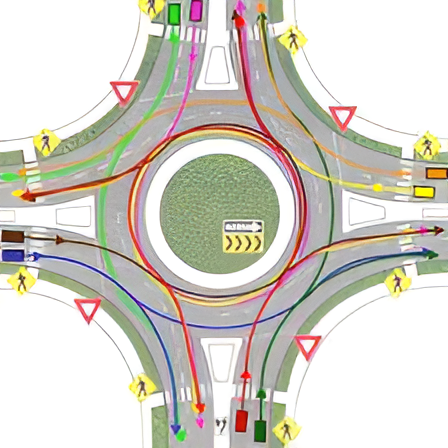 The picture shows:
A
an open intersection
B
a divided highway.
C
a crossing
D
a roundabout
Answer Explanation
The correct driving rule is: a roundabout. Following standard DMV road rules and practicing defensive driving ensures safety for all road users.
The correct driving rule is: a roundabout. Following standard DMV road rules and practicing defensive driving ensures safety for all road users.
Question 16:
At a railroad crossing, you must stop at least 15 feet from the tracks if you see/hear:
A
lowered crossing gates.
B
flashing red lights.
C
a bell.
D
All of the above.
Answer Explanation
All of the listed points are essential driving requirements: lowered crossing gates; flashing red lights; a bell. Practicing each ensures compliance with DMV safety laws.
All of the listed points are essential driving requirements: lowered crossing gates; flashing red lights; a bell. Practicing each ensures compliance with DMV safety laws.
Question 17:
A steady yellow light means:
A
Be prepared to stop for the red light.
B
Drive with caution.
C
Be prepared to go. The light will soon be green.
Answer Explanation
According to standard right-of-way regulations: Be prepared to stop for the red light. Yielding appropriately prevents intersection collisions and maintains safe traffic flow.
According to standard right-of-way regulations: Be prepared to stop for the red light. Yielding appropriately prevents intersection collisions and maintains safe traffic flow.
Question 18:
A thumping sound can be a warning:
A
that a tire blowout is about to occur.
B
of a steering failure.
C
of a brake failure.
Answer Explanation
The correct driving rule is: that a tire blowout is about to occur. Following standard DMV road rules and practicing defensive driving ensures safety for all road users.
The correct driving rule is: that a tire blowout is about to occur. Following standard DMV road rules and practicing defensive driving ensures safety for all road users.
Question 19:
If you are involved in a crash, you must:
A
Take pictures and post them on Facebook and other social media sites.
B
Stop.
C
Leave the scene.
D
It depends on the level of damage.
Answer Explanation
The correct driving rule is: stop. Following standard DMV road rules and practicing defensive driving ensures safety for all road users.
The correct driving rule is: stop. Following standard DMV road rules and practicing defensive driving ensures safety for all road users.
Question 20:
Regulation signs normally are ____ rectangles with ____ letters or symbols.
A
yellow; black
B
white; black
C
green; white
Answer Explanation
The correct driving rule is: white; black. Following standard DMV road rules and practicing defensive driving ensures safety for all road users.
The correct driving rule is: white; black. Following standard DMV road rules and practicing defensive driving ensures safety for all road users.