Question 1:
Drivers are required to yield to pedestrians in a crosswalk.
A
True
B
False
Answer Explanation
Drivers must always yield the right-of-way to pedestrians crossing at intersections and crosswalks: True. Stop and allow them to clear the lane safely.
Drivers must always yield the right-of-way to pedestrians crossing at intersections and crosswalks: True. Stop and allow them to clear the lane safely.
Question 2:
If involved in an accident, drivers should:
A
avoid standing or walking in traffic lanes.
B
turn off the ignitions of wrecked vehicles.
C
stop their vehicle at or near the scene.
D
All of the above.
Answer Explanation
All of the listed points are essential driving requirements: avoid standing or walking in traffic lanes; turn off the ignitions of wrecked vehicles; stop their vehicle at or near the scene. Practicing each ensures compliance with DMV safety laws.
All of the listed points are essential driving requirements: avoid standing or walking in traffic lanes; turn off the ignitions of wrecked vehicles; stop their vehicle at or near the scene. Practicing each ensures compliance with DMV safety laws.
Question 3:
You are driving at night, and a vehicle comes toward you with their high beam headlights on. You should:
A
flash your headlights once quickly.
B
look in the direction of the vehicle.
C
keep your high beams on.
Answer Explanation
The correct driving rule is: flash your headlights once quickly. Following standard DMV road rules and practicing defensive driving ensures safety for all road users.
The correct driving rule is: flash your headlights once quickly. Following standard DMV road rules and practicing defensive driving ensures safety for all road users.
Question 4:
 This road sign means:
A
Crossroad
B
Hospital parking ahead
C
Merge
Answer Explanation
This traffic sign indicates: Crossroad. Observing and obeying all roadway signs ensures safe traffic flow and legal driving.
This traffic sign indicates: Crossroad. Observing and obeying all roadway signs ensures safe traffic flow and legal driving.
Question 5:
When there is a _______ at an intersection, you should come to a complete stop, yield to cross traffic/pedestrians, and then proceed when clear.
A
a solid green light
B
a solid red light
C
a flashing red light
D
a flashing yellow light
Answer Explanation
Drivers must always yield the right-of-way to pedestrians crossing at intersections and crosswalks: a flashing red light. Stop and allow them to clear the lane safely.
Drivers must always yield the right-of-way to pedestrians crossing at intersections and crosswalks: a flashing red light. Stop and allow them to clear the lane safely.
Question 6:
Double solid yellow lines mean:
A
the lane to the right may pass.
B
passing is not permitted in either direction.
C
the lane to the left may pass.
D
passing is permitted in either direction.
Answer Explanation
The correct driving rule is: passing is not permitted in either direction. Following standard DMV road rules and practicing defensive driving ensures safety for all road users.
The correct driving rule is: passing is not permitted in either direction. Following standard DMV road rules and practicing defensive driving ensures safety for all road users.
Question 7:
Drivers who have been drinking are more likely to:
A
keep a safe following distance.
B
yield right-of-way to oncoming vehicles.
C
be less reactive.
Answer Explanation
The correct driving rule is: be less reactive. Following standard DMV road rules and practicing defensive driving ensures safety for all road users.
The correct driving rule is: be less reactive. Following standard DMV road rules and practicing defensive driving ensures safety for all road users.
Question 8:
If driving in foggy weather, drivers should turn on their high-beams to increase the field of vision.
A
True
B
False
Answer Explanation
The correct driving rule is: False. Following standard DMV road rules and practicing defensive driving ensures safety for all road users.
The correct driving rule is: False. Following standard DMV road rules and practicing defensive driving ensures safety for all road users.
Question 9:
When you make a left turn from a two-way road into a four-lane highway, you must:
A
enter the left lane, to the right of the center line.
B
enter the right lane, to the left of the center line.
C
go straight through the intersection, and then make the turn.
Answer Explanation
Defensive driving guidelines state that: enter the left lane, to the right of the center line. Anticipating road hazards and communicating maneuvers keeps traffic predictable and safe.
Defensive driving guidelines state that: enter the left lane, to the right of the center line. Anticipating road hazards and communicating maneuvers keeps traffic predictable and safe.
Question 10:
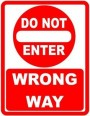 This road sign means:
A
Drivers may proceed if the way is clear
B
Drivers are about to enter a one way street the wrong way
C
U-turns are prohibited
Answer Explanation
This traffic sign indicates: drivers are about to enter a one way street the wrong way. Observing and obeying all roadway signs ensures safe traffic flow and legal driving.
This traffic sign indicates: drivers are about to enter a one way street the wrong way. Observing and obeying all roadway signs ensures safe traffic flow and legal driving.
Question 11:
To avoid hydroplaning you should:
A
keep your tires properly inflated.
B
slow down when roads are wet.
C
All of the above.
Answer Explanation
All of the listed points are essential driving requirements: keep your tires properly inflated; slow down when roads are wet. Practicing each ensures compliance with DMV safety laws.
All of the listed points are essential driving requirements: keep your tires properly inflated; slow down when roads are wet. Practicing each ensures compliance with DMV safety laws.
Question 12:
A speed limit is the __________ speed at which a vehicle may legally travel on the road under ideal conditions.
A
maximum
B
minimum
C
suggested
D
None of the above.
Answer Explanation
For safe speed and stopping control: maximum. Adjusting speed to match visibility and road traction prevents loss of steering grip.
For safe speed and stopping control: maximum. Adjusting speed to match visibility and road traction prevents loss of steering grip.
Question 13:
 This road sign means:
A
Keep left
B
Divided highway begins
C
Lane ends
Answer Explanation
This traffic sign indicates: Divided highway begins. Observing and obeying all roadway signs ensures safe traffic flow and legal driving.
This traffic sign indicates: Divided highway begins. Observing and obeying all roadway signs ensures safe traffic flow and legal driving.
Question 14:
Never make a U-turn from:
A
the lane you’re in.
B
the right lane.
C
the left part of the lane nearest to the centerline of the roadway.
Answer Explanation
According to standard right-of-way regulations: the right lane. Yielding appropriately prevents intersection collisions and maintains safe traffic flow.
According to standard right-of-way regulations: the right lane. Yielding appropriately prevents intersection collisions and maintains safe traffic flow.
Question 15:
 This road sign warns drivers that:
A
they are coming to a point where another traffic lane joins the one they are on.
B
a divided highway is ahead.
C
the one-way street or roadway is about to change to two-way traffic.
Answer Explanation
This traffic sign indicates: the one-way street or roadway is about to change to two-way traffic. Observing and obeying all roadway signs ensures safe traffic flow and legal driving.
This traffic sign indicates: the one-way street or roadway is about to change to two-way traffic. Observing and obeying all roadway signs ensures safe traffic flow and legal driving.
Question 16:
 What does a flashing yellow light mean?
A
The same thing as a stop sign.
B
Drivers may move forward with caution.
C
All of the above.
Answer Explanation
According to standard right-of-way regulations: drivers may move forward with caution. Yielding appropriately prevents intersection collisions and maintains safe traffic flow.
According to standard right-of-way regulations: drivers may move forward with caution. Yielding appropriately prevents intersection collisions and maintains safe traffic flow.
Question 17:
Drivers may cross a double yellow line to pass another vehicle if:
A
the yellow line next to the other side of the road is broken.
B
the vehicle ahead moves to the right to let them pass.
C
the yellow line next to their side of the road is broken.
Answer Explanation
The correct driving rule is: the yellow line next to their side of the road is broken. Following standard DMV road rules and practicing defensive driving ensures safety for all road users.
The correct driving rule is: the yellow line next to their side of the road is broken. Following standard DMV road rules and practicing defensive driving ensures safety for all road users.
Question 18:
What is the main reason night driving is more difficult than daytime driving?
A
The use of headlight is required by law.
B
Reduced visibility.
C
Driving within the range.
Answer Explanation
The correct driving rule is: Reduced visibility. Following standard DMV road rules and practicing defensive driving ensures safety for all road users.
The correct driving rule is: Reduced visibility. Following standard DMV road rules and practicing defensive driving ensures safety for all road users.
Question 19:
If the vehicle you are driving starts to skid, you should:
A
brake lightly.
B
turn off the ignition.
C
stay off the brakes.
Answer Explanation
The correct driving rule is: stay off the brakes. Following standard DMV road rules and practicing defensive driving ensures safety for all road users.
The correct driving rule is: stay off the brakes. Following standard DMV road rules and practicing defensive driving ensures safety for all road users.
Question 20:
You should always travel:
A
at the speed of the vehicle behind.
B
according to weather and road conditions.
C
at the speed limit.
Answer Explanation
The correct driving rule is: according to weather and road conditions. Following standard DMV road rules and practicing defensive driving ensures safety for all road users.
The correct driving rule is: according to weather and road conditions. Following standard DMV road rules and practicing defensive driving ensures safety for all road users.
Question 21:
The first sign drivers see when approaching a highway-rail intersection is usually:
A
a crossbuck sign.
B
an advance warning sign.
C
a speed limit sign.
Answer Explanation
According to standard right-of-way regulations: an advance warning sign. Yielding appropriately prevents intersection collisions and maintains safe traffic flow.
According to standard right-of-way regulations: an advance warning sign. Yielding appropriately prevents intersection collisions and maintains safe traffic flow.
Question 22:
This sign means:
A
The highway ahead is divided into two one-way roadways.
B
Roundabout ahead. Slow down.
C
The divided highway on which drivers are traveling ends ahead.
Answer Explanation
This traffic sign indicates: The highway ahead is divided into two one-way roadways. Observing and obeying all roadway signs ensures safe traffic flow and legal driving.
This traffic sign indicates: The highway ahead is divided into two one-way roadways. Observing and obeying all roadway signs ensures safe traffic flow and legal driving.
Question 23:
In general, you should pass vehicles going in the same direction as you are going:
A
only if the other driver signals it is safe.
B
whenever you have the opportunity to do so.
C
on the right.
D
on the left.
Answer Explanation
The correct driving rule is: on the left. Following standard DMV road rules and practicing defensive driving ensures safety for all road users.
The correct driving rule is: on the left. Following standard DMV road rules and practicing defensive driving ensures safety for all road users.
Question 24:
A broken yellow line on your side of the roadway only means:
A
Passing is permitted on both sides.
B
Passing is permitted on your side of the roadway.
C
Passing is not permitted on either side.
Answer Explanation
The correct driving rule is: Passing is permitted on your side of the roadway. Following standard DMV road rules and practicing defensive driving ensures safety for all road users.
The correct driving rule is: Passing is permitted on your side of the roadway. Following standard DMV road rules and practicing defensive driving ensures safety for all road users.
Question 25:
When you come to a flashing yellow light, you must:
A
slow down and cross carefully.
B
stop before crossing.
C
speed up to beat the red light.
Answer Explanation
According to standard right-of-way regulations: slow down and cross carefully. Yielding appropriately prevents intersection collisions and maintains safe traffic flow.
According to standard right-of-way regulations: slow down and cross carefully. Yielding appropriately prevents intersection collisions and maintains safe traffic flow.