Question 1:
If your turn signals fail, you should use _____ to indicate your intention to turn.
A
your emergency flashers
B
your horn
C
your high beams
D
hand signals
Answer Explanation
The correct driving rule is: hand signals. Following standard DMV road rules and practicing defensive driving ensures safety for all road users.
The correct driving rule is: hand signals. Following standard DMV road rules and practicing defensive driving ensures safety for all road users.
Question 2:
When other drivers around you are acting in anger, you should:
A
slow down or move over safely.
B
distance yourself from the situation.
C
avoid making eye contact.
D
All of the above.
Answer Explanation
All of the listed points are essential driving requirements: slow down or move over safely; distance yourself from the situation; avoid making eye contact. Practicing each ensures compliance with DMV safety laws.
All of the listed points are essential driving requirements: slow down or move over safely; distance yourself from the situation; avoid making eye contact. Practicing each ensures compliance with DMV safety laws.
Question 3:
Which of the following is a defensive driving skill/technique?
A
Maintain the correct speed.
B
Do not drive if you are very weary.
C
All of the above.
Answer Explanation
All of the listed points are essential driving requirements: Maintain the correct speed; Do not drive if you are very weary. Practicing each ensures compliance with DMV safety laws.
All of the listed points are essential driving requirements: Maintain the correct speed; Do not drive if you are very weary. Practicing each ensures compliance with DMV safety laws.
Question 4:
Drivers who are 21 years of age or older considered to be driving under the influence if their blood alcohol concentration (BAC) is:
A
.02 or more.
B
.04 or more.
C
.88 or more.
D
.08 or more.
Answer Explanation
Under state DUI and traffic safety laws: .08 or more. Alcohol degrades judgment, slows reaction times, and distorts depth perception.
Under state DUI and traffic safety laws: .08 or more. Alcohol degrades judgment, slows reaction times, and distorts depth perception.
Question 5:
 This road sign is:
A
a speed reduction sign.
B
a warning sign.
C
a regulatory sign.
Answer Explanation
This traffic sign indicates: a regulatory sign. Observing and obeying all roadway signs ensures safe traffic flow and legal driving.
This traffic sign indicates: a regulatory sign. Observing and obeying all roadway signs ensures safe traffic flow and legal driving.
Question 6:
 This sign warns drivers that:
A
the highway ahead is divided into two one-way roadways. Drivers should keep to the right.
B
there is a winding road ahead.
C
there is a double curve ahead.
Answer Explanation
This traffic sign indicates: there is a double curve ahead. Observing and obeying all roadway signs ensures safe traffic flow and legal driving.
This traffic sign indicates: there is a double curve ahead. Observing and obeying all roadway signs ensures safe traffic flow and legal driving.
Question 7:
When you prepare to make a left turn from a one-way road into a one-way road, you must:
A
move into the right lane, or to the left side of a single lane.
B
move into the right lane, or to the right side of a single lane.
C
move into the left lane, or to the left side of a single lane.
Answer Explanation
The correct driving rule is: move into the left lane, or to the left side of a single lane. Following standard DMV road rules and practicing defensive driving ensures safety for all road users.
The correct driving rule is: move into the left lane, or to the left side of a single lane. Following standard DMV road rules and practicing defensive driving ensures safety for all road users.
Question 8:
When you get in a car to drive, the first thing you should do is:
A
check your rear view mirror.
B
adjust the steering wheel.
C
adjust your seat belt.
D
adjust your seat.
Answer Explanation
The correct driving rule is: adjust your seat. Following standard DMV road rules and practicing defensive driving ensures safety for all road users.
The correct driving rule is: adjust your seat. Following standard DMV road rules and practicing defensive driving ensures safety for all road users.
Question 9:
What does a red arrow on a traffic light mean?
A
You may proceed slowly through the intersection.
B
You must stop and then proceed when the way is clear.
C
You may turn in the direction of the arrow.
D
You must stop. Do not go in the direction of the arrow until a green light or arrow light goes on.
Answer Explanation
The correct driving rule is: you must stop. Do not go in the direction of the arrow until a green light or arrow light goes on. Following standard DMV road rules and practicing defensive driving ensures safety for all road users.
The correct driving rule is: you must stop. Do not go in the direction of the arrow until a green light or arrow light goes on. Following standard DMV road rules and practicing defensive driving ensures safety for all road users.
Question 10:
When you are driving, turning your head and looking before changing lanes is:
A
a good driving habit.
B
unnecessary, you should use your rearview mirror instead.
C
a bad driving habit.
D
prohibited.
Answer Explanation
The correct driving rule is: a good driving habit. Following standard DMV road rules and practicing defensive driving ensures safety for all road users.
The correct driving rule is: a good driving habit. Following standard DMV road rules and practicing defensive driving ensures safety for all road users.
Question 11:
Warning signs normally are:
A
rectangles.
B
triangles.
C
diamond-shaped.
Answer Explanation
The correct driving rule is: diamond-shaped. Following standard DMV road rules and practicing defensive driving ensures safety for all road users.
The correct driving rule is: diamond-shaped. Following standard DMV road rules and practicing defensive driving ensures safety for all road users.
Question 12:
Drivers may cross solid yellow lines:
A
at any time.
B
only to pass traffic moving in the same direction.
C
when making turns.
D
during daylight hours only.
Answer Explanation
The correct driving rule is: when making turns. Following standard DMV road rules and practicing defensive driving ensures safety for all road users.
The correct driving rule is: when making turns. Following standard DMV road rules and practicing defensive driving ensures safety for all road users.
Question 13:
 This road sign means:
A
Merging traffic
B
Steep grade ahead
C
Intersection ahead
Answer Explanation
This traffic sign indicates: Steep grade ahead. Observing and obeying all roadway signs ensures safe traffic flow and legal driving.
This traffic sign indicates: Steep grade ahead. Observing and obeying all roadway signs ensures safe traffic flow and legal driving.
Question 14:
Highway hypnosis is a driving condition that can result from:
A
heavy traffic.
B
staring at the roadway for long periods of time.
C
travelling on HOV lanes.
D
frequent rest stops.
Answer Explanation
Defensive driving guidelines state that: staring at the roadway for long periods of time. Anticipating road hazards and communicating maneuvers keeps traffic predictable and safe.
Defensive driving guidelines state that: staring at the roadway for long periods of time. Anticipating road hazards and communicating maneuvers keeps traffic predictable and safe.
Question 15:
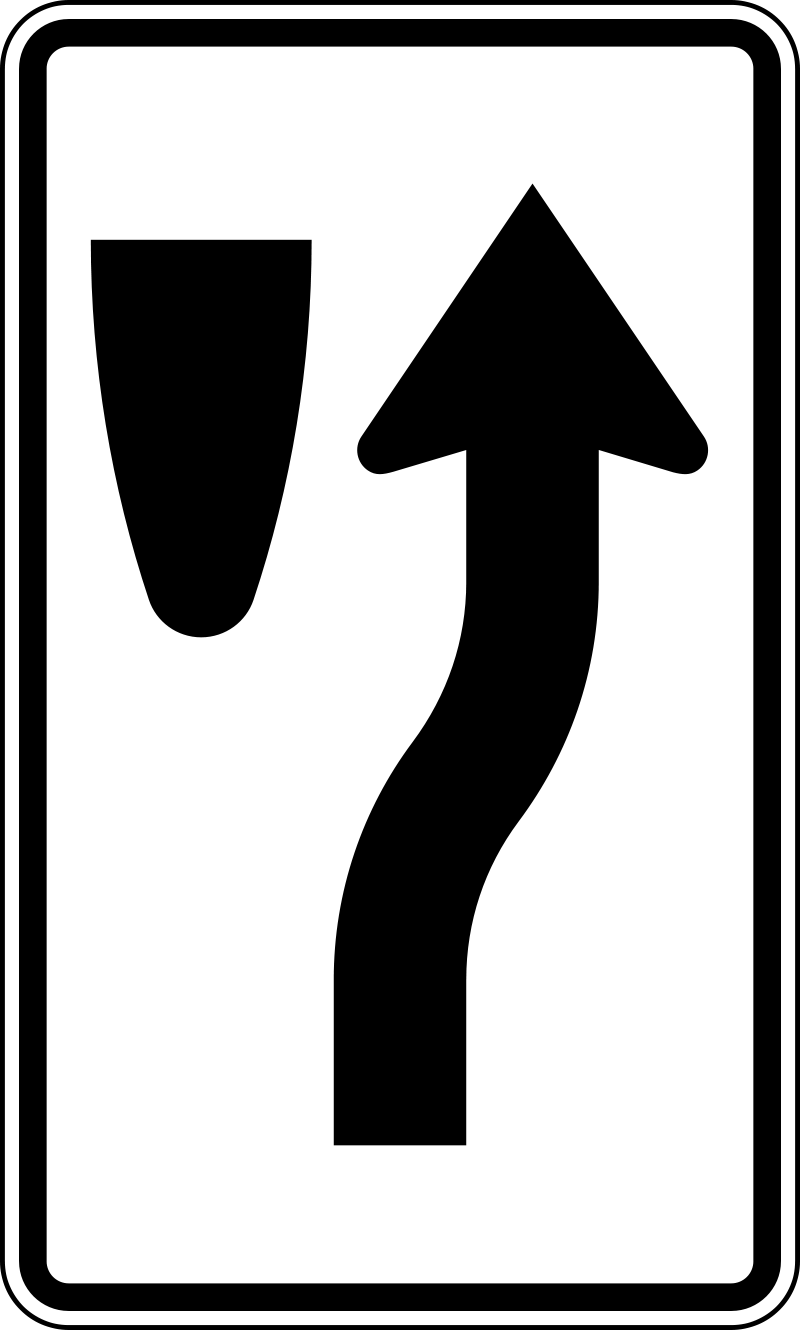 This road sign means:
A
Stop sign ahead
B
Keep to the side indicated by the arrow
C
Side road
D
Low shoulder
Answer Explanation
This traffic sign indicates: keep to the side indicated by the arrow. Observing and obeying all roadway signs ensures safe traffic flow and legal driving.
This traffic sign indicates: keep to the side indicated by the arrow. Observing and obeying all roadway signs ensures safe traffic flow and legal driving.
Question 16:
A red traffic signal light means that you must:
A
when there is no stop line, stop before entering any crosswalk.
B
stop at the stop line.
C
where there is no stop line or crosswalk, stop before entering the intersection.
D
All of the above.
Answer Explanation
This sign alerts drivers to several mandatory requirements: when there is no stop line, stop before entering any crosswalk, stop at the stop line, where there is no stop line or crosswalk, stop before entering the intersection. Obeying all posted traffic control instructions is required by law.
This sign alerts drivers to several mandatory requirements: when there is no stop line, stop before entering any crosswalk, stop at the stop line, where there is no stop line or crosswalk, stop before entering the intersection. Obeying all posted traffic control instructions is required by law.
Question 17:
When driving in travel lanes on the roadway:
A
you may make a U-turn if you get on the wrong entrance ramp of the freeway.
B
you may stop to let out passengers.
C
do not stop for any reason, keep moving until you can safely pull off the road.
D
you may make back up quickly if there are no vehicles behind.
Answer Explanation
The correct driving rule is: do not stop for any reason, keep moving until you can safely pull off the road. Following standard DMV road rules and practicing defensive driving ensures safety for all road users.
The correct driving rule is: do not stop for any reason, keep moving until you can safely pull off the road. Following standard DMV road rules and practicing defensive driving ensures safety for all road users.
Question 18:
Your BAC depends on:
A
how much alcohol you drink.
B
how much time passes between drinks.
C
All of the above.
Answer Explanation
Alcohol and impairing substances degrade all critical driving functions: how much alcohol you drink; how much time passes between drinks. Driving while impaired carries severe criminal and safety penalties.
Alcohol and impairing substances degrade all critical driving functions: how much alcohol you drink; how much time passes between drinks. Driving while impaired carries severe criminal and safety penalties.
Question 19:
Aggressive driving includes:
A
quick lane changes without a signal.
B
chasing or challenging other drivers.
C
All of the above.
Answer Explanation
All of the listed points are essential driving requirements: quick lane changes without a signal; chasing or challenging other drivers. Practicing each ensures compliance with DMV safety laws.
All of the listed points are essential driving requirements: quick lane changes without a signal; chasing or challenging other drivers. Practicing each ensures compliance with DMV safety laws.
Question 20:
You are driving in the left lane and want to change to the right lane. Before changing lanes, you should check your mirrors, signal and:
A
look over your left shoulder.
B
look over both shoulders for vehicles in front of you.
C
accelerate slightly before looking around your vehicle.
D
look over your right shoulder.
Answer Explanation
State laws require signaling your intention: look over your right shoulder. Signal at least 100 feet before making a turn or changing lanes.
State laws require signaling your intention: look over your right shoulder. Signal at least 100 feet before making a turn or changing lanes.
Question 21:
Drive below the posted speed limit when:
A
anything makes conditions less than perfect.
B
you are on a four lane road.
C
entering a highway where there are other cars.
D
others drive below the speed limit.
Answer Explanation
For safe speed and stopping control: anything makes conditions less than perfect. Adjusting speed to match visibility and road traction prevents loss of steering grip.
For safe speed and stopping control: anything makes conditions less than perfect. Adjusting speed to match visibility and road traction prevents loss of steering grip.
Question 22:
An edge line that angles toward the center of the road indicates that:
A
the road is narrower ahead.
B
there’s a narrow bridge ahead.
C
you must turn right.
Answer Explanation
The correct driving rule is: the road is narrower ahead. Following standard DMV road rules and practicing defensive driving ensures safety for all road users.
The correct driving rule is: the road is narrower ahead. Following standard DMV road rules and practicing defensive driving ensures safety for all road users.
Question 23:
What should drivers do in case of a brake failure?
A
Shift to a lower gear.
B
Tie a white cloth on the left door handle.
C
Brake lightly.
Answer Explanation
The correct driving rule is: shift to a lower gear. Following standard DMV road rules and practicing defensive driving ensures safety for all road users.
The correct driving rule is: shift to a lower gear. Following standard DMV road rules and practicing defensive driving ensures safety for all road users.
Question 24:
Many crashes are caused by:
A
yielding the right of way.
B
frequently checking mirrors and blind spot.
C
maintaining a 4-second following distance between your vehicle and any vehicle in front of you.
D
driving too fast for conditions.
Answer Explanation
The correct driving rule is: driving too fast for conditions. Following standard DMV road rules and practicing defensive driving ensures safety for all road users.
The correct driving rule is: driving too fast for conditions. Following standard DMV road rules and practicing defensive driving ensures safety for all road users.
Question 25:
 This sign indicates:
A
the maximum width of a vehicle allowed on the highway.
B
the maximum legal height allowed in this State.
C
the overpass ahead has a low clearance.
D
a steep grade
Answer Explanation
This traffic sign indicates: the overpass ahead has a low clearance. Observing and obeying all roadway signs ensures safe traffic flow and legal driving.
This traffic sign indicates: the overpass ahead has a low clearance. Observing and obeying all roadway signs ensures safe traffic flow and legal driving.