Question 1:
Your car stalls on the tracks at a railroad crossing, and a collision with a train is imminent. After getting yourself and your passengers out of the car, you should:
A
run toward the train but stay off the tracks.
B
signal the train to stop.
C
cross the tracks.
Answer Explanation
The correct driving rule is: run toward the train but stay off the tracks. Following standard DMV road rules and practicing defensive driving ensures safety for all road users.
The correct driving rule is: run toward the train but stay off the tracks. Following standard DMV road rules and practicing defensive driving ensures safety for all road users.
Question 2:
After you stop for a school bus, you must:
A
turn off your engine.
B
pass the bus before the red lights stop flashing.
C
None of the above.
Answer Explanation
When a school bus displays flashing red lights and extended stop sign: None of the above. Traffic in both directions must come to a full stop on undivided roads until children are clear.
When a school bus displays flashing red lights and extended stop sign: None of the above. Traffic in both directions must come to a full stop on undivided roads until children are clear.
Question 3:
A driver cuts off another vehicle, or threatens another motorist or a pedestrian. These are examples of:
A
excessive driving
B
road rage
C
defensive driving
Answer Explanation
Drivers must always yield the right-of-way to pedestrians crossing at intersections and crosswalks: road rage. Stop and allow them to clear the lane safely.
Drivers must always yield the right-of-way to pedestrians crossing at intersections and crosswalks: road rage. Stop and allow them to clear the lane safely.
Question 4:
When driving on a multi-lane highway, you should __________ if you are driving slower than the traffic around you.
A
not change lanes
B
stay in the left lane
C
speed up
D
stay in the right lane
Answer Explanation
Defensive driving guidelines state that: stay in the right lane. Anticipating road hazards and communicating maneuvers keeps traffic predictable and safe.
Defensive driving guidelines state that: stay in the right lane. Anticipating road hazards and communicating maneuvers keeps traffic predictable and safe.
Question 5:
When approaching any intersection or driveway, drivers should:
A
look both ways and be ready to stop.
B
pass other vehicles and then stop.
C
drive at the fastest speed just before entering the intersection.
Answer Explanation
According to standard right-of-way regulations: look both ways and be ready to stop. Yielding appropriately prevents intersection collisions and maintains safe traffic flow.
According to standard right-of-way regulations: look both ways and be ready to stop. Yielding appropriately prevents intersection collisions and maintains safe traffic flow.
Question 6:
Drivers can not pass a vehicle on the left if:
A
they approach the top of a hill on a two-way road and can not see over it.
B
they can not safely return to the right lane before they reach a solid yellow center line for the right lane.
C
All of the above.
Answer Explanation
All of the listed points are essential driving requirements: they approach the top of a hill on a two-way road and can not see over it; they can not safely return to the right lane before they reach a solid yellow center line for the right lane. Practicing each ensures compliance with DMV safety laws.
All of the listed points are essential driving requirements: they approach the top of a hill on a two-way road and can not see over it; they can not safely return to the right lane before they reach a solid yellow center line for the right lane. Practicing each ensures compliance with DMV safety laws.
Question 7:
What should you do if a vehicle is approaching head-on in your lane?
A
Pull over to the left and use your emergency lights to stop the other driver.
B
Decrease speed, pull over to the right and sound your horn to warn the other driver.
C
Turn off the ignition if your vehicle has power steering.
Answer Explanation
The correct driving rule is: Decrease speed, pull over to the right and sound your horn to warn the other driver. Following standard DMV road rules and practicing defensive driving ensures safety for all road users.
The correct driving rule is: Decrease speed, pull over to the right and sound your horn to warn the other driver. Following standard DMV road rules and practicing defensive driving ensures safety for all road users.
Question 8:
Emergency vehicles:
A
may follow each other.
B
may use a loudspeaker to give instructions.
C
have the right-of-way when using siren and red/blue lights.
D
All of the above.
Answer Explanation
All of the listed points are essential driving requirements: may follow each other; may use a loudspeaker to give instructions; have the right-of-way when using siren and red/blue lights. Practicing each ensures compliance with DMV safety laws.
All of the listed points are essential driving requirements: may follow each other; may use a loudspeaker to give instructions; have the right-of-way when using siren and red/blue lights. Practicing each ensures compliance with DMV safety laws.
Question 9:
If a driver follows you too closely, you should:
A
move to another lane if possible.
B
activate your stop lights.
C
brake suddenly.
Answer Explanation
The correct driving rule is: move to another lane if possible. Following standard DMV road rules and practicing defensive driving ensures safety for all road users.
The correct driving rule is: move to another lane if possible. Following standard DMV road rules and practicing defensive driving ensures safety for all road users.
Question 10:
When meeting a car with blinding headlights, you should:
A
look toward the right side of the road.
B
dim your lights, then speed up and pass quickly.
C
use your emergency flashers to warn the other driver.
D
look toward the left side of the road.
Answer Explanation
The correct driving rule is: look toward the right side of the road. Following standard DMV road rules and practicing defensive driving ensures safety for all road users.
The correct driving rule is: look toward the right side of the road. Following standard DMV road rules and practicing defensive driving ensures safety for all road users.
Question 11:
The first sign drivers see when approaching a highway-rail intersection is usually:
A
a crossbuck sign.
B
an advance warning sign.
C
a speed limit sign.
Answer Explanation
According to standard right-of-way regulations: an advance warning sign. Yielding appropriately prevents intersection collisions and maintains safe traffic flow.
According to standard right-of-way regulations: an advance warning sign. Yielding appropriately prevents intersection collisions and maintains safe traffic flow.
Question 12:
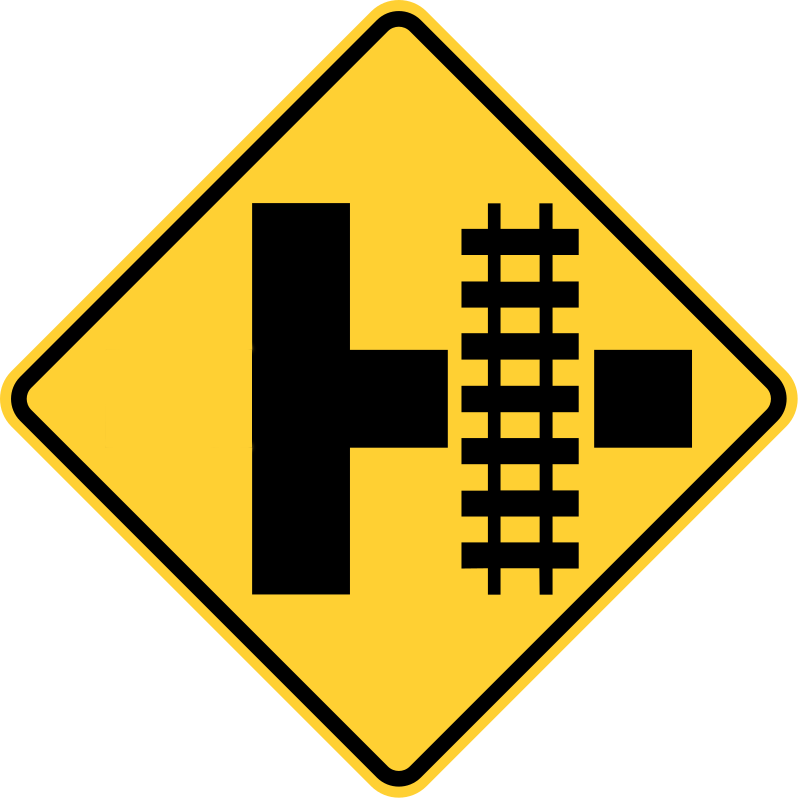 What does this sign indicate?
A
Parallel railroad crossing (side road)
B
Low ground clearance railroad crossing
C
Parallel railroad crossing (crossroad)
Answer Explanation
Circular signs with an 'X' and 'RR' designate a Railroad Advance Warning: Parallel railroad crossing (side road). Drivers must slow down, look both ways, listen for trains, and be prepared to stop.
Circular signs with an 'X' and 'RR' designate a Railroad Advance Warning: Parallel railroad crossing (side road). Drivers must slow down, look both ways, listen for trains, and be prepared to stop.
Question 13:
 This sign means:
A
A road crosses the main highway ahead.
B
The divided highway on which drivers are traveling ends ahead.
C
Drivers are coming to a point where another traffic lane joins the one they are on.
Answer Explanation
This traffic sign indicates: drivers are coming to a point where another traffic lane joins the one they are on. Observing and obeying all roadway signs ensures safe traffic flow and legal driving.
This traffic sign indicates: drivers are coming to a point where another traffic lane joins the one they are on. Observing and obeying all roadway signs ensures safe traffic flow and legal driving.
Question 14:
Warning signs are normally:
A
blue.
B
yellow.
C
red.
D
green.
Answer Explanation
The correct driving rule is: yellow. Following standard DMV road rules and practicing defensive driving ensures safety for all road users.
The correct driving rule is: yellow. Following standard DMV road rules and practicing defensive driving ensures safety for all road users.
Question 15:
Regulatory signs are:
A
Suggestions
B
Warnings
C
Law
Answer Explanation
The correct driving rule is: Law. Following standard DMV road rules and practicing defensive driving ensures safety for all road users.
The correct driving rule is: Law. Following standard DMV road rules and practicing defensive driving ensures safety for all road users.
Question 16:
Before entering a traffic circle, drivers must slow down and yield to ___________ in the traffic circle.
A
pedestrians
B
vehicles
C
bicyclists
D
All of the above.
Answer Explanation
Safe navigation at intersections requires following all established rules: pedestrians; vehicles; bicyclists. Always yield right-of-way properly to prevent collisions.
Safe navigation at intersections requires following all established rules: pedestrians; vehicles; bicyclists. Always yield right-of-way properly to prevent collisions.
Question 17:
 This road sign means:
A
Crossroad
B
Hospital parking ahead
C
Merge
Answer Explanation
This traffic sign indicates: Crossroad. Observing and obeying all roadway signs ensures safe traffic flow and legal driving.
This traffic sign indicates: Crossroad. Observing and obeying all roadway signs ensures safe traffic flow and legal driving.
Question 18:
If your brakes are wet, you can dry them by:
A
riding the pedal lightly.
B
pull over to the right and wait until it stops raining.
C
having them checked by a mechanic.
Answer Explanation
The correct driving rule is: riding the pedal lightly. Following standard DMV road rules and practicing defensive driving ensures safety for all road users.
The correct driving rule is: riding the pedal lightly. Following standard DMV road rules and practicing defensive driving ensures safety for all road users.
Question 19:
When a ‘Road Closed’ sign is displayed, drivers must:
A
make a U-turn.
B
look for a detour or another route.
C
come to a complete stop and wait for the lights to turn green.
Answer Explanation
The correct driving rule is: look for a detour or another route. Following standard DMV road rules and practicing defensive driving ensures safety for all road users.
The correct driving rule is: look for a detour or another route. Following standard DMV road rules and practicing defensive driving ensures safety for all road users.
Question 20:
 This road sign means:
A
No Passing Zone
B
Railroad Warning
C
One-way street ahead
D
Two way left turn
Answer Explanation
Circular signs with an 'X' and 'RR' designate a Railroad Advance Warning: Railroad Warning. Drivers must slow down, look both ways, listen for trains, and be prepared to stop.
Circular signs with an 'X' and 'RR' designate a Railroad Advance Warning: Railroad Warning. Drivers must slow down, look both ways, listen for trains, and be prepared to stop.