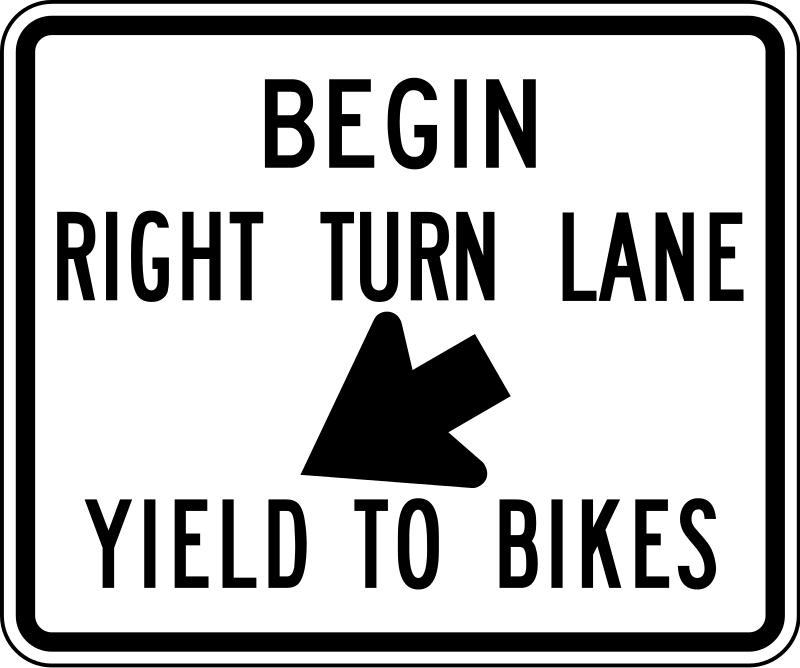
A)Drivers have the right of way over bikes turning left.
B)Vehicles turning left must yield to bikes entering a right turn lane.
C)Motor vehicles entering an exclusive right-turn lane must weave across bicycle traffic in bicycle lanes.
4.
This sign warns that:
A)traffic must merge left.
B)the bridge ahead is wide enough for only one vehicle at a time.
C)traffic must merge right.
5.
What does a flashing red light mean?
A)NO TURN ON RED.
B)The same thing as a stop sign.
C)Drivers may move forward with caution.
6.
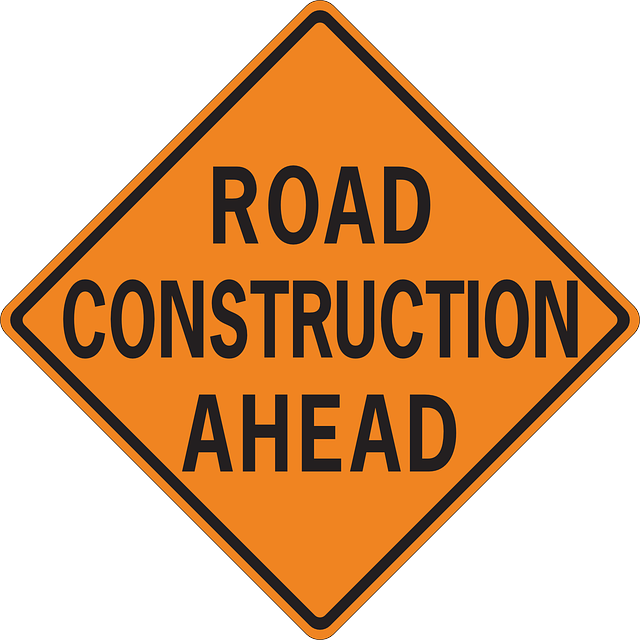
This road sign means:
A)One-way traffic ahead
B)No passing zone
C)Construction zone ahead
D)Your lane ends ahead
7.
This sign means:
A)The road will curve to the right, then to the left.
B)Road slippery when wet. Drive slowly.
C)Winding road ahead. Drive with caution.
8.
This sign means:
A)Bicycles should yield to vehicles ahead.
B)Warning: a bikeway crosses the roadway ahead.
C)The lane ahead is reserved for bicycles.
9.
This road sign means:
A)Divided highway ahead
B)Merging traffic
C)Flagger ahead
10.
This road sign means:
A)Right turn permitted on red light
B)Drivers must turn right
C)No U-turns
D)No right turn permitted
11.
What is the most important rule to remember in any emergency?
A)Do not panic.
B)Run away.
C)Call the police.
12.
Speed limit signs are:
A)service signs
B)regulation signs (regulatory signs)
C)warning signs
13.
Every time you get behind the wheel, you:
A)accept responsibility for your actions.
B)must obey Virginias traffic laws.
C)must ensure you are a safe driver.
D)All of the above.
14.
The speed limit in school zones is:
A)25 MPH
B)15 MPH
C)20 MPH
D)35 MPH
15.
You can pass on the right:
A)when a vehicle ahead makes a right turn.
B)when a vehicle ahead makes a left turn.
C)when a vehicle that is approaching from the opposite direction is prepared to turn left.
16.
Bicyclists must:
A)ride in a bicycle lane, if available.
B)remain to the right when they prepare for a left turn.
C)remain near the left edge of the road.
17.
On average, how long does it take your body to remove the alcohol contained in 5 ounces of wine?
A)one hour.
B)30 minutes.
C)3 hours.
18.
Double solid yellow lines mean:
A)the lane to the right may pass.
B)passing is not permitted in either direction.
C)the lane to the left may pass.
D)passing is permitted in either direction.
19.
What should you do if one of your tires blows out?
A)Hold the steering wheel tight and brake immediately to avoid the risk of skidding.
B)Leave the road immediately.
C)Hold the steering wheel tight and slowly take your foot off the gas pedal.
20.
A broken white line:
A)means passing or crossing is prohibited in that lane.
B)separates two lanes traveling in the same direction.
C)marks the right edge of the roadway.
21.
When driving on a multi-lane highway, you should __________ if you are driving slower than the traffic around you.
A)not change lanes
B)stay in the left lane
C)speed up
D)stay in the right lane
22.
To avoid the risk of being involved in an alcohol-related crash, you should:
A)decide before you start drinking that you are not going to drive.
B)say 'No, thanks' if someone offers you alcohol.
C)call a taxi if you've been drinking.
D)All of the above.
23.
ABS is the acronym for:
A)Anti-Braking System
B)Average-Beam System
C)Anti-Locking Brake System
24.
Drivers must yield the right-of-way to:
A)military convoys.
B)pedestrians crossing a public street or highway.
C)funeral processions.
D)All of the above.
25.
When approaching a stopped school bus with its red lights flashing and its stop arm extended, you must:
A)stop 15 feet away from the bus.
B)stop only if children are present.
C)stop and remain stopped until the red lights stop flashing and the stop arm has been withdrawn.
D)stop and remain stopped until it appears safe to proceed.
26.
If a driver follows you too closely, you should:
A)move to another lane if possible.
B)activate your stop lights.
C)brake suddenly.
27.
If you drive without liability insurance coverage on your vehicle, in Virginia you face:
A)a fine.
B)higher insurance premiums.
C)driver's license suspension.
D)All of the above.
28.
How can you prevent fatigue on a long trip?
A)Plan to drive long trips with a companion.
B)Get enough sleep.
C)All of the above.
29.
What is the first thing you should do if your wheels move off the pavement?
A)Pull the steering wheel back.
B)Pull over to the right and sound your horn to warn the other drivers.
C)Ease your foot off the gas pedal and brake gently.
30.
A vehicle is stopped at a crosswalk to permit a pedestrian to cross the roadway. The driver of the vehicle approaching from the rear should:
A)sound the horn.
B)overtake and pass the stopped vehicle.
C)not overtake and pass the stopped vehicle.
31.
What should you do if your rear wheels start to skid?
A)Steer left if your rear wheels slide right.
B)If the vehicle has ABS, pump the pedal carefully.
C)Turn the steering wheel in the direction the vehicle is trying to go.
32.
Which of the following does NOT affect the distance that it takes to stop your vehicle?
A)Perception time.
B)Braking distance.
C)Reaction distance.
D)Steering ability.
33.
Unlike passenger cars, trucks have blind spots:
A)on the right.
B)directly behind them.
C)on the front.
34.
One broken line indicates:
A)You can pass other vehicles and change lanes, if it is safe.
B)You can not pass other vehicles or go across the line.
C)You can change lanes, but only when traffic conditions or obstructions in the road make it necessary.
35.
Traffic lights are normally ____________ from the top to bottom or left to right.
A)red, green and yellow
B)green, yellow and red
C)red, yellow and green
36.
You are stopped at a stop sign and you are going to go straight through the intersection. A car on the cross road has stopped at a stop sign on your right and is going to go straight. Who has the right-of-way?
A)Whoever enters the intersection first.
B)You.
C)The car on your right.
37.
Parking is not allowed:
A)on the road side of a parked vehicle.
B)in a tunnel.
C)All of the above.
38.
For protection, motorcyclists are required to:
A)keep their headlights and taillights on at all times.
B)signal turns, lane changes and stops.
C)wear approved helmets.
39.
A thumping sound can be a warning:
A)that a tire blowout is about to occur.
B)of a steering failure.
C)of a brake failure.
40.
Trucks, buses and RVs have:
A)much larger blind spots than cars.
B)no blind spots.
C)blind spots the same size as cars.
D)much smaller blind spots than cars.
ANSWER KEYCheck answers after completing the test.