←
Back to Test
Hide Answer Key
Print / Save as PDF
Print / PDF
drive
quiz
.com
UT DMV PERMİT PRACTİCE TEST 20
Utah
Duration: 23 min
|
Questions: 25
Student Name:
Date:
Correct:
Incorrect:
Score:
1.
When exiting a highway, you should slow down:
A)
when you first see the exit sign.
B)
before moving into the exit lane.
C)
once you have moved into the exit lane.
D)
once you see the toll booth.
2.
Parking is not allowed:
A)
in an intersection, unless permitted by signs.
B)
within 300 feet of a pedestrian safety area.
C)
on public roads
3.
A traffic sign with a red circle around and a slash over a symbol means:
A)
the maneuver shown by the symbol is not allowed.
B)
Do not drive faster than the posted speed limit.
C)
the maneuver shown on the sign should be executed with extreme caution.
4.
A flashing yellow light means:
A)
The light will soon change from green to red.
B)
Drive with caution.
C)
Yield the right-of-way to other traffic at the intersection.
5.
When you get in a car to drive, the first thing you should do is:
A)
check your rear view mirror.
B)
adjust the steering wheel.
C)
adjust your seat belt.
D)
adjust your seat.
6.
Emergency vehicles:
A)
may follow each other.
B)
may use a loudspeaker to give instructions.
C)
have the right-of-way when using siren and red/blue lights.
D)
All of the above.
7.
When you are in a line of traffic that is crossing a railroad track that has no signals or gates:
A)
you may pass slower drivers crossing the track.
B)
before you start to cross, you need to make sure there is space to get all the way across the tracks without stopping.
C)
you have the right of way and do not need to check for trains.
D)
All of the above.
8.
To safely cross a railroad, drivers should:
A)
listen and look both ways, then proceed if it is safe to do so.
B)
drive across quickly if a train is approaching, or if it is too close, stop and then back up.
C)
stop within 10 feet of all railroad crossings.
D)
look both ways only if the red light is flashing.
9.
This sign means:
A)
A road crosses the main highway ahead.
B)
The divided highway on which drivers are traveling ends ahead.
C)
Drivers are coming to a point where another traffic lane joins the one they are on.
10.
When driving at night with no other vehicles ahead, a driver should use:
A)
high beam lights.
B)
low-beam lights.
C)
parking lights.
11.
Drivers must yield to pedestrians:
A)
only if the pedestrian is in a crosswalk.
B)
if the pedestrian signals to the driver that the driver must stop.
C)
only if the pedestrian is on the same side of the road.
D)
even when the pedestrian crosses the street without looking both ways.
12.
When driving on slick roads, drivers should:
A)
accelerate quickly.
B)
take turns more slowly.
C)
use alternate routes.
D)
drive as they would on dry roads.
13.
At intersections marked with stop lines, drivers must:
A)
come to a complete stop.
B)
slow down and enter the intersection.
C)
signal other vehicles to stop.
14.
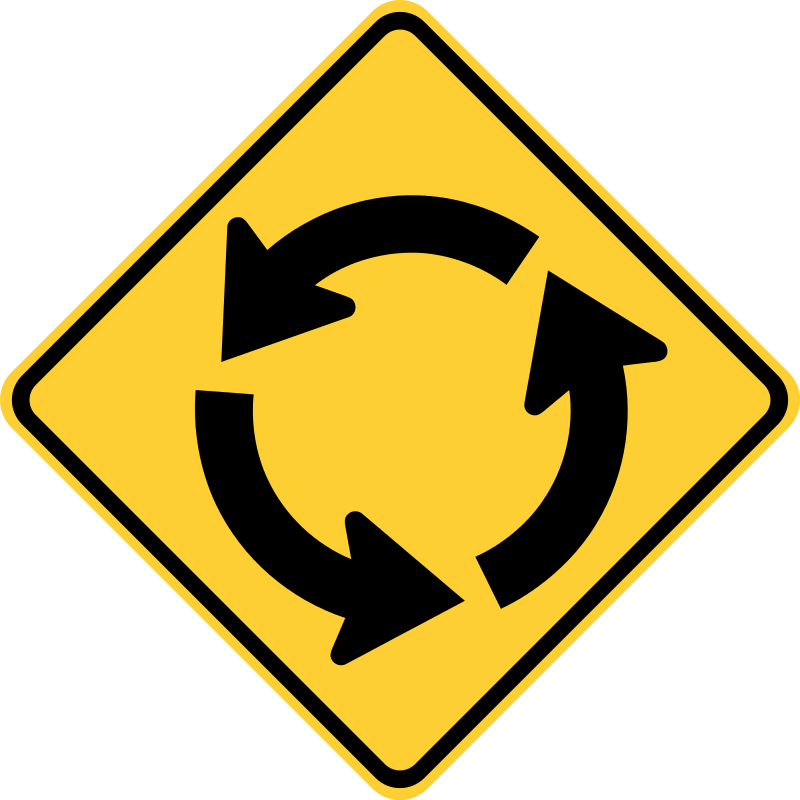
This road sign:
A)
warns drivers of a sharp turn left. Drivers should slow their speed and keep to the left.
B)
provides an advance notice of a roundabout.
C)
warns drivers that U-turns are not permitted.
D)
is a no-right-turns sign.
15.
When children are close, what should you do before you back out of a driveway?
A)
Rely on your mirrors.
B)
Get out of the car and check behind the car.
C)
Look through your back window for children.
16.
Drivers who eat and drink while driving:
A)
have no driving errors.
B)
may have trouble controlling their vehicles.
C)
must yield the right-of-way.
D)
tend to be more aggressive.
17.
When following a motorcycle, drivers must remember that motorcycles can ____________ than other vehicles.
A)
accelerate much faster
B)
stop much more quickly
C)
stop much more slowly
18.
To avoid having to make an emergency stop while driving in traffic, drivers should:
A)
drive in the right lane only.
B)
look ahead and maintain a safe following distance.
C)
sound their horn to warn other drivers.
D)
drive slower than the flow of traffic.
19.
Vertical rectangles tell drivers:
A)
the law.
B)
what is not allowed.
C)
the direction they should travel.
20.
Your first response to reduced visibility should be:
A)
to look for road edge markings to guide you.
B)
to turn on your windshield wipers.
C)
to reduce your speed.
D)
to turn on your headlights.
21.
When driving near light rail vehicles, drivers should:
A)
never drive around lowered crossing gates.
B)
expect trains on any track at any time.
C)
always obey signs and traffic signals.
D)
All of the above.
22.
Directions given by traffic officers ___________ signs, signals or pavement markings.
A)
take precedence over
B)
are less important than
C)
must obey
23.
If an aggressive driver cuts you off, you should:
A)
sound your horn.
B)
look towards the left side of the road.
C)
stay calm and get out of the aggressive driver's way.
D)
call the police immediately.
24.
The first sign drivers see when approaching a highway-rail intersection is usually:
A)
a crossbuck sign.
B)
an advance warning sign.
C)
a speed limit sign.
25.
This road sign warns drivers that:
A)
they are coming to a point where another traffic lane joins the one they are on.
B)
a divided highway is ahead.
C)
the one-way street or roadway is about to change to two-way traffic.
ANSWER KEY
Check answers after completing the test.
1
C
2
A
3
A
4
B
5
D
6
D
7
B
8
A
9
C
10
A
11
D
12
B
13
A
14
B
15
B
16
B
17
B
18
B
19
A
20
C
21
D
22
A
23
C
24
B
25
C