 drivequiz.com
 Question 1
To reduce the chance of a deer hit, it is important to know that daily deer activity is highest:
A
at dawn and dusk.
B
when it’s dark.
C
between 2 PM and 5 AM.
D
between 1 PM and 3 PM.
No explanation available.
Question 2
What should you do in case of a brake failure?
A
Pull off the road into an open space, if available.
B
Apply the parking brake slowly.
C
All of the above.
No explanation available.
Question 3
Who has a greater risk of being involved in a traffic crash?
A
Drivers who are driving alone.
B
Young people.
C
All of the above.
No explanation available.
Question 4
For a first Zero Tolerance violation, the driver license will be:
A
revoked until the driver reaches 21.
B
suspended for 6 months.
C
suspended for 18 months.
D
revoked for at least two years
No explanation available.
Question 5
At a stop sign there is no stop line, you must stop:
A
before you enter the intersection.
B
before you enter the crosswalk.
C
after you enter the crosswalk.
No explanation available.
Question 6
Who is most at risk?
A
Drivers who have overslept.
B
Drivers who are driving long distances without rest breaks.
C
Experienced drivers.
No explanation available.
Question 7
___________ normally are white rectangles with black letters or symbols.
A
Warning signs
B
Destination signs (guide signs)
C
Regulation signs (regulatory signs)
No explanation available.
Question 8
To maintain a good “space cushion” between your vehicle and the one ahead, you should use the:
A
three-second rule.
B
two-second rule.
C
“safe distance” rule.
D
“space cushion” rule.
No explanation available.
Question 9
If you are convicted of Aggravated DWI as a first offense, you face:
A
up to 1 year in jail.
B
fine of between $2,500 and $5000.
C
Minimum 3-Year Revocation
D
a 60-day suspension.
No explanation available.
Question 10
When following motorcycles, drivers should:
A
reduce the minimum following distance.
B
try to pass them as they have different braking capabilities than other motor vehicles.
C
keep more space in front of their vehicle.
No explanation available.
Question 11
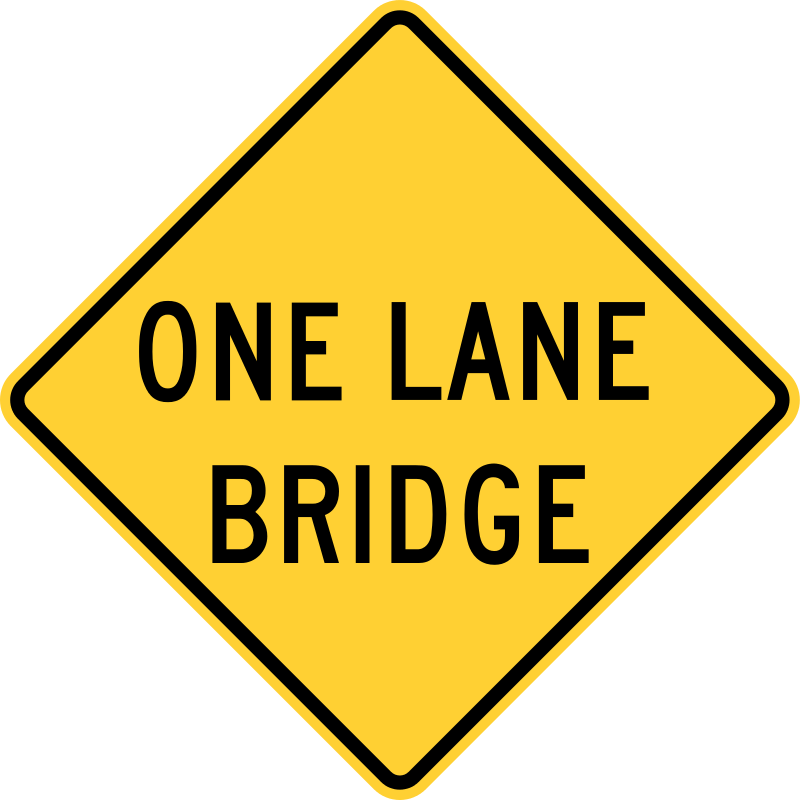 What should drivers do when they see this sign?
A
Make sure the bridge is clear of oncoming traffic before they cross.
B
Look to the left and right for other traffic.
C
Allow others to merge smoothly.
No explanation available.
Question 12
A BAC of ___ percent or more is evidence of aggravated driving while intoxicated.
A
0.08
B
0.18
C
0.8
D
0.25
No explanation available.
Question 13
If the traffic lights are out of service when you approach an intersection, you:
A
must continue according to the rules of right-of-way.
B
must slow down and yield to oncoming traffic and pedestrians.
C
must come to a stop as you would for a stop sign.
D
must proceed with caution.
No explanation available.
Question 14
 Vertical rectangles tell drivers:
A
the law.
B
what is not allowed.
C
the direction they should travel.
No explanation available.
Question 15
In New York State, you can be arrested for driving with a blood alcohol content (BAC) of ___ percent or more.
A
0.008
B
0.08
C
0.18
D
0.8
No explanation available.
Question 16
Where there is no bicycle lane, where on the road must a bicyclist ride?
A
on the left shoulder of the road.
B
near the right curb or edge of the road.
C
near the left edge of the road.
No explanation available.
Question 17
Who is most at risk?
A
Drivers who are fatigued.
B
Drivers who are driving on long, boring roads.
C
All of the above.
No explanation available.
Question 18
Destination signs are ______ with ____ letters and symbols.
A
green; white
B
blue; white
C
white; black
No explanation available.
Question 19
Pedestrians must:
A
face traffic as they walk.
B
obey traffic signals and traffic officers.
C
never stand in the road to hitchhike.
D
All of the above.
No explanation available.
Question 20
Examples of proper glass maintenance include:
A
Replacing worn wiper blades.
B
Keeping your windows clean and clear.
C
All of the above.
No explanation available.