DriveQuiz drivequiz.com

SC DMV PERMİT PRACTİCE TEST 13

South Carolina
Duration: 27 min
|
Questions: 30
Student Name:
Date:
Correct:      Incorrect:      Score:      
1.
Your red traffic signal changes to green while a pedestrian is crossing in your traffic lane. The right of way should be given:
A) by the pedestrian, but only when vehicles are turning left.
B) by the pedestrian.
C) to the pedestrian.
2.
A signalized intersection is ahead. Prepare to stop if the light turns yellow or red.
This sign means:
A) No traffic signal ahead
B) Traffic signal ahead
C) Open intersection ahead
3.
Left turns on a red light are allowed:
A) from a one-way street into a one-way street.
B) Never.
C) at intersections, after stopping, if the way is clear.
4.
If an emergency vehicle with flashing lights is traveling toward you:
A) signal the emergency vehicle that they can pass you.
B) make every effort to give them a clear path of travel.
C) increase you speed until you reach the next intersection, then let the emergency vehicle pass.
5.
ABS is the acronym for:
A) Anti-Braking System
B) Average-Beam System
C) Anti-Locking Brake System
6.
To give yourself a 3 to 4 second following distance from the vehicle ahead of you:
A) count the seconds it takes the vehicle ahead of you to reach the point you are at.
B) pass a stationary object and count how many seconds it takes the vehicle ahead to do the same.
C) watch as the vehicle ahead passes a stationary object and count the seconds it takes you to reach that same point.
7.
When driving in fog, you should use your high beam headlights.
A) True
B) False
8.
Bicyclists must:
A) ride in a bicycle lane, if available.
B) remain to the right when they prepare for a left turn.
C) remain near the left edge of the road.
9.
When is it illegal to pass another vehicle?
A) On a hill or curve.
B) At highway intersections.
C) All of the above.
10.
What can you do to prevent skids on snow and ice?
A) Allow the wheels to keep turning.
B) Brake early and gently.
C) All of the above.
11.
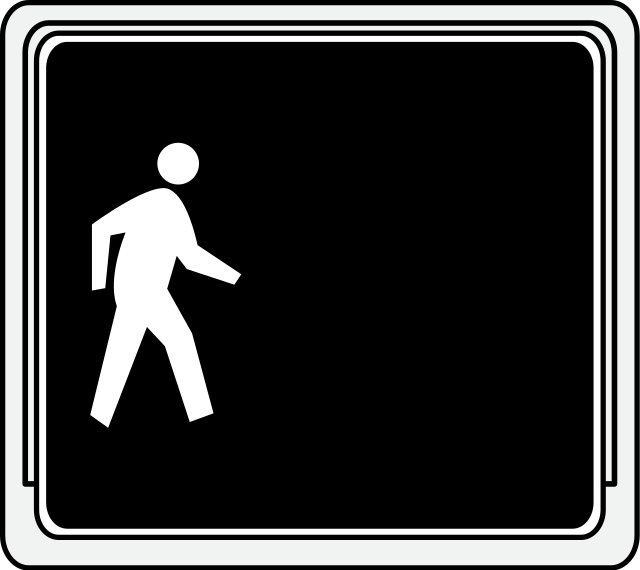
Illuminated white walking person indicates pedestrians have right-of-way to begin crossing the street in the designated crosswalk.
What does the pictured signal indicate?
A) A pedestrian may begin crossing the street.
B) Pedestrians may turn right.
C) A pedestrian may not not begin crossing the street.
12.
When an aggressive driver confronts you, you should:
A) Try to move away safely.
B) Remain calm and relaxed.
C) All of the above.
13.
In case of skidding, drivers should NOT:
A) take their foot off the gas pedal.
B) pump the brakes gently if they are about to hit something.
C) tap the gas pedal with their foot.
14.
When entering and starting a parked vehicle, you should:
A) in heavy traffic, tell other drivers to stop so you may enter the vehicle.
B) before you enter the vehicle, look around for obstacles that may interfere with safe driving.
C) back up slowly, then enter the vehicle.
15.
It is against the law to:
A) go around lowered railroad gates at a crossing.
B) pass a school bus with flashing red lights and the stop sign arm extended.
C) pass within 100 feet of a railroad crossing.
D) All of the above.
16.
The roadway becomes particularly slippery during wet or rainy conditions. Reduce your speed, increase following distance, and avoid abrupt braking or steering.
When they see this sign, drivers:
A) should be prepared to make sharp turns at a high speed.
B) need to be prepared to turn right and then left quickly.
C) should not speed up or brake quickly.
17.
A vehicle that enters a road from a driveway:
A) has the right-of-way.
B) must yield to traffic approaching from the right, while it has the right-of-way over vehicles approaching from the left.
C) must stop and yield the right-of-way to traffic on the roadway and to pedestrians.
18.
The ‘Slower Traffic Keep Right’ sign is used:
A) at most intersections.
B) on multiple lane highways.
C) in school zones.
19.
If a driver follows you too closely, you should:
A) move to another lane if possible.
B) activate your stop lights.
C) brake suddenly.
20.
You can pass on the right:
A) when a vehicle ahead makes a right turn.
B) when a vehicle ahead makes a left turn.
C) when a vehicle that is approaching from the opposite direction is prepared to turn left.
21.
Yellow traffic signs:
A) guide drivers.
B) when combined with an octagonal shape, tell drivers they must come to a complete stop at the marked stop line.
C) warn drivers.
22.
When driving in fog, you should:
A) Increase your speed to avoid causing an accident.
B) Turn on your high beam headlights.
C) Slow down and use your low beam headlights. If fog is heavy, pull off road and stop.
23.
Alerts drivers to an upcoming crosswalk where pedestrians frequently cross. Slow down and yield right-of-way to anyone in or about to enter the roadway.
The picture shows:
A) a railroad advance warning sign.
B) a speeding fines doubled sign.
C) a reversible road sign.
24.
Drinking alcohol and/or using drugs affects:
A) your coordination.
B) your judgement.
C) All of the above.
25.
When the road is slippery you should:
A) decrease the following distance.
B) slow and pro-ceed with caution.
C) check your brakes.
26.
To see objects in your blind spot when changing lanes, drivers should check:
A) only the inside rearview mirror.
B) over the left or right shoulder.
C) only the left outside mirror.
27.
When changing lanes, you should remember that:
A) vehicles with two outside mirrors have no blind spots.
B) You only need to turn and look over your right shoulder for lane changes to the right or left.
C) you should look over your left shoulder for a left lane change and your right shoulder for a right lane change.
28.
Where are yield signs usually placed?
A) At intersections, if there is no marked stop line.
B) Where auxiliary roads lead into major roads.
C) Where major roads lead into auxiliary roads.
29.
What should you do in case of a steering failure?
A) Pump your gas pedal a few times to increase the pressure.
B) Don't panic. Turn on your emergency lights to let other drivers know you are having car problems. Move toward the side of the road and bring the car to a gradual stop.
C) Leave the road immediately.
30.
At a red traffic light with a green arrow, you may proceed in the direction of the arrow:
A) after making a complete stop first.
B) if you wait until the light changes.
C) if you are in the proper lane and the roadway is clear.
ANSWER KEY Check answers after completing the test.
1 C
2 B
3 A
4 B
5 C
6 C
7 B
8 A
9 C
10 C
11 A
12 C
13 C
14 B
15 D
16 C
17 C
18 B
19 A
20 B
21 C
22 C
23 A
24 C
25 B
26 B
27 C
28 B
29 B
30 C