DriveQuiz drivequiz.com

RI DMV PERMİT PRACTİCE TEST 4

Rhode Island
Duration: 23 min
|
Questions: 25
Student Name:
Date:
Correct:      Incorrect:      Score:      
1.
When a school bus is stopped with its red lights flashing:
A) drivers only need to stop if children are present.
B) drivers don't need to stop unless they are in a school zone.
C) drivers may not pass while the red lights are flashing.
D) you never need to stop.
2.
When you see an emergency vehicle with flashing lights, you must:
A) stop exactly where you are.
B) pull to the curb and stop.
C) speed up and take the nearest exit.
D) slow down and keep moving in your lane.
3.
You are coming to an intersection and have a green light. Pedestrians are crossing against the red. You should:
A) claim your right-of-way and proceed with caution.
B) honk your horn.
C) speed up and pass in front of the pedestrians.
D) stop to let pedestrians cross safely.
4.
Indicates an upcoming bicycle crossing or shared road zone. Always leave at least 3 feet of clearance when passing cyclists.
This road sign means:
A) Bicycle crossing
B) Bicycles have the right-of-way
C) This lane is reserved for bicyclists
5.
When you reach an intersection with a stop sign, you should:
A) follow the vehicle ahead of you.
B) stop, look right, then left, then right again.
C) stop, look left, then right, then left again.
D) check your rearview mirror, look left, then right, then proceed.
6.
Hydroplaning is a situation in which:
A) your tires throw water to the rear, causing problems for the vehicles behind.
B) the tires of the car ahead cause sheets of water to splash on your vehicle.
C) one of your tires goes flat, causing the others to skid.
D) your tires ride up on a thin surface of water, losing contact with the pavement, and resulting in sudden loss of control
7.
Roads are the most slippery:
A) the first rain after a dry spell.
B) after it has been raining for an hour or more.
C) for the first 2 hours of a rain storm.
8.
When a driver has their left arm and hand extended upward, the driver plans to:
A) go straight ahead.
B) turn right.
C) turn left.
D) come to a stop.
9.
Drivers must not drive at:
A) a speed that is greater than reasonable.
B) a speed that is not prudent for the circumstances.
C) a speed that is greater than the posted speed limit.
D) All of the above.
10.
When approaching a railroad crossing that has no warning signals (such as electric flashing lights or gates) a driver should look, listen and slow down.
A) False
B) True
11.
A broken yellow line alongside a solid yellow line means:
A) Passing is permitted on the side of the broken yellow line
B) Passing is not permitted in either direction
C) Passing on the right is permitted in either direction
12.
Broken white lines can be crossed over:
A) when it is safe to change lanes.
B) only when passing another car.
C) at any time.
D) only in passing zones.
13.
Sudden wind gusts on highways:
A) are generally caused by dust and dirt blowing around.
B) can cause one to lose control of their vehicle.
C) only affect large vehicles.
14.
What can you do to prevent skids on snow and ice?
A) Allow the wheels to keep turning.
B) Brake early and gently.
C) All of the above.
15.
On slippery roads, drivers should:
A) slow down.
B) increase their speed to avoid hydroplaning.
C) not drive faster than 25 MPH.
D) go faster.
16.
A steep downhill grade is ahead. Trucks and heavy vehicles should downshift to a lower gear to prevent brake overheating.
This traffic sign warns you about:
A) merging traffic.
B) a hill or a downgrade up ahead on the road.
C) an intersection ahead.
D) a winding road.
17.
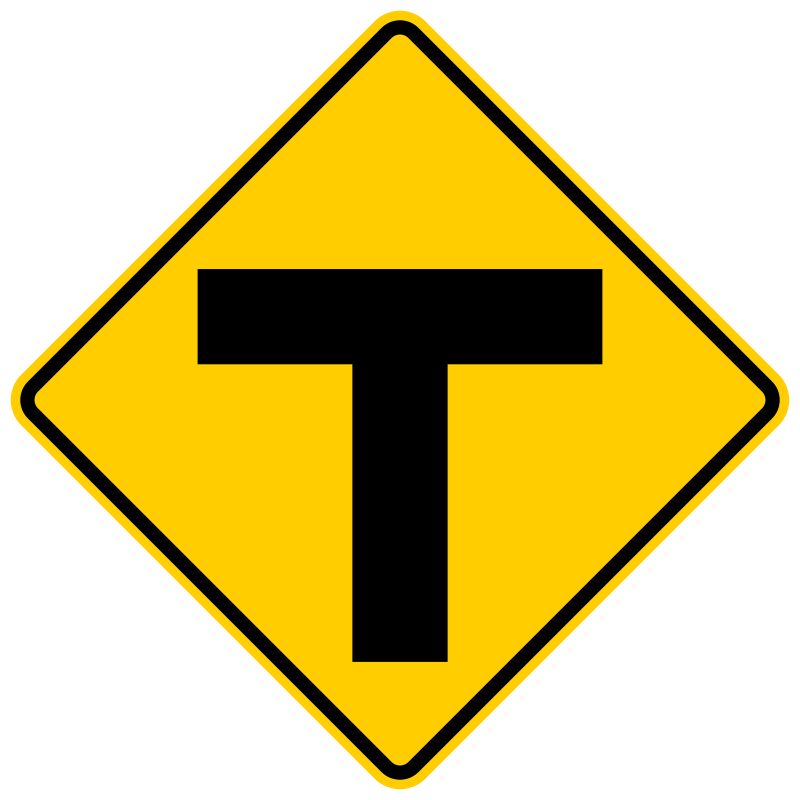
The roadway ends ahead at a T-junction. You must turn either left or right after yielding right-of-way to traffic on the cross street.
This road sign means:
A) Side road
B) T-intersection ahead
C) Keep right
D) Left lane must turn left
18.
If you approach a flashing red traffic light, you should treat the intersection the same as:
A) a yield sign.
B) a stop sign.
C) a warning sign.
19.
When a pedestrian carrying a white cane is at the corner ready to cross the street in front of you, before making your right turn, you should:
A) use your horn to help the pedestrian cross the street.
B) turn off the ignition until the person crosses the street.
C) yield the right-of-way and wait until the pedestrian crosses the street.
20.
Drivers under the age of 21 are subject to a specific restriction prohibiting them from driving:
A) before consuming alcohol.
B) with alcohol in their system.
C) before midnight.
21.
Warns of two consecutive curves in opposite directions (e.g., curves right then left). Slow down to maintain control.
This sign warns drivers that:
A) the highway ahead is divided into two one-way roadways. Drivers should keep to the right.
B) there is a winding road ahead.
C) there is a double curve ahead.
22.
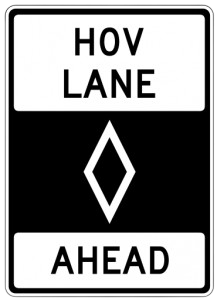
High-Occupancy Vehicle (HOV) diamond lane ahead. Only vehicles carrying the minimum required number of passengers (usually 2 or more) may use this lane.
This road sign indicates that:
A) a lane is reserved for certain purposes or certain vehicles.
B) buses and car pools may not travel in the restricted lane.
C) vehicles cannot go straight ahead. Cars must turn either to the right or left.
23.
Indicates an upcoming bicycle crossing or shared road zone. Always leave at least 3 feet of clearance when passing cyclists.
This road sign means:
A) Yield right-of-way to bicycles
B) Bicycles cross or ride beside traffic
C) Yield to motorcyles, but not to bicycles
D) Bicycles have the same rights as other vehicles
24.
Drivers should not sound their horn when:
A) near blind pedestrians.
B) visibility ahead is limited.
C) they may hit another vehicle.
25.
_____________ lights indicate that drivers should slow down and proceed with caution at an intersection.
A) Red
B) Flashing yellow
C) Flashing red
D) Yellow
ANSWER KEY Check answers after completing the test.
1 C
2 B
3 D
4 A
5 C
6 D
7 A
8 B
9 D
10 B
11 A
12 A
13 B
14 C
15 A
16 B
17 B
18 B
19 C
20 B
21 C
22 A
23 B
24 A
25 B