DriveQuiz drivequiz.com

MT DMV PERMİT PRACTİCE TEST 18

Montana
Duration: 30 min
|
Questions: 33
Student Name:
Date:
Correct:      Incorrect:      Score:      
1.
Warning signs normally are:
A) rectangles.
B) triangles.
C) diamond-shaped.
2.
When changing lanes, you should:
A) check your mirrors, signal and change lanes.
B) signal, change lanes and check your mirrors.
C) signal, check your mirrors and blind spot in the direction you plan to move, then change lanes.
D) signal and change lanes.
3.
The roadway becomes particularly slippery during wet or rainy conditions. Reduce your speed, increase following distance, and avoid abrupt braking or steering.
This sign indicates:
A) Warning: drunk drivers.
B) Winding road. Drive with caution.
C) The road may be slippery when wet. Drive slowly.
4.
When you leave your vehicle unattended, you must:
A) lock the ignition and remove the ignition key.
B) set the parking brake.
C) turn off the engine.
D) All of the above.
5.
When children are close, what should you do before you back out of a driveway?
A) Rely on your mirrors.
B) Get out of the car and check behind the car.
C) Look through your back window for children.
6.
If you missed your exit on a freeway, you should:
A) use the right turn signal, check your mirrors and move to the right.
B) None of the above.
C) go to the next exit and come back to the exit you missed.
D) make a quick U-turn from your lane of travel.
7.
Another road crosses the highway ahead. Look left and right for crossing or entering vehicles.
This road sign means:
A) You must turn right
B) Railroad crossing
C) Crossroad ahead
D) 4-way stop
8.
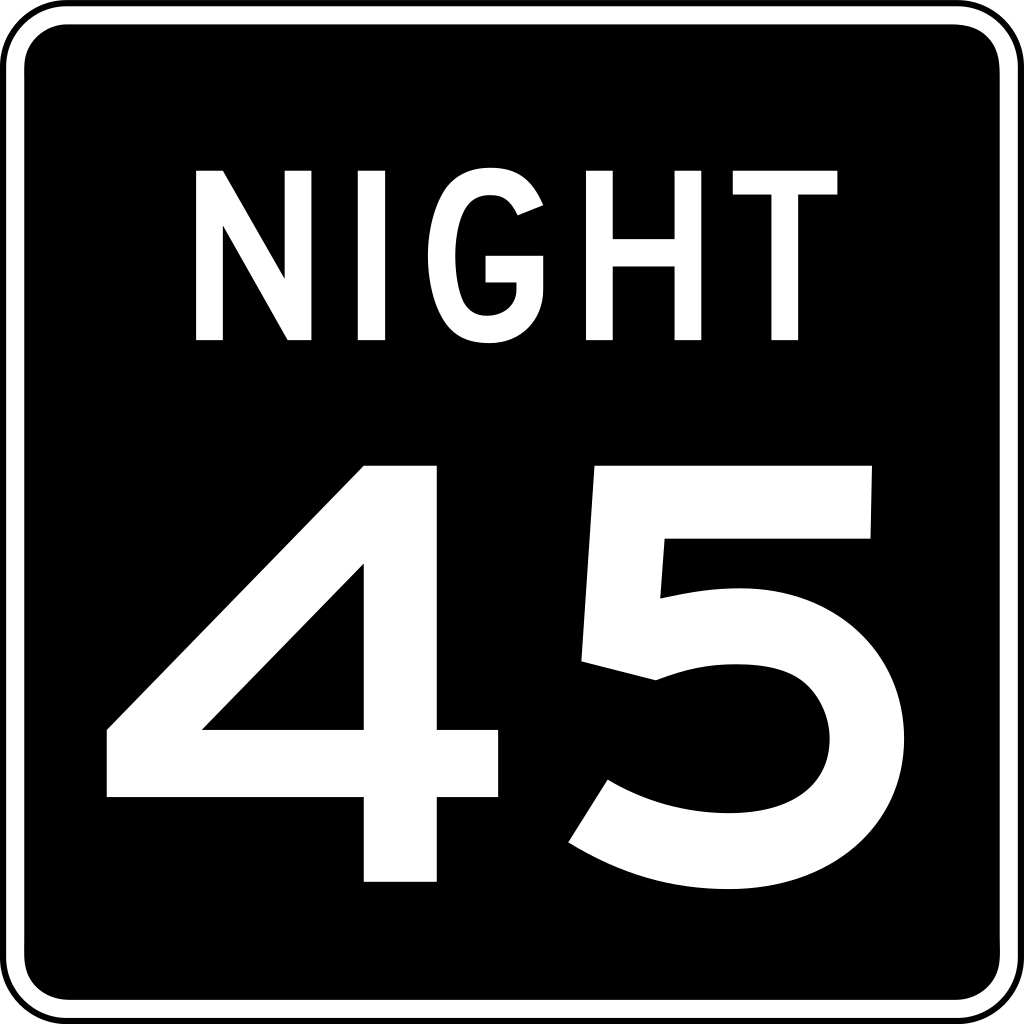
Indicates a lower maximum legal speed limit that applies only during nighttime hours for safety.
This sign means:
A) Take route 45 if you are driving at night.
B) The night-time speed limit is 45 MPH.
C) The minimum speed limit is 45 MPH.
9.
If the entrance lane is too short to allow acceleration to highway speed, you should:
A) go to the next entrance ramp.
B) stop and wait for a large gap in traffic, then enter the highway and accelerate quickly.
C) merge into highway traffic as soon as possible.
10.
What do warning signs mean?
A) Danger ahead.
B) Drivers are approaching a location where there is a special rule.
C) All of the above.
11.
Warns that a one-way street or divided highway is ending, and you are entering a roadway with oncoming traffic in the opposing lane. Stay to the right.
This road sign means:
A) Divided highway ahead
B) Two-way traffic ahead
C) Four-lane traffic ahead
12.
To avoid having to make an emergency stop while driving in traffic, drivers should:
A) drive in the right lane only.
B) look ahead and maintain a safe following distance.
C) sound their horn to warn other drivers.
D) drive slower than the flow of traffic.
13.
Passing is prohibited:
A) when a school bus is stopped to load or unload children on a public road.
B) at intersections.
C) whenever a solid line marks the left side of your lane.
D) All of the above.
14.
When you see an emergency vehicle with flashing lights, you must:
A) pull over to the side of the road and stop.
B) increase your speed to provide a clear path for the emergency vehicle.
C) slow down until it passes you.
D) drive with your flashers on.
15.
While driving, it is important to slow down:
A) when the road is wet.
B) on narrow roads.
C) at intersections.
D) All of the above.
16.
You are driving in the left lane and want to change to the right lane. Before changing lanes, you should check your mirrors, signal and:
A) look over your left shoulder.
B) look over both shoulders for vehicles in front of you.
C) accelerate slightly before looking around your vehicle.
D) look over your right shoulder.
17.
You should increase your following distance when:
A) exiting a freeway.
B) following a motorcycle.
C) driving behind a large vehicle that blocks your vision.
D) All of the above.
18.
Diamond-shaped signs:
A) are used to warn of hazards on roadways.
B) indicate no pass zones.
C) typically provide guidance to drivers.
19.
The median divider ends ahead, and you are returning to a two-way, two-lane undivided roadway. Watch for oncoming traffic on your left.
This road sign means:
A) Curves ahead
B) Divided highway ahead
C) Divided highway ends
20.
Blind spots around a large vehicle are _________________ than the blind spots around a car.
A) larger and deeper
B) less dangerous
C) narrower and shorter
21.
One broken line indicates:
A) You can pass other vehicles and change lanes, if it is safe.
B) You can not pass other vehicles or go across the line.
C) You can change lanes, but only when traffic conditions or obstructions in the road make it necessary.
22.
When an approaching driver at night blinds you by failing to dim their high beams, you should look:
A) straight down the middle of the road.
B) towards the left side of the road.
C) None of the other answers is correct.
D) towards the right side of the road.
23.
Warns of an extremely sharp 180-degree curve ahead. Decelerate significantly before entering the turn.
This sign means:
A) Hairpin corner ahead.
B) Warning: U-turn ahead.
C) Sharp right turn ahead.
24.
When drivers see the ‘Wrong Way’ sign:
A) they are going the wrong way on an expressway exit ramp.
B) they must drive past this sign and reach the next intersection.
C) they must not leave the pavement except in an emergency.
25.
Indicates an upcoming bicycle crossing or shared road zone. Always leave at least 3 feet of clearance when passing cyclists.
This road sign means:
A) Yield right-of-way to bicycles
B) Bicycles cross or ride beside traffic
C) Yield to motorcyles, but not to bicycles
D) Bicycles have the same rights as other vehicles
26.
When you approach a railroad crossing, but you do not see a train. You must stop:
A) if a stop sign is posted.
B) if the crossing lights are flashing.
C) if a crossing gate is lowered.
D) All of the above.
27.
Because many crashes happen when a vehicle is turning left, drivers should:
A) slow down gradually while checking the rear view mirror.
B) move into the left lane of a multilane road.
C) yield to oncoming vehicles, bicyclists and pedestrians.
D) All of the above.
28.
Distracted driving:
A) causes the driver to react more slowly to hazards.
B) is only dangerous for inexperienced drivers.
C) usually causes the driver to drive slower.
D) is never dangerous.
29.
You may pass another vehicle:
A) when there is a solid yellow line on your side.
B) on a curve or a hill.
C) on the shoulder of the highway.
D) None of the above.
30.
Road signs that point out scenic areas and parks are:
A) brown and white.
B) black and orange.
C) green and white.
31.
You may park or stop along the shoulder of the freeway:
A) if you need to check your smartphone for directions.
B) only if you have an emergency.
C) if no part of your vehicle is on the road.
D) as long as you turn on your emergency flashers.
32.
The road curves gradually to the right ahead. Reduce speed before entering the curve.
This sign is used to warn drivers about:
A) road construction.
B) changes in traffic lanes.
C) curves ahead.
D) drowsy driving.
33.
Road rage and aggressive driving may be caused by:
A) unsafe lane changes.
B) tailgating.
C) speeding.
D) All of the above.
ANSWER KEY Check answers after completing the test.
1 C
2 C
3 C
4 D
5 B
6 C
7 C
8 B
9 B
10 C
11 B
12 B
13 D
14 A
15 D
16 D
17 D
18 A
19 C
20 A
21 A
22 D
23 A
24 A
25 B
26 D
27 D
28 A
29 D
30 A
31 B
32 C
33 D