A)slow down and watch for children crossing the road.
B)obey signals from crossing guards.
C)stop if necessary.
D)All of the above.
2.
To keep your vehicle from rolling into traffic when parked on a hill, if you are facing uphill you should:
A)turn the front wheels away from the curb or edge of the road.
B)turn the back wheels towards the curb or edge of the road.
C)set the parking brake and keep the front wheels straight.
D)turn the front wheels towards the curb or edge of the road.
3.
A red traffic sign means?
A)Do not enter.
B)Stop.
C)All of the above.
4.
This is:
A)a side road sign.
B)a merging traffic sign.
C)a right curve sign.
5.
You must pull over to the edge of the road and allow an emergency vehicle to pass:
A)only if the emergency vehicle is following you.
B)regardless of your direction.
C)only if the emergency vehicle is approaching.
D)None of the above.
6.
Drivers must be prepared for anything coming up in the road ahead. They should:
A)scan the road for traffic conditions and possible hazards.
B)drive with the right foot resting lightly on the brake pedal.
C)stare straight ahead at all times.
D)maintain focus toward the left of the road.
7.
When an approaching driver at night blinds you by failing to dim their high beams, you should look:
A)straight down the middle of the road.
B)towards the left side of the road.
C)None of the other answers is correct.
D)towards the right side of the road.
8.
Select the most effective safety restraint(s) in a traffic crash.
A)Lap and shoulder belt only
B)Air bag only
C)Pumping brakes.
D)A combination of lap/shoulder belt and air bag.
9.
___________ are green with white letters and symbols.
A)Warning signs
B)Destination signs (guide signs)
C)Regulation signs (regulatory signs)
10.
A steady green light at intersections means:
A)You may drive through the intersection if the road is clear
B)You must increase your speed
C)You may not turn right
11.
A flashing yellow light means:
A)Merging traffic ahead
B)Pedestrian crossing
C)Come to a full stop
D)Proceed with caution
12.
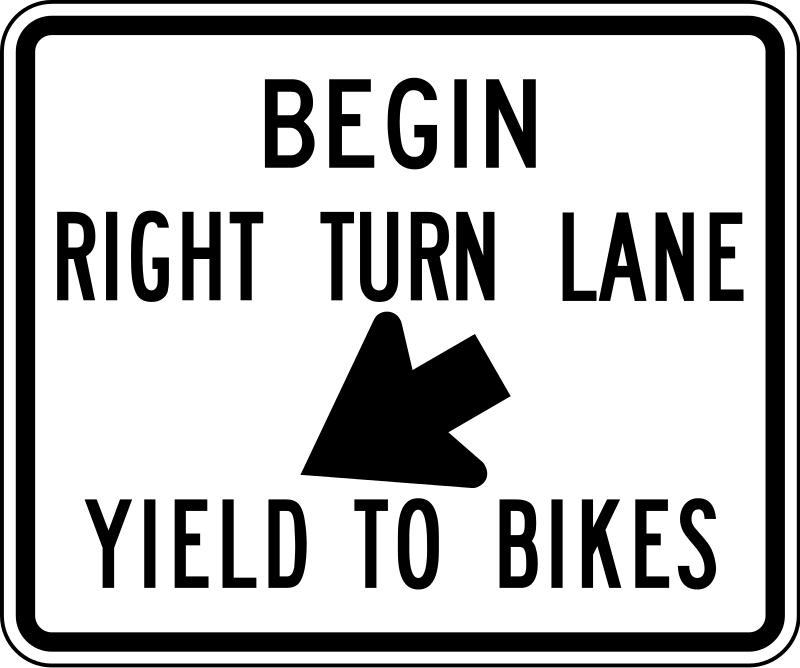
What does this road sign indicate?
A)Drivers have the right of way over bikes turning left.
B)Vehicles turning left must yield to bikes entering a right turn lane.
C)Motor vehicles entering an exclusive right-turn lane must weave across bicycle traffic in bicycle lanes.
13.
Drivers must yield for emergency vehicles:
A)Never.
B)only when other vehicles yield.
C)when they see a flashing red or blue light or hear a siren.
D)None of the above.
14.
A traffic sign with a red circle around and a slash over a symbol means:
A)the maneuver shown by the symbol is not allowed.
B)Do not drive faster than the posted speed limit.
C)the maneuver shown on the sign should be executed with extreme caution.
15.
To avoid being in a truck driver’s blind spot, you should:
A)never pass the truck and put your headlights on.
B)avoid driving on either side of the truck and don’t tailgate.
C)flash your lights.
D)sound your horn.
16.
This road sign means:
A)Drive with caution and be ready to stop
B)Slow down or stop
C)You must come to a complete stop
17.
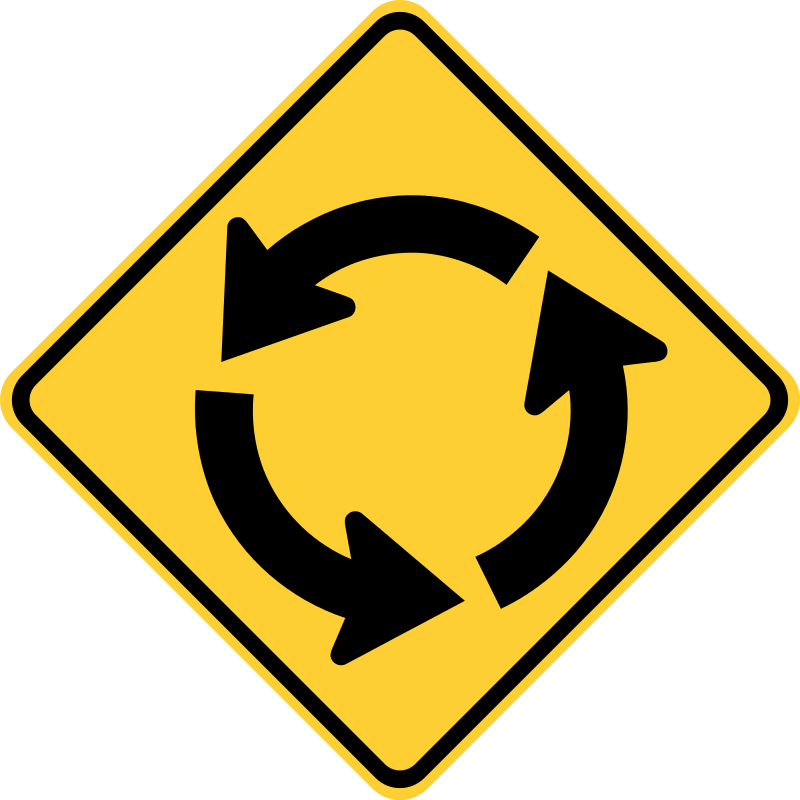
This sign means:
A)The highway ahead is divided into two one-way roadways.
B)Roundabout ahead. Slow down.
C)The divided highway on which drivers are traveling ends ahead.
18.
What do flashing red lights on a school bus indicate?
A)The bus is stopped to load or discharge passengers.
B)Traffic that approaches from either direction may proceed.
C)The bus is about to stop.
19.
If you hear a thumping sound while driving, you should:
A)hook your shoe under the gas pedal and see if you can free it.
B)get off the road and check your tires.
C)try your emergency lights.
20.
Alcohol causes:
A)poor judgment.
B)loss of concentration.
C)reduced perception.
D)All of the above.
21.
You may park or stop along the shoulder of the freeway:
A)if you need to check your smartphone for directions.
B)only if you have an emergency.
C)if no part of your vehicle is on the road.
D)as long as you turn on your emergency flashers.
22.
You can pass on the right:
A)when a vehicle ahead makes a right turn.
B)when a vehicle ahead makes a left turn.
C)when a vehicle that is approaching from the opposite direction is prepared to turn left.
23.
When a hazard is seen ahead, reaction distance:
A)is the sum of perception distance and braking distance.
B)equals total stopping distance minus perception distance.
C)is how far a vehicle will continue to travel, in ideal conditions, before the driver hits the brakes.
24.
What do warning signs mean?
A)Danger ahead.
B)Drivers are approaching a location where there is a special rule.
C)All of the above.
25.
This traffic sign warns you about:
A)merging traffic.
B)a hill or a downgrade up ahead on the road.
C)an intersection ahead.
D)a winding road.
26.
Your blind spot is the area of the road:
A)you see in your rearview mirror.
B)directly behind your vehicle.
C)you cannot see without moving your head.
D)you see in your side mirror.
27.
Drivers may pass another vehicle if the line dividing two lanes is a ________ line.
A)broken white
B)double solid yellow
C)solid yellow
D)solid white
28.
You are stopped at a stop sign and you are going to go straight through the intersection. A car on the cross road has stopped at a stop sign on your right and is going to go straight. Who has the right-of-way?
A)Whoever enters the intersection first.
B)You.
C)The car on your right.
29.
This road sign means:
A)Crossroads ahead
B)Side Road
C)Turn right or go through
D)Flagger ahead
30.
When driving on major highways you should:
A)be ready to react to road hazards.
B)stay alert.
C)keep your eyes moving.
D)All of the above.
31.
This road sign:
A)warns drivers of a sharp turn left. Drivers should slow their speed and keep to the left.
B)provides an advance notice of a roundabout.
C)warns drivers that U-turns are not permitted.
D)is a no-right-turns sign.
32.
Which shape is a warning sign?
A)Diamond
B)Triangle
C)Pennant
33.
If another vehicle is approaching you head-on in your lane, you should _______, sound your horn and brake.
A)steer right
B)None of the other answers is correct.
C)steer left
D)stay in the center of your lane
34.
A motorist arriving at the intersection must yield the right of way to motorists who arrived before him.
A)True
B)False
35.
This road sign warns drivers that:
A)they are coming to a point where another traffic lane joins the one they are on.
B)a divided highway is ahead.
C)the one-way street or roadway is about to change to two-way traffic.
36.
You want to turn left at an intersection ahead. A car reaches the intersection from the opposite direction and moves straight ahead. You:
A)can turn left. You have the right of way.
B)must wait for the car to go through before you turn.
C)may not enter the intersection to prepare for your left turn if the light is green.
37.
Vertical rectangles tell drivers:
A)the law.
B)what is not allowed.
C)the direction they should travel.
38.
This sign means:
A)Bicycles should yield to vehicles ahead.
B)Warning: a bikeway crosses the roadway ahead.
C)The lane ahead is reserved for bicycles.
39.
To drive defensively, you must:
A)anticipate errors by other drivers.
B)assume that a driver who approaches a STOP sign on a side road is actually going to stop.
C)not check behind you through your mirrors.
40.
This road sign means:
A)Merging traffic from the right
B)Sharp curves ahead
C)Intersection ahead
ANSWER KEYCheck answers after completing the test.