DriveQuiz drivequiz.com

KY DMV PERMİT PRACTİCE TEST 12

Kentucky
Duration: 36 min
|
Questions: 40
Student Name:
Date:
Correct:      Incorrect:      Score:      
1.
If a driver follows you too closely, you should:
A) move to another lane if possible.
B) activate your stop lights.
C) brake suddenly.
2.
With a Class C Driver’s License you may:
A) operate vehicles with a gross vehicle weight rating of more than 26,001 pounds.
B) operate any motor vehicle, regardless of size or weight.
C) operate vehicles with a gross vehicle weight rating of less than 26,001 pounds.
3.
Arrows on the roadway:
A) show which lanes you must use.
B) indicate reserved lanes.
C) indicate HOV lanes.
4.
Warns that a one-way street or divided highway is ending, and you are entering a roadway with oncoming traffic in the opposing lane. Stay to the right.
This road sign means:
A) Divided highway ahead
B) Two-way traffic ahead
C) Four-lane traffic ahead
5.
Which signs have black letters on a yellow or orange background?
A) Warning signs (diamond)
B) Regulatory signs (vertical rectangle)
C) Railroad advance warning signs (round)
6.
Warns of two consecutive curves in opposite directions (e.g., curves right then left). Slow down to maintain control.
This road sign means:
A) There is a series of sharp turns up ahead on the road
B) Sharp right turn ahead.
C) A road joins from the right
7.
If the entrance lane is too short to allow acceleration to highway speed, you should:
A) go to the next entrance ramp.
B) stop and wait for a large gap in traffic, then enter the highway and accelerate quickly.
C) merge into highway traffic as soon as possible.
8.
You are stopped at a stop sign and you are going to go straight through the intersection. A car on the cross road has stopped at a stop sign on your right and is going to go straight. Who has the right-of-way?
A) Whoever enters the intersection first.
B) You.
C) The car on your right.
9.
Before entering a curve, you should:
A) pump your brakes several times.
B) activate your turn signal.
C) reduce your speed.
10.
Prohibits drivers from making a 180-degree turn to travel in the opposite direction at this intersection or stretch of road.
This road sign means:
A) No left turn
B) No U-turn
C) Detour ahead
11.
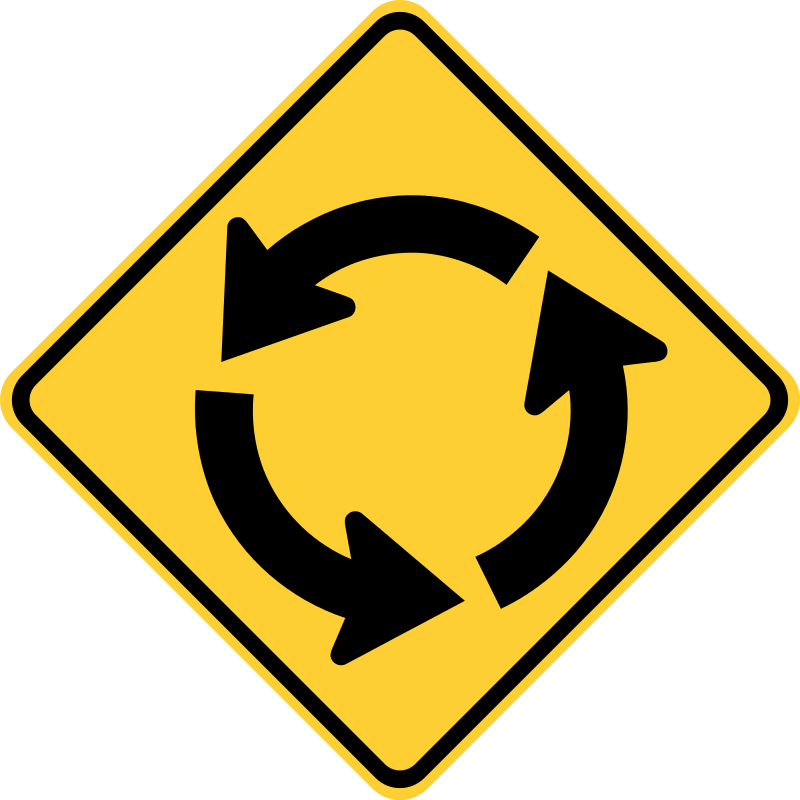
A circular intersection is ahead. Vehicles inside the roundabout have right-of-way; entering traffic must yield to traffic approaching from the left.
This road sign:
A) warns drivers of a sharp turn left. Drivers should slow their speed and keep to the left.
B) provides an advance notice of a roundabout.
C) warns drivers that U-turns are not permitted.
D) is a no-right-turns sign.
12.
Paved road surface ends and transitions to gravel, dirt, or unpaved roadway. Reduce speed and prepare for reduced traction.
This road sign warns drivers that:
A) the road surface ahead changes to a low-type surface or earth road.
B) vehicles must leave the pavement immediately.
C) the dirt on the side of the road is soft.
13.
The yield sign is ___ and white, with ___ letters.
A) yellow; black
B) red; red
C) red; white
14.
Warns drivers that two separate lanes moving in the same direction are merging into one. Drivers in the right lane must adjust speed and merge smoothly with existing traffic.
This yellow sign means:
A) Lane ends ahead
B) Undivided highway ahead
C) Merging traffic ahead
15.
What is the meaning of blue traffic signs?
A) A blue background indicates a regulatory sign.
B) They give directional information.
C) Blue indicates road user services.
16.
Right turns are strictly prohibited at this intersection under all circumstances.
This road sign means:
A) No left turn
B) No right turn
C) No U-turns
17.
You should always travel:
A) at the speed of the vehicle behind.
B) according to weather and road conditions.
C) at the speed limit.
18.
Slow down and give right-of-way to all oncoming vehicles, cyclists, and pedestrians. Stop completely if necessary before entering the intersection or merging.
The yield sign means:
A) Go. The light will soon be red.
B) If the way is clear, you may move forward slowly without stopping.
C) Stop if you can.
19.
Another road crosses the highway ahead. Look left and right for crossing or entering vehicles.
This road sign means:
A) A four-way intersection is ahead
B) Do not pass
C) A steep grade is ahead
20.
A steep downhill grade is ahead. Trucks and heavy vehicles should downshift to a lower gear to prevent brake overheating.
This sign indicates that:
A) there is a steep hill ahead.
B) trucks are merging from the right
C) there's a side road ahead
21.
The roadway becomes particularly slippery during wet or rainy conditions. Reduce your speed, increase following distance, and avoid abrupt braking or steering.
This road sign means:
A) Winding road
B) Side road ahead
C) Slippery when wet
22.
When approaching an intersection with a traffic control signal that is not working, drivers should:
A) stop as you would if there were stop signs in all directions, yield the right-of-way, then enter the intersection.
B) speed up and proceed through the intersection.
C) try not to stop if the intersection is clear.
23.
While driving, you see a flooded roadway ahead. You should:
A) stop your vehicle on the roadway.
B) proceed through the flooded area with caution.
C) turn around and find another route to get to your destination.
24.
If you meet a stopped school bus with the lights flashing and the signal arm extended, you should:
A) proceed at 15 MPH or less, if no children are present.
B) stop.
C) watch for children and proceed at normal speed.
25.
If you get on a wrong expressway exit, you must:
A) get off at the next exit and look for signs that tell you how to return to the expressway.
B) use the the exit ramp to accelerate to expressway speed and blend with traffic.
C) drive in reverse to return to the expressway.
26.
Which of the following must you obey over the others?
A) Red light
B) Stop sign
C) Police officer
27.
You may not turn right (or left from a one-way onto a one-way) while the traffic signal is red. Wait for the green signal before turning.
This sign tells drivers:
A) they must wait for the traffic signal to turn green before turning right or left.
B) they may not turn right or left during the red light.
C) All of the above.
28.
Driving at excessive speed:
A) improves your reaction time.
B) often leads to high-risk decision-making.
C) does not increase the chance of a crash.
29.
Unlike passenger cars, trucks have blind spots:
A) on the right.
B) directly behind them.
C) on the front.
30.
The bridge ahead has narrower lanes or shoulders than the preceding road. Use caution when meeting oncoming vehicles.
This sign warns drivers of:
A) a reduction of lanes.
B) a dip in the road. Drivers should be ready to stop if the dip is filled with water.
C) a bridge ahead, wide enough to accommodate two lanes of traffic, but with very little clearance.
31.
Your BAC depends on:
A) how much alcohol you drink.
B) how much time passes between drinks.
C) All of the above.
32.
Vehicles stopped behind a school bus when the red lights are flashing must remain stopped until:
A) the flashing lights turn green.
B) the stop arm is retracted and the bus begins moving.
C) all students are off the bus.
33.
When dust is blowing across the roadway making it difficult to see other vehicles, you should drive slower and turn on your:
A) headlights.
B) parking lights.
C) emergency flashers.
34.
The roadway becomes particularly slippery during wet or rainy conditions. Reduce your speed, increase following distance, and avoid abrupt braking or steering.
This road sign means:
A) Slow down, slippery when wet
B) Detour ahead
C) Road curves ahead
35.
Roads are most slippery:
A) just before it rains.
B) when it stops raining.
C) when it first starts to rain.
36.
When turning left at an intersection:
A) you should never yield to oncoming traffic and pedestrians.
B) oncoming traffic and pedestrians should yield to you.
C) you should always yield to oncoming traffic and pedestrians.
37.
Bicyclists must:
A) ride in a bicycle lane, if available.
B) remain to the right when they prepare for a left turn.
C) remain near the left edge of the road.
38.
When you cannot see any farther than 100 feet ahead due to rain, snow, smoke, fog or blowing dust, you cannot safely drive faster than:
A) 40 MPH
B) 30 MPH
C) 20 MPH
39.
A crosswalk is:
A) a special type of 4-way intersection.
B) an area designated for blind persons.
C) the area where pedestrians may cross the road.
40.
To see vehicles in your blind spots, you must look:
A) in your outside rearview mirror.
B) over your shoulders.
C) in your side mirrors.
ANSWER KEY Check answers after completing the test.
1 A
2 C
3 A
4 B
5 A
6 A
7 B
8 C
9 C
10 B
11 B
12 A
13 B
14 C
15 C
16 B
17 B
18 B
19 A
20 A
21 C
22 A
23 C
24 B
25 A
26 C
27 C
28 B
29 B
30 C
31 C
32 B
33 A
34 A
35 C
36 C
37 A
38 B
39 C
40 B