DriveQuiz drivequiz.com

HI DMV PERMİT PRACTİCE TEST 8

Hawaii
Duration: 27 min
|
Questions: 30
Student Name:
Date:
Correct:      Incorrect:      Score:      
1.
Drivers should be aware that a motorcyclist may:
A) decrease speed and rise off the seat when approaching a railroad crossing.
B) quickly change speed or lane position.
C) All of the above.
2.
If your front wheels start to skid, the first thing you should do is:
A) Take your foot off the gas pedal and shift to neutral.
B) Immediately turn in the direction you want to go.
C) Speed up, pump your brakes and steer in the direction the vehicle is trying to go.
3.
When you prepare to make a left turn from a one-way road into a two-way road, you must:
A) enter the two-way road to the left of its center line.
B) approach the turn in the right lane or from the right side of a single lane.
C) approach the turn in the left lane or from the left side of a single lane.
4.
Regulatory signs are:
A) Suggestions
B) Warnings
C) Law
5.
When you see an emergency vehicle with flashing lights behind you, you should:
A) slow down, provide a clear path for the emergency vehicle and stop.
B) keep moving slowly, staying to the right side of the road.
C) disregard the signal if there are other lanes available for the emergency vehicle.
D) immediately come to a complete stop.
6.
Gauging the speed of a motorcycle may be difficult because:
A) motorcycles take up less of your field of vision.
B) motorcycles often slow down by downshifting.
C) many motorcyclists do not activate the brake light.
7.
When driving, it is important to keep a space cushion _______ of your vehicle.
A) only on the left and right side
B) only in back
C) on all sides
D) only in front
8.
Drivers may cross solid yellow lines:
A) at any time.
B) only to pass traffic moving in the same direction.
C) when making turns.
D) during daylight hours only.
9.
Alerts drivers to an upcoming crosswalk where pedestrians frequently cross. Slow down and yield right-of-way to anyone in or about to enter the roadway.
What should drivers do when they see this road sign?
A) come to a complete stop and wait for a train to cross.
B) slow down, look for a train, and be prepared to stop.
C) look for a human flagger.
10.
You notice a vehicle defect which may affect the safe operation of your vehicle. You should:
A) drive the vehicle slower.
B) correct the defect when you can afford it.
C) not carry passengers until the defect is corrected.
D) correct the defect as soon as possible.
11.
Which of the following must you obey over the others?
A) Red light
B) Stop sign
C) Police officer
12.
Which of the following is a common cause of a traffic collisions?
A) Following too closely.
B) Excessive speed for conditions.
C) Distracted driving.
D) All of the above.
13.
As long as you don’t leave the road, you may legally pass a vehicle on the right:
A) if you are on a two-lane, two-way road and the other vehicle is turning left.
B) when you are turning into a one-way street with no oncoming traffic.
C) Never.
D) Only during daylight hours.
14.
When driving in fog, drivers should use:
A) low beam headlights.
B) parking lights.
C) high beam headlights.
15.
Warns drivers that two separate lanes moving in the same direction are merging into one. Drivers in the right lane must adjust speed and merge smoothly with existing traffic.
This sign means:
A) A road crosses the main highway ahead.
B) The divided highway on which drivers are traveling ends ahead.
C) Drivers are coming to a point where another traffic lane joins the one they are on.
16.
When the highway you are driving on is divided by two solid yellow lines, you:
A) may cross the yellow lines only to make a U-turn.
B) may never cross the yellow lines.
C) may cross the yellow lines only if there is no on-coming traffic.
D) may cross the yellow lines only to make a left turn into a private road or a driveway.
17.
Which shape is a yield sign?
A) Vertical rectangle
B) Upside-down triangle
C) Diamond
18.
Blue service guide sign indicating that emergency medical and hospital facilities are located in the direction of the arrow.
What does this road sign indicate?
A) Hospital service
B) Area reserved for people with disabilities
C) Interstate highway
19.
If a driver follows you too closely, you should:
A) move to another lane if possible.
B) activate your stop lights.
C) brake suddenly.
20.
Indicates that traffic is permitted to pass on either the left or the right side of an island, median, or obstruction.
This road sign tells drivers that:
A) they must change lane immediately.
B) they must turn either to the right or left.
C) the one-way street or roadway ahead ends.
D) None of the above.
21.
Come to a complete stop before the stop line, crosswalk, or intersection. Look left, right, and left again, and proceed only when it is safe and right-of-way is clear.
This road sign means:
A) Slow down or stop
B) Stop
C) Road narrows ahead
22.
Lanes of traffic moving in the same direction are divided by ____ lines.
A) orange
B) yellow
C) black
D) white
23.
What should you do in case of a brake failure?
A) Pull off the road into an open space, if available.
B) Apply the parking brake slowly.
C) All of the above.
24.
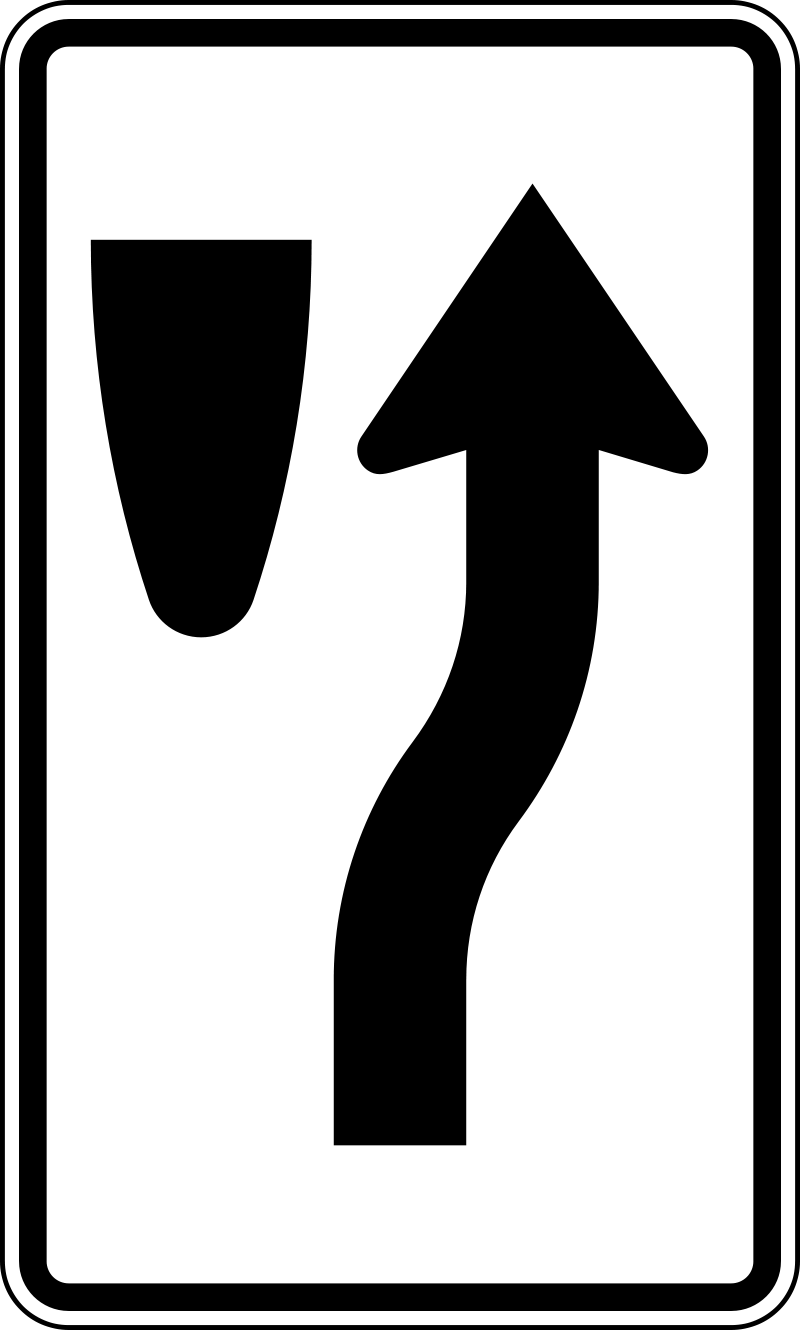
Drivers must pass to the right side of a traffic island, median barrier, or highway divider.
This road sign means:
A) Stop sign ahead
B) Keep to the side indicated by the arrow
C) Side road
D) Low shoulder
25.
If you hear a thumping sound while driving, you should:
A) hook your shoe under the gas pedal and see if you can free it.
B) get off the road and check your tires.
C) try your emergency lights.
26.
Alcohol causes:
A) poor judgment.
B) loss of concentration.
C) reduced perception.
D) All of the above.
27.
When approaching a highway-rail intersection, the first sign drivers see is usually:
A) an RXR round sign on a yellow background.
B) a stop sign.
C) a yield sign.
28.
When passing trucks, drivers of a small vehicle must be prepared for:
A) falling vehicle parts.
B) wind gusts from the truck.
C) large truck signs.
D) a loud noise.
29.
You are stopped behind other vehicles waiting at a stop sign. When the intersection is clear:
A) you may follow the vehicle ahead without stopping again.
B) you may proceed with caution through the intersection without stopping if there is no other traffic.
C) you must stop again at the stop sign.
D) you must proceed through the intersection without stopping again.
30.
When an approaching driver at night blinds you by failing to dim their high beams, you should look:
A) straight down the middle of the road.
B) towards the left side of the road.
C) None of the other answers is correct.
D) towards the right side of the road.
ANSWER KEY Check answers after completing the test.
1 C
2 A
3 C
4 C
5 A
6 A
7 C
8 C
9 B
10 D
11 C
12 D
13 A
14 A
15 C
16 B
17 B
18 A
19 A
20 B
21 B
22 D
23 C
24 B
25 B
26 D
27 A
28 B
29 C
30 D