You reach an intersection that is not controlled at the same time as a driver on your right, and both of you prepare to go straight. Who has the right-of-way?
A)You.
B)No one.
C)The other driver.
3.
This sign warns that:
A)traffic must merge left.
B)the bridge ahead is wide enough for only one vehicle at a time.
C)traffic must merge right.
4.
When your wheels slip off the road edge, you should:
A)slow down using the brakes gently. When at a safe speed, turn the steering wheel to return to the pavement.
B)speed up and steer back onto the pavement gradually.
C)jerk the steering wheel to force the vehicle back onto the pavement.
D)slam on your brakes and stop.
5.
If you stop along the road at night:
A)turn on your emergency flashers and leave your low beams on.
B)turn off your emergency lights and leave your high beams on.
C)turn on your headlights only.
D)turn off all your lights.
6.
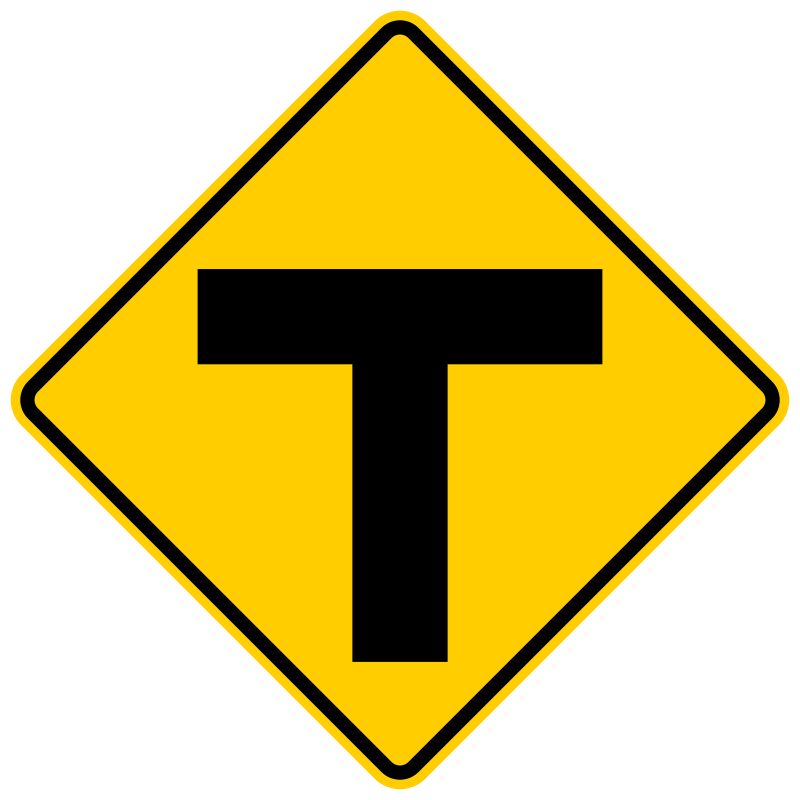
This road sign means:
A)Side road
B)T-intersection ahead
C)Keep right
D)Left lane must turn left
7.
When children are close, what should you do before you back out of a driveway?
A)Rely on your mirrors.
B)Get out of the car and check behind the car.
C)Look through your back window for children.
8.
The sign in the picture:
A)is a Construction and Maintenance Traffic Control sign.
B)is found at most intersections and indicates that drivers must yield to other vehicles.
C)is displayed on the rear of slow moving vehicles.
9.
Signs and markings requiring that you obey the indicated instruction are known as _____ signs.
A)warning
B)guide
C)regulatory
D)information
10.
Drivers may install on their private vehicle:
A)a siren.
B)a muffler cutout, bypass, or similar device.
C)a blue light visible outside of the vehicle.
D)None of the above.
11.
For protection, motorcyclists are required to:
A)keep their headlights and taillights on at all times.
B)signal turns, lane changes and stops.
C)wear approved helmets.
12.
When changing lanes, you should not:
A)signal your intentions early.
B)check your side and rear view mirrors.
C)use the inside rearview mirror to check for blind spots
D)check to see if other drivers are moving into the same lane.
13.
When towing a trailer, drivers must make sure that:
A)about 50% to 70% of the trailer weight is on the vehicle’s trailer hitch.
B)the trailer has a safety chain which is connected to a part of the trailer hitch.
C)the trailer is equipped with a safety chain that is attached to the frame of the towing vehicle.
D)the trailer has a safety chain which is securely attached to the vehicle’s bumper.
14.
Your blind spot is the area of the road:
A)you see in your rearview mirror.
B)directly behind your vehicle.
C)you cannot see without moving your head.
D)you see in your side mirror.
15.
You are approaching an intersection with a yellow flashing light. You should:
A)stop and wait for the light to change.
B)speed up to beat the red light.
C)prepare to stop; the light is about to turn red.
D)proceed with caution through the intersection.
16.
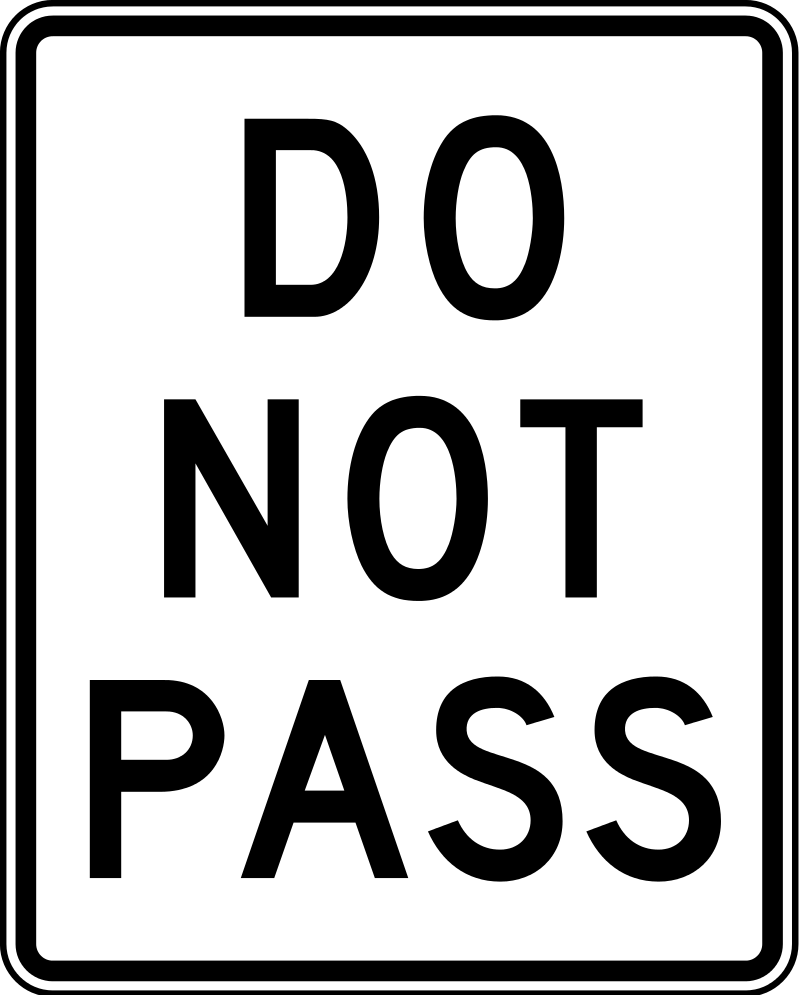
This sign means drivers must not pass other vehicles:
A)unless it is safe to do so.
B)within 250 feet of this sign.
C)when it's dark.
D)for any reason.
17.
What should you do if one of your tires blows out?
A)Hold the steering wheel tight and brake immediately to avoid the risk of skidding.
B)Leave the road immediately.
C)Hold the steering wheel tight and slowly take your foot off the gas pedal.
18.
When a ‘Road Closed’ sign is displayed, drivers must:
A)make a U-turn.
B)look for a detour or another route.
C)come to a complete stop and wait for the lights to turn green.
19.
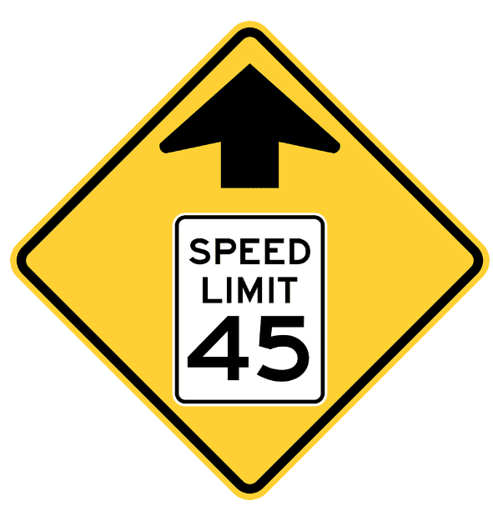
This warning sign:
A)provides advance notice to upcoming speed limit change.
B)shows the current speed limit that all vehicles traveling in the direction of the arrow must not exceed.
C)indicates the suggested highest safe speed.
20.
Yellow traffic signs:
A)guide drivers.
B)when combined with an octagonal shape, tell drivers they must come to a complete stop at the marked stop line.
C)warn drivers.
21.
In heavy rain, tires can begin to ride on the water that is on top of the road pavement. This is called:
A)rideplaning.
B)hydroplaning.
C)pavement-planing.
D)waterplaning.
22.
When you see an emergency vehicle with flashing lights behind you, you must:
A)slow down and keep moving.
B)drive to the right edge of the road and slow down.
C)pull over to the right and stop.
D)stop as quickly as you can.
23.
This road sign means:
A)Railroad Crossing
B)Side Road
C)Intersection
D)No Passing Zone
24.
A 4-way stop sign means:
A)The first vehicle to reach the intersection should move forward first.
B)Traffic from all four directions must stop.
C)There are four stop signs at the intersection.
D)All of the above.
25.
What is the main reason night driving is more difficult than daytime driving?
A)The use of headlight is required by law.
B)Reduced visibility.
C)Driving within the range.
26.
When driving a vehicle upon any public street or highway, you must:
A)show your driver’s license upon demand.
B)carry your license with you.
C)have a valid driver’s license.
D)All of the above.
27.
Keeping a space cushion between you and the other vehicles around you is important because it:
A)gives you time to react to situations.
B)prevents distractions from other vehicles.
C)keeps other drivers alert.
D)keeps traffic flowing at a safe pace.
28.
What should drivers do when the red lights begin to flash?
A)Stop.
B)Yield.
C)Slow down.
29.
The traffic light is green and you want to drive straight through an intersection. If a car is already in the intersection and is making a turn, you must:
A)enter the intersection and then stop.
B)drive through the intersection. You have the right-of-way.
C)let that car complete its turn before you enter the intersection.
30.
Because many crashes happen when a vehicle is turning left, drivers should:
A)slow down gradually while checking the rear view mirror.
B)move into the left lane of a multilane road.
C)yield to oncoming vehicles, bicyclists and pedestrians.
D)All of the above.
ANSWER KEYCheck answers after completing the test.