DriveQuiz drivequiz.com

HI DMV PERMİT PRACTİCE TEST 11

Hawaii
Duration: 27 min
|
Questions: 30
Student Name:
Date:
Correct:      Incorrect:      Score:      
1.
Bicyclists must:
A) ride in a bicycle lane, if available.
B) remain to the right when they prepare for a left turn.
C) remain near the left edge of the road.
2.
Warns of an extremely sharp 180-degree curve ahead. Decelerate significantly before entering the turn.
This sign means:
A) Hairpin corner ahead.
B) Warning: U-turn ahead.
C) Sharp right turn ahead.
3.
Which statement about motorcycles is true?
A) Motorcyclists are less vulnerable to injury than a car driver if involved in an accident.
B) It is generally easier to judge a motorcycle’s distance and speed.
C) The small profile of the motorcycle may make it appear closer and travelling faster than it actually is.
D) Motorcycles are allowed the full width of a lane in which to maneuver.
4.
You are driving up a hill and are approaching a heavy truck from the rear. You should know that:
A) you may not be able to safely pass the truck.
B) the truck may be traveling at a speed slower than the posted speed limit.
C) you may not be able to legally pass the truck.
D) All of the above.
5.
Before turning, you should:
A) increase your speed.
B) sound your horn to alert the other drivers.
C) give the proper turn signal.
D) change lanes.
6.
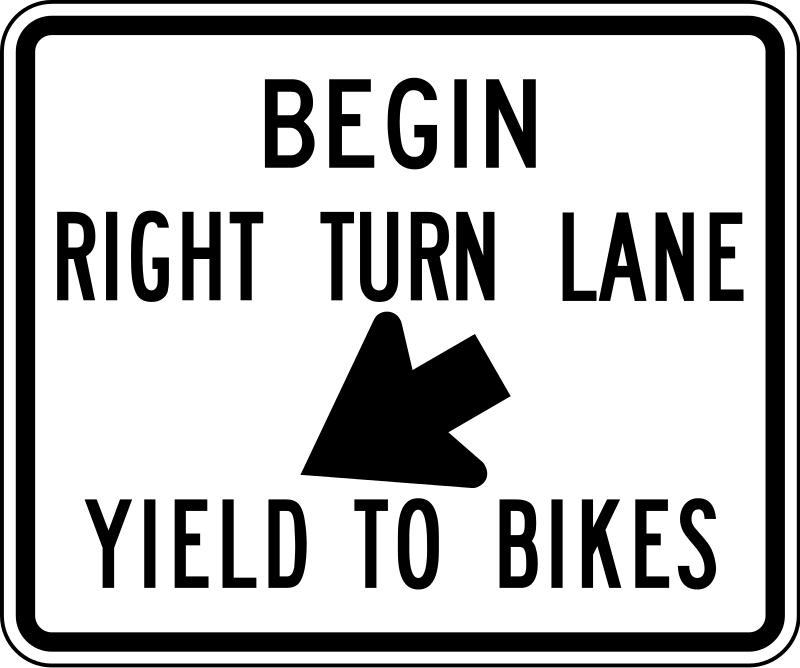
Drivers turning right must merge into the bike lane before turning, first checking mirrors and blind spots and yielding to all cyclists.
What does this road sign indicate?
A) Drivers have the right of way over bikes turning left.
B) Vehicles turning left must yield to bikes entering a right turn lane.
C) Motor vehicles entering an exclusive right-turn lane must weave across bicycle traffic in bicycle lanes.
7.
If one of your tires blows out while driving, you should:
A) apply the brakes firmly and steer toward the right edge of the road.
B) pump the brakes.
C) hold the steering wheel firmly, slow down, and steer smoothly.
8.
Double solid lines on the roadway mean:
A) you cannot pass.
B) you can not go across the lines except to turn left to enter or leave the highway.
C) All of the above.
9.
From top to bottom, traffic lights are:
A) green, red and yellow.
B) green, yellow and red.
C) red, yellow and green.
10.
Yellow diamond warning that pedestrians may be crossing ahead. Exercise caution and yield.
This sign means:
A) Pedestrian sidewalk ahead.
B) Pedestrians must yield the right-of-way ahead.
C) Pedestrian crossing ahead.
11.
A pedestrian starts to cross in front of your vehicle. You should:
A) sound your horn and proceed with caution.
B) slow down.
C) speed up and pass in front of the pedestrian.
D) stop until the person is out of the crosswalk.
12.
Object marker used to mark obstacles or bridge abutments near the edge of the road to alert drivers at night.
When they see a yellow X signal, drivers should:
A) come to a complete stop at the marked stop line.
B) turn off the ignition.
C) prepare to leave the lane safely.
13.
Blind spots around a large vehicle are _________________ than the blind spots around a car.
A) larger and deeper
B) less dangerous
C) narrower and shorter
14.
A steep downhill grade is ahead. Trucks and heavy vehicles should downshift to a lower gear to prevent brake overheating.
This traffic sign warns you about:
A) merging traffic.
B) a hill or a downgrade up ahead on the road.
C) an intersection ahead.
D) a winding road.
15.
When a stop is required at an intersection with no stop line or crosswalk:
A) Drivers should stop only at a place where the driver can see at least 100 feet on either side.
B) Drivers are required to slow down to make sure crossing traffic is clear.
C) Drivers are not required to stop.
D) Drivers should stop at the point nearest the intersecting roadway where the driver has a view of approaching traffic on the intersecting roadway before actually entering the roadway.
16.
An aggressive driver:
A) competes with other traffic.
B) weaves in and out of traffic.
C) shows little or no respect for traffic laws.
D) All of the above.
17.
An edge line that angles toward the center of the road indicates that:
A) the road is narrower ahead.
B) there’s a narrow bridge ahead.
C) you must turn right.
18.
What should you do if you see smoke come from under the hood?
A) Call the fire department and then pull off the road and park your vehicle.
B) Pull off the road and park your vehicle. Turn off the ignition, get away from the car and call the fire department.
C) Try to fight the fire yourself.
19.
Warns that a one-way street or divided highway is ending, and you are entering a roadway with oncoming traffic in the opposing lane. Stay to the right.
This sign warns ____________ ahead.
A) of two-way traffic
B) of a reduction of lanes
C) that a divided highway ends
20.
Parking, standing, or stopping is prohibited at all times in this designated zone except for emergency vehicles.
This road sign means:
A) No parking
B) Yield
C) No left turn
D) Divided highway
21.
To keep your vehicle from rolling into traffic when parked on a hill, if you are facing uphill you should:
A) turn the front wheels away from the curb or edge of the road.
B) turn the back wheels towards the curb or edge of the road.
C) set the parking brake and keep the front wheels straight.
D) turn the front wheels towards the curb or edge of the road.
22.
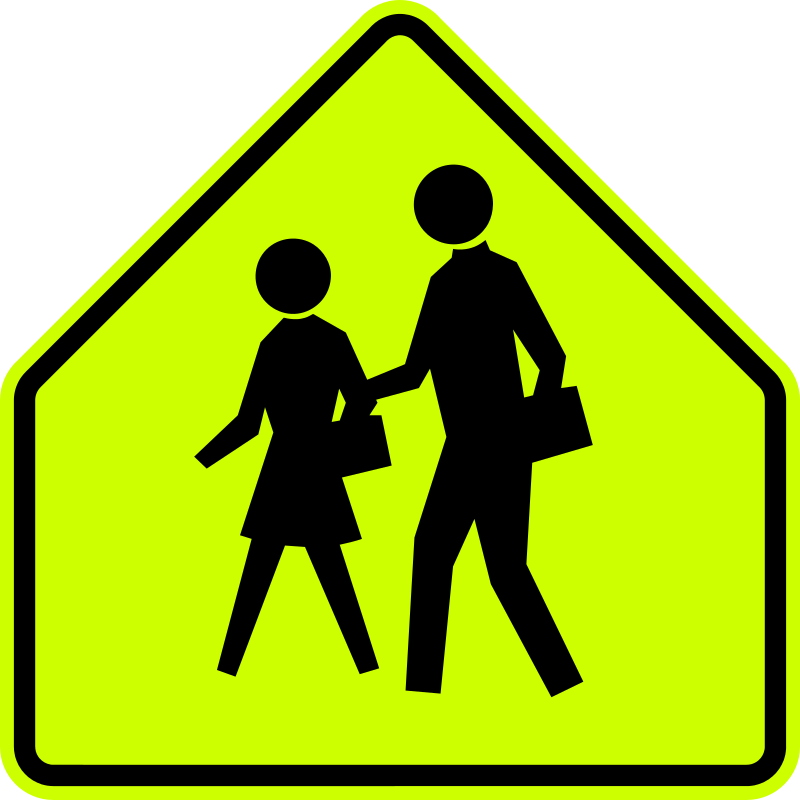
Five-sided pentagon sign indicating an upcoming school area. Watch for children crossing, school buses, and observe posted reduced school speed limits.
This warning sign means:
A) You are approaching a school
B) Watch out for children crossing the street
C) Slow down, drive with caution and watch for children
D) All of the above.
23.
When parked facing down hill, your wheels should be turned:
A) toward the curb.
B) in any direction.
C) parallel to the curb.
D) away from the curb.
24.
Drivers can not pass a vehicle on the left if:
A) they approach the top of a hill on a two-way road and can not see over it.
B) they can not safely return to the right lane before they reach a solid yellow center line for the right lane.
C) All of the above.
25.
Right turns are strictly prohibited at this intersection under all circumstances.
This sign tells drivers that:
A) they must make a left turn at the intersection.
B) U-turns are not allowed.
C) they must not make a right turn.
D) None of the above.
26.
When you are driving on the roadway and hear a siren behind you, you should:
A) pull over to the side and stop.
B) slow down and drive with caution.
C) speed up to get out of the way.
D) immediately come to a complete stop.
27.
Warns that a one-way street or divided highway is ending, and you are entering a roadway with oncoming traffic in the opposing lane. Stay to the right.
This sign warns drivers that:
A) they cannot go straight ahead.
B) they will soon be facing oncoming traffic.
C) a shared lane starts ahead.
28.
When riding in a vehicle, small children:
A) must never be allowed to ride in someone's lap or standing on a seat.
B) may not wear safety belts if an adult is sitting next to them.
C) are allowed to stand on the floor in the back of the vehicle.
D) may not wear safety belts when sitting in the backseat.
29.
When you see a 'reduced speed ahead' sign, you as a driver should know:
A) that you should maintain your vehicle’s speed till you get to the slower speed zone.
B) that the sign is only there for poke-along drivers.
C) that you should begin to reduce your vehicle’s speed.
D) that it's dangerous to slow down because traffic starts to back up.
30.
Does a vehicle prepared to enter a traffic circle or rotary have right-of-way over vehicles in the circle?
A) Yes, but only if they are entering the rotary from the right lane.
B) No. Vehicles already in the circle have the right-of-way.
C) Only if the light is green.
D) Yes.
ANSWER KEY Check answers after completing the test.
1 A
2 A
3 D
4 D
5 C
6 C
7 C
8 C
9 C
10 C
11 D
12 C
13 A
14 B
15 D
16 D
17 A
18 B
19 A
20 A
21 A
22 D
23 A
24 C
25 C
26 A
27 B
28 A
29 C
30 B