Question 1:
Bicyclists must:
A
ride in a bicycle lane, if available.
B
remain to the right when they prepare for a left turn.
C
remain near the left edge of the road.
The correct driving rule is: ride in a bicycle lane, if available. Following standard DMV road rules and practicing defensive driving ensures safety for all road users.
Question 2:
 This sign means:
A
Hairpin corner ahead.
B
Warning: U-turn ahead.
C
Sharp right turn ahead.
This traffic sign indicates: Hairpin corner ahead. Observing and obeying all roadway signs ensures safe traffic flow and legal driving.
Question 3:
Which statement about motorcycles is true?
A
Motorcyclists are less vulnerable to injury than a car driver if involved in an accident.
B
It is generally easier to judge a motorcycle’s distance and speed.
C
The small profile of the motorcycle may make it appear closer and travelling faster than it actually is.
D
Motorcycles are allowed the full width of a lane in which to maneuver.
The correct driving rule is: Motorcycles are allowed the full width of a lane in which to maneuver. Following standard DMV road rules and practicing defensive driving ensures safety for all road users.
Question 4:
You are driving up a hill and are approaching a heavy truck from the rear. You should know that:
A
you may not be able to safely pass the truck.
B
the truck may be traveling at a speed slower than the posted speed limit.
C
you may not be able to legally pass the truck.
D
All of the above.
Sharing the road safely requires mutual awareness and respect: you may not be able to safely pass the truck; the truck may be traveling at a speed slower than the posted speed limit; you may not be able to legally pass the truck. Maintaining safe space cushions protects all roadway users.
Question 5:
Before turning, you should:
A
increase your speed.
B
sound your horn to alert the other drivers.
C
give the proper turn signal.
D
change lanes.
The correct driving rule is: give the proper turn signal. Following standard DMV road rules and practicing defensive driving ensures safety for all road users.
Question 6:
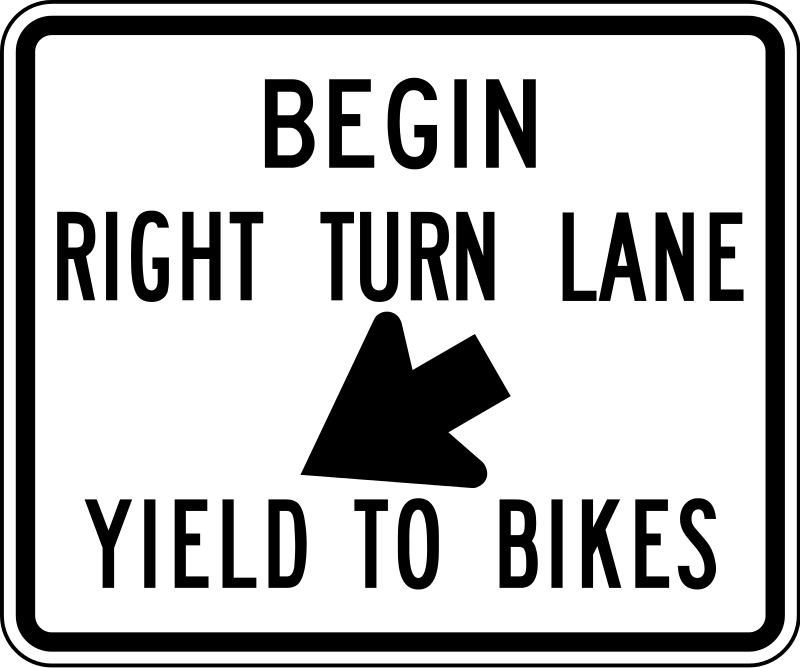 What does this road sign indicate?
A
Drivers have the right of way over bikes turning left.
B
Vehicles turning left must yield to bikes entering a right turn lane.
C
Motor vehicles entering an exclusive right-turn lane must weave across bicycle traffic in bicycle lanes.
This traffic sign indicates: Motor vehicles entering an exclusive right-turn lane must weave across bicycle traffic in bicycle lanes. Observing and obeying all roadway signs ensures safe traffic flow and legal driving.
Question 7:
If one of your tires blows out while driving, you should:
A
apply the brakes firmly and steer toward the right edge of the road.
B
pump the brakes.
C
hold the steering wheel firmly, slow down, and steer smoothly.
The correct driving rule is: hold the steering wheel firmly, slow down, and steer smoothly. Following standard DMV road rules and practicing defensive driving ensures safety for all road users.
Question 8:
Double solid lines on the roadway mean:
A
you cannot pass.
B
you can not go across the lines except to turn left to enter or leave the highway.
C
All of the above.
All of the listed points are essential driving requirements: you cannot pass; you can not go across the lines except to turn left to enter or leave the highway. Practicing each ensures compliance with DMV safety laws.
Question 9:
From top to bottom, traffic lights are:
A
green, red and yellow.
B
green, yellow and red.
C
red, yellow and green.
The correct driving rule is: red, yellow and green. Following standard DMV road rules and practicing defensive driving ensures safety for all road users.
Question 10:
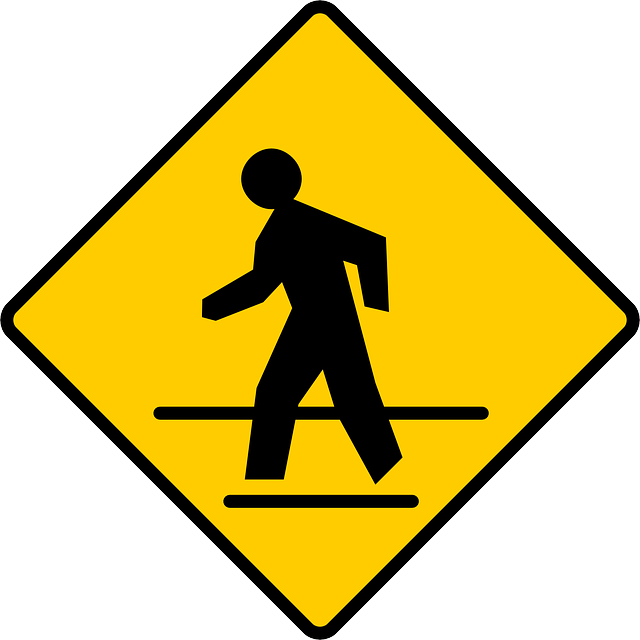 This sign means:
A
Pedestrian sidewalk ahead.
B
Pedestrians must yield the right-of-way ahead.
C
Pedestrian crossing ahead.
This traffic sign indicates: Pedestrian crossing ahead. Observing and obeying all roadway signs ensures safe traffic flow and legal driving.
Question 11:
A pedestrian starts to cross in front of your vehicle. You should:
A
sound your horn and proceed with caution.
B
slow down.
C
speed up and pass in front of the pedestrian.
D
stop until the person is out of the crosswalk.
Drivers must always yield the right-of-way to pedestrians crossing at intersections and crosswalks: stop until the person is out of the crosswalk. Stop and allow them to clear the lane safely.
Question 12:
 When they see a yellow X signal, drivers should:
A
come to a complete stop at the marked stop line.
B
turn off the ignition.
C
prepare to leave the lane safely.
State laws require signaling your intention: prepare to leave the lane safely. Signal at least 100 feet before making a turn or changing lanes.
Question 13:
Blind spots around a large vehicle are _________________ than the blind spots around a car.
A
larger and deeper
B
less dangerous
C
narrower and shorter
The correct driving rule is: larger and deeper. Following standard DMV road rules and practicing defensive driving ensures safety for all road users.
Question 14:
 This traffic sign warns you about:
A
merging traffic.
B
a hill or a downgrade up ahead on the road.
C
an intersection ahead.
D
a winding road.
This traffic sign indicates: a hill or a downgrade up ahead on the road. Observing and obeying all roadway signs ensures safe traffic flow and legal driving.
Question 15:
When a stop is required at an intersection with no stop line or crosswalk:
A
Drivers should stop only at a place where the driver can see at least 100 feet on either side.
B
Drivers are required to slow down to make sure crossing traffic is clear.
C
Drivers are not required to stop.
D
Drivers should stop at the point nearest the intersecting roadway where the driver has a view of approaching traffic on the intersecting roadway before actually entering the roadway.
Drivers must always yield the right-of-way to pedestrians crossing at intersections and crosswalks: drivers should stop at the point nearest the intersecting roadway where the driver has a view of approaching traffic on the intersecting roadway before actually entering the roadway. Stop and allow them to clear the lane safely.
Question 16:
An aggressive driver:
A
competes with other traffic.
B
weaves in and out of traffic.
C
shows little or no respect for traffic laws.
D
All of the above.
All of the listed points are essential driving requirements: competes with other traffic; weaves in and out of traffic; shows little or no respect for traffic laws. Practicing each ensures compliance with DMV safety laws.
Question 17:
An edge line that angles toward the center of the road indicates that:
A
the road is narrower ahead.
B
there’s a narrow bridge ahead.
C
you must turn right.
The correct driving rule is: the road is narrower ahead. Following standard DMV road rules and practicing defensive driving ensures safety for all road users.
Question 18:
What should you do if you see smoke come from under the hood?
A
Call the fire department and then pull off the road and park your vehicle.
B
Pull off the road and park your vehicle. Turn off the ignition, get away from the car and call the fire department.
C
Try to fight the fire yourself.
The correct driving rule is: pull off the road and park your vehicle. Turn off the ignition, get away from the car and call the fire department. Following standard DMV road rules and practicing defensive driving ensures safety for all road users.
Question 19:
 This sign warns ____________ ahead.
A
of two-way traffic
B
of a reduction of lanes
C
that a divided highway ends
This traffic sign indicates: of two-way traffic. Observing and obeying all roadway signs ensures safe traffic flow and legal driving.
Question 20:
 This road sign means:
A
No parking
B
Yield
C
No left turn
D
Divided highway
This traffic sign indicates: No parking. Observing and obeying all roadway signs ensures safe traffic flow and legal driving.
Question 21:
To keep your vehicle from rolling into traffic when parked on a hill, if you are facing uphill you should:
A
turn the front wheels away from the curb or edge of the road.
B
turn the back wheels towards the curb or edge of the road.
C
set the parking brake and keep the front wheels straight.
D
turn the front wheels towards the curb or edge of the road.
Under standard parking and curb regulations: turn the front wheels away from the curb or edge of the road. Following parking distance clearances keeps roadways unobstructed and emergency lanes accessible.
Question 22:
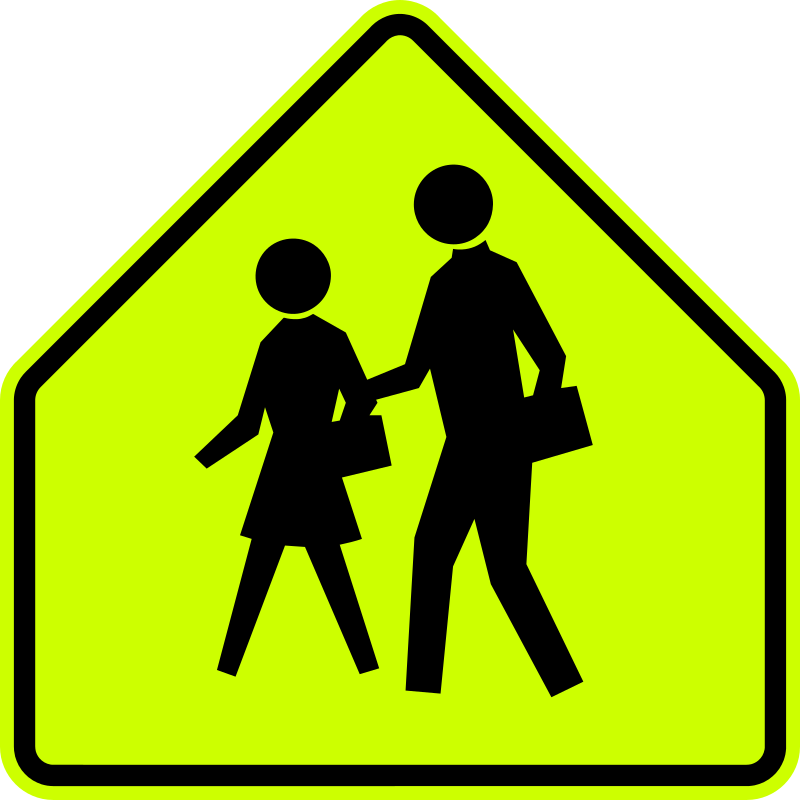 This warning sign means:
A
You are approaching a school
B
Watch out for children crossing the street
C
Slow down, drive with caution and watch for children
D
All of the above.
This sign alerts drivers to several mandatory requirements: You are approaching a school, Watch out for children crossing the street, Slow down, drive with caution and watch for children. Obeying all posted traffic control instructions is required by law.
Question 23:
When parked facing down hill, your wheels should be turned:
A
toward the curb.
B
in any direction.
C
parallel to the curb.
D
away from the curb.
The correct driving rule is: toward the curb. Following standard DMV road rules and practicing defensive driving ensures safety for all road users.
Question 24:
Drivers can not pass a vehicle on the left if:
A
they approach the top of a hill on a two-way road and can not see over it.
B
they can not safely return to the right lane before they reach a solid yellow center line for the right lane.
C
All of the above.
All of the listed points are essential driving requirements: they approach the top of a hill on a two-way road and can not see over it; they can not safely return to the right lane before they reach a solid yellow center line for the right lane. Practicing each ensures compliance with DMV safety laws.
Question 25:
 This sign tells drivers that:
A
they must make a left turn at the intersection.
B
U-turns are not allowed.
C
they must not make a right turn.
D
None of the above.
This traffic sign indicates: they must not make a right turn. Observing and obeying all roadway signs ensures safe traffic flow and legal driving.
Question 26:
When you are driving on the roadway and hear a siren behind you, you should:
A
pull over to the side and stop.
B
slow down and drive with caution.
C
speed up to get out of the way.
D
immediately come to a complete stop.
The correct driving rule is: pull over to the side and stop. Following standard DMV road rules and practicing defensive driving ensures safety for all road users.
Question 27:
This sign warns drivers that:
A
they cannot go straight ahead.
B
they will soon be facing oncoming traffic.
C
a shared lane starts ahead.
This traffic sign indicates: they will soon be facing oncoming traffic. Observing and obeying all roadway signs ensures safe traffic flow and legal driving.
Question 28:
When riding in a vehicle, small children:
A
must never be allowed to ride in someone's lap or standing on a seat.
B
may not wear safety belts if an adult is sitting next to them.
C
are allowed to stand on the floor in the back of the vehicle.
D
may not wear safety belts when sitting in the backseat.
The correct driving rule is: must never be allowed to ride in someone's lap or standing on a seat. Following standard DMV road rules and practicing defensive driving ensures safety for all road users.
Question 29:
When you see a 'reduced speed ahead' sign, you as a driver should know:
A
that you should maintain your vehicle’s speed till you get to the slower speed zone.
B
that the sign is only there for poke-along drivers.
C
that you should begin to reduce your vehicle’s speed.
D
that it's dangerous to slow down because traffic starts to back up.
For safe speed and stopping control: that you should begin to reduce your vehicle’s speed. Adjusting speed to match visibility and road traction prevents loss of steering grip.
Question 30:
Does a vehicle prepared to enter a traffic circle or rotary have right-of-way over vehicles in the circle?
A
Yes, but only if they are entering the rotary from the right lane.
B
No. Vehicles already in the circle have the right-of-way.
C
Only if the light is green.
D
Yes.
Vehicles entering a roundabout must yield right-of-way to circulating traffic already inside: No. Vehicles already in the circle have the right-of-way. Wait for a safe gap before entering.