DriveQuiz drivequiz.com

HARDEST 50 QUESTİONS

Special Tests
Duration: 45 min
|
Questions: 50
Student Name:
Date:
Correct:      Incorrect:      Score:      
1.
Warning signs are normally:
A) blue.
B) yellow.
C) red.
D) green.
2.
Controlled substances include:
A) marijuana
B) prescription drugs
C) alcoholic beverages
D) All of the above.
3.
When driving on a wet road:
A) as you drive faster, your tires may lose traction.
B) you must be aware that the pavement gets even more slippery when it's been raining for long periods of time.
C) you should follow the vehicle ahead of you more closely.
D) as you decrease your speed, the road becomes more slippery.
4.
You have stopped for a train at a railroad crossing. After the train passes, you must:
A) look to see if another train is coming, then cross the tracks if it is safe to do so.
B) watch for vehicles that must stop at railroad crossings (school buses, vehicles carrying hazardous materials, etc.).
C) All of the above.
5.
A driver can legally pass on the right of another vehicle:
A) that is preparing to turn left, if there is room to go by safely.
B) anytime.
C) None of the other answers is correct.
D) anytime, if the vehicle is a bicycle.
6.
Seat belts on buses are exempt on buses purchased new prior to:
A) December 31, 2010.
B) December 31, 2015.
C) December 31, 2000.
D) October 31, 2002.
7.
Blocking an intersection during rush hour traffic is not permitted:
A) under any circumstances.
B) unless you entered the intersection on a green light.
C) unless you have the right-of-way.
8.
Construction zone signs are generally:
A) rectangular with white red coloring.
B) triangular with black and yellow coloring.
C) diamond or rectangular with orange and black coloring.
9.
Green signs tell you about services along the roadway.
A) False
B) True
10.
When you prepare to make a left turn from a one-way road into a two-way road, you must:
A) enter the two-way road to the left of its center line.
B) approach the turn in the right lane or from the right side of a single lane.
C) approach the turn in the left lane or from the left side of a single lane.
11.
When a driver is turning and a pedestrian is crossing without a traffic light, __________ must yield the right-of-way.
A) the pedestrian
B) the driver
C) both
D) whoever is slower
12.
You are coming to an intersection and have a green light. Pedestrians are crossing against the red. You should:
A) claim your right-of-way and proceed with caution.
B) honk your horn.
C) speed up and pass in front of the pedestrians.
D) stop to let pedestrians cross safely.
13.
Who must wear safety belts in Illinois?
A) All drivers and front seat passengers ages 8 and older.
B) All drivers and passengers (front and back seat) ages 8 and older.
C) All drivers and front seat passengers.
14.
Drinking alcohol affects:
A) Your coordination.
B) Your vision.
C) All of the above.
15.
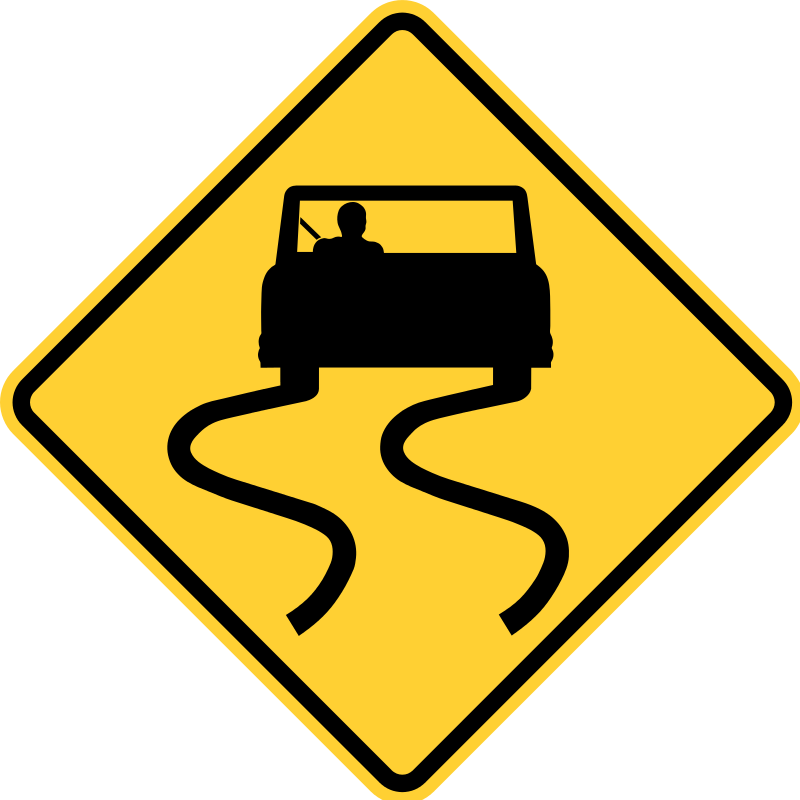
The roadway becomes particularly slippery during wet or rainy conditions. Reduce your speed, increase following distance, and avoid abrupt braking or steering.
This yellow sign means:
A) there is a sharp curve in the road ahead.
B) the road ahead has many curves.
C) the road ahead may be slippery.
16.
In 55 MPH traffic you are least likely to be involved in a collision if you:
A) stay within that speed range.
B) drive a few MPH faster than most.
C) drive a few MPH slower than most.
17.
Green and white signs:
A) give information about directions and distances.
B) are mainly used at intersections and driveways.
C) warn drivers of unexpected road conditions.
18.
Which of the following is NOT true about ABS?
A) It improves the vehicle stability.
B) It helps increase your stopping distance.
C) It improves the steering ability.
19.
The average reaction distance at 60 MPH is:
A) 33 feet
B) 158 feet
C) 66 feet
D) 359 feet
20.
After passing a vehicle, it is safe to return to your lane:
A) when you can no longer see the vehicle over your right shoulder.
B) after about five seconds.
C) when you see the front bumper of the other vehicle in your mirror.
21.
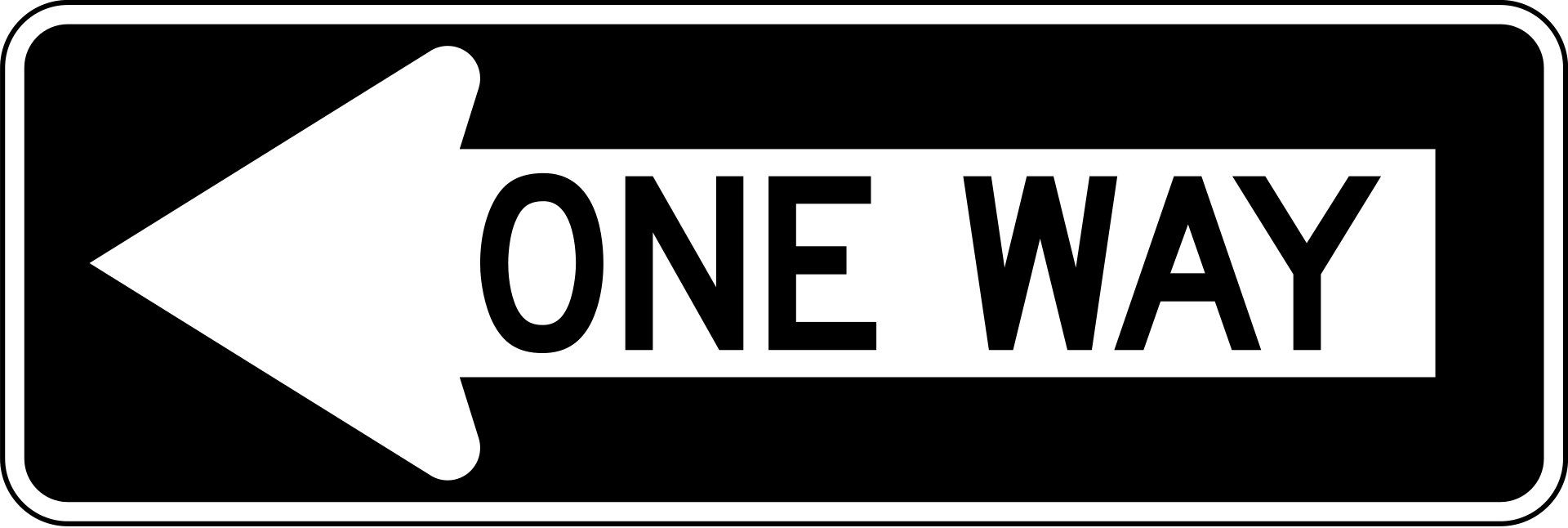
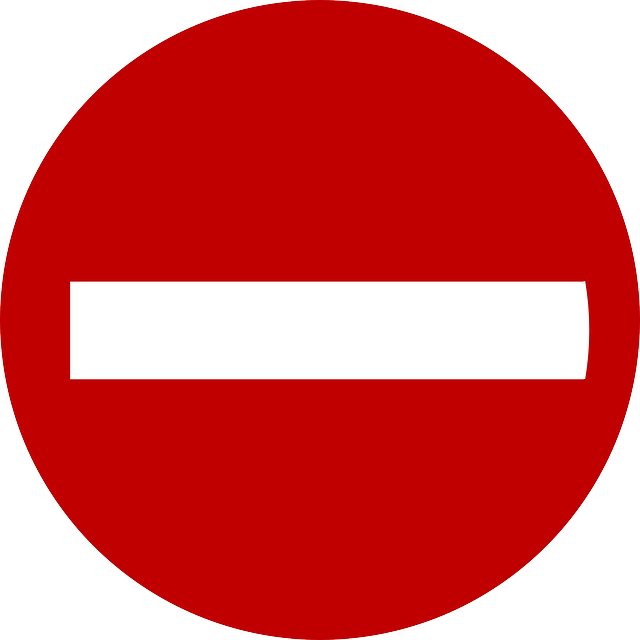
Traffic flows only in the direction indicated by the arrow. Never drive in the opposing direction.
This road sign means:
A) Traffic flows only in the direction of the arrow
B) Turn right or left
C) No right turn
D) Sharp curve ahead
22.
Where are yield signs usually placed?
A) At intersections, if there is no marked stop line.
B) Where auxiliary roads lead into major roads.
C) Where major roads lead into auxiliary roads.
23.
Reaction time is slower:
A) after drinking alcohol.
B) after sleeping.
C) between 9 and 11 PM.
24.
Always wear your shoulder strap seat belt:
A) under your right arm.
B) loosely fastened.
C) snug without any slack.
D) behind your back.
25.
A red arrow pointing to the right on a traffic light means you may:
A) turn in that direction after you come to a complete stop.
B) turn in that direction after slowing and checking traffic.
C) not turn in that direction until the light turns green.
26.
Braking distance is:
A) usually 50 feet.
B) how far a vehicle will travel, in ideal conditions, while the driver is braking.
C) the total distance a vehicle has traveled until it comes to a complete stop.
D) how far a vehicle will continue to travel before the driver hits the brakes.
27.
To be able to turn quickly, your hands should be:
A) placed outside of the steering wheel on opposite sides
B) next to each other on the top of the steering wheel.
C) on the steering wheel, so they are at the 6 and 12 o'clock positions.
28.
Drivers should allow a larger space cushion when stopping:
A) at a stop sign.
B) on an up-hill.
C) at an intersection.
D) at a yield sign.
29.
Slow down and give right-of-way to all oncoming vehicles, cyclists, and pedestrians. Stop completely if necessary before entering the intersection or merging.
This road sign means:
A) You have the right of way
B) No Passing Zone
C) Yield the right-of-way
30.
Your vehicles braking distance will be much longer:
A) when driving at night.
B) on interstate highways.
C) on wet, icy or gravel roads.
D) All of the above.
31.
Warns of two consecutive curves in opposite directions (e.g., curves right then left). Slow down to maintain control.
This sign warns drivers that:
A) the highway ahead is divided into two one-way roadways. Drivers should keep to the right.
B) there is a winding road ahead.
C) there is a double curve ahead.
32.
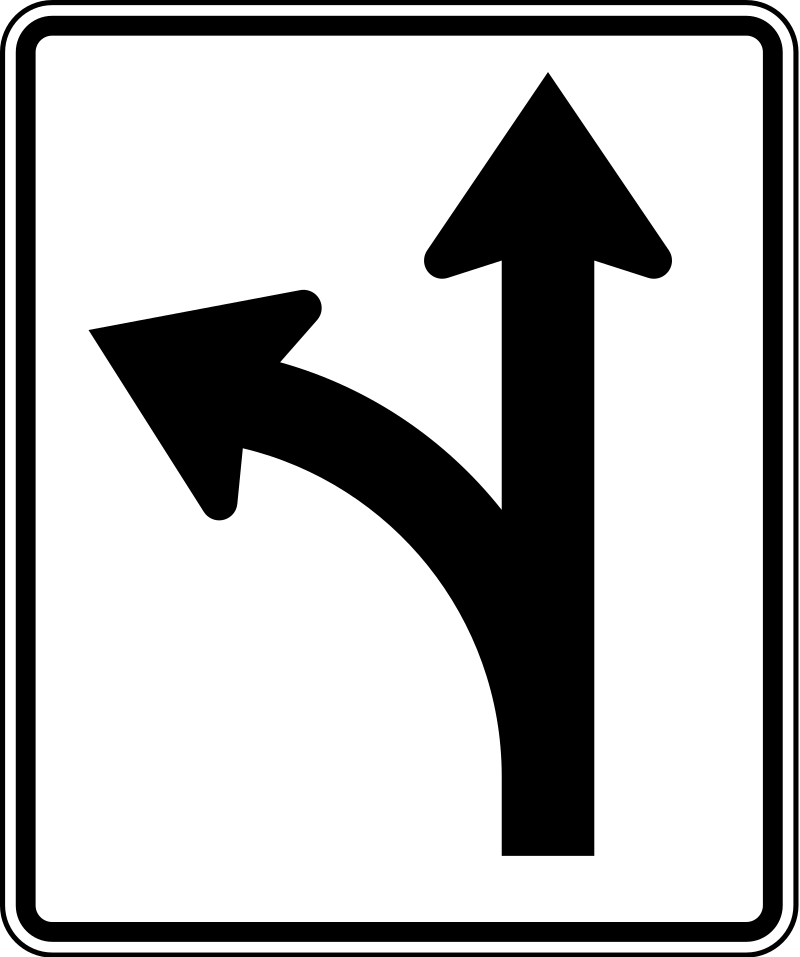
From this lane, drivers may either turn left or proceed straight ahead through the intersection.
This road sign means:
A) Detour ahead
B) Turn left or go through
C) Divided highway ahead
33.
You reach an intersection and you want to turn left. The light is green but oncoming traffic is heavy. You should:
A) wait in the center of the intersection for traffic to clear.
B) go to the next intersection.
C) wait at the crosswalk for traffic to clear.
34.
When the road is slippery you should:
A) decrease the following distance.
B) slow and pro-ceed with caution.
C) check your brakes.
35.
Double solid lines on the roadway mean:
A) you cannot pass.
B) you can not go across the lines except to turn left to enter or leave the highway.
C) All of the above.
36.
Drivers should not sound their horn when:
A) near blind pedestrians.
B) visibility ahead is limited.
C) they may hit another vehicle.
37.
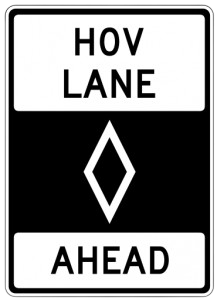
High-Occupancy Vehicle (HOV) diamond lane ahead. Only vehicles carrying the minimum required number of passengers (usually 2 or more) may use this lane.
This road sign indicates that:
A) a lane is reserved for certain purposes or certain vehicles.
B) buses and car pools may not travel in the restricted lane.
C) vehicles cannot go straight ahead. Cars must turn either to the right or left.
38.
All of the above.
A) Traffic that approaches from either direction may proceed.
B) The bus is about to stop.
C) The bus is stopped to load or discharge passengers.
39.
Indicates you have entered an exit ramp or one-way street in the incorrect direction. Stop immediately and safely turn around.
This sign means:
A) U-turns not allowed.
B) Stop sign ahead.
C) Do not enter a road or off ramp where the sign is posted.
40.
When passing you should NOT:
A) leave less than 4 feet of space between your vehicle and the vehicle you are passing.
B) signal left to let others know that you will be pulling out.
C) look in your rearview mirrors and glance over your shoulder before pulling out to pass.
D) go far enough past the vehicle you are passing so that you can see the vehicle in your inside rearview mirror.
41.
At 50 MPH, a vehicle will travel a minimum of ___ feet before the driver can bring it to a complete stop.
A) 158
B) 100
C) 268
D) 55
42.
Which of the following is a way to avoid road rage?
A) Shouting obscenities.
B) Not getting behind the wheel if you are tired.
C) Making eye contact with other drivers.
D) All of the above.
43.
When you drive near parks and playgrounds, you should expect children:
A) not to cross unless they are with an adult.
B) to know when it is safe to cross.
C) to stop at the curb before crossing the street.
D) to suddenly run into the street.
44.
Where must a pedestrian walk when there are no sidewalks?
A) On the side of the road, in the same direction of traffic.
B) In the middle of the road, facing oncoming traffic.
C) On the side of the road, facing the traffic.
45.
Slow down and give right-of-way to all oncoming vehicles, cyclists, and pedestrians. Stop completely if necessary before entering the intersection or merging.
The yield sign means:
A) Go. The light will soon be red.
B) If the way is clear, you may move forward slowly without stopping.
C) Stop if you can.
46.
A work zone:
A) is marked with black and white signs.
B) might involve vehicles and moving workers.
C) does not require that the driver slow down and pay extra attention.
D) All of the above.
47.
An eight-lane highway has ________ pedestrian countdown period ___ a four-lane road.
A) the same; as
B) a longer; than
C) half the; of
D) a shorter; than
48.
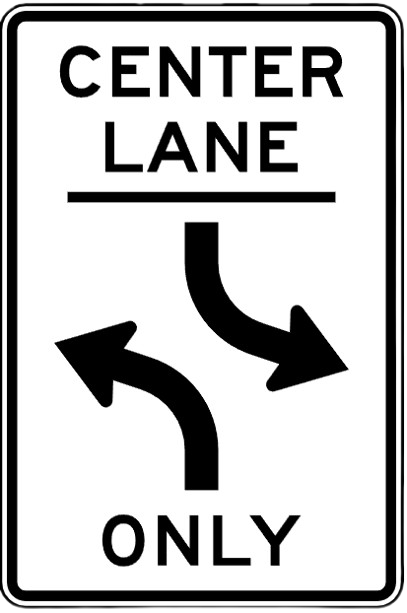
Indicates a two-way left-turn lane in the center of the road. Must only be used to make left turns or U-turns (where permitted), not for regular travel or passing.
This road sign means:
A) Extra lane to the left
B) Two way left turn
C) Lane shifting
49.
When driving in the far right lane of a freeway, you:
A) must give the right-of-way to merging traffic.
B) should expect merging vehicles at on-ramps.
C) must be driving slower than other traffic.
50.
Which of the following is NOT true? Your license must be revoked if:
A) you are found guilty of drug possession.
B) you are found guilty of not stopping to give help when the vehicle you are driving is involved in a crash causing death or personal injury.
C) you use tobacco and you are under the age of 14.
D) All of the above.
ANSWER KEY Check answers after completing the test.
1 B
2 B
3 A
4 C
5 A
6 C
7 A
8 C
9 A
10 C
11 B
12 D
13 B
14 C
15 C
16 A
17 A
18 B
19 C
20 C
21 A
22 B
23 A
24 C
25 C
26 B
27 A
28 B
29 C
30 C
31 C
32 B
33 A
34 B
35 C
36 A
37 A
38 C
39 C
40 A
41 C
42 B
43 D
44 C
45 B
46 B
47 B
48 B
49 B
50 C