DriveQuiz drivequiz.com

FL DMV PERMİT PRACTİCE TEST 9

Florida
Duration: 45 min
|
Questions: 50
Student Name:
Date:
Correct:      Incorrect:      Score:      
1.
Ramp signals:
A) control the rate of vehicles entering an expressway.
B) are considered speed control devices.
C) control the types of vehicles entering a freeway.
D) are used to warn drivers of unexpected ramp conditions.
2.
You are driving on a two-lane road with traffic moving in opposite directions, and a solid yellow line is painted on your side of the center line. You:
A) may not pass other vehicles.
B) may pass only if you are within 100 feet of a bridge, tunnel, or railroad crossing.
C) may cross the solid yellow line when changing lanes.
D) must pass other vehicles on the right.
3.
The Florida “standard” speed limit on limited access highways is:
A) 55 MPH.
B) 90 MPH.
C) 70 MPH.
D) 45 MPH.
4.
Object marker used to mark obstacles or bridge abutments near the edge of the road to alert drivers at night.
When they see a yellow X signal, drivers should:
A) come to a complete stop at the marked stop line.
B) turn off the ignition.
C) prepare to leave the lane safely.
5.
Low beam headlamps are only effective for speeds up to ___ MPH.
A) 50-55
B) 20-25
C) 30-35
D) 70-85
6.
The length of a point suspension is:
A) 1 year for 24 points within a 36-month period.
B) 3 months for 18 points within a 18-month period.
C) 30 days for 12 points within a 12-month period.
D) All of the above.
7.
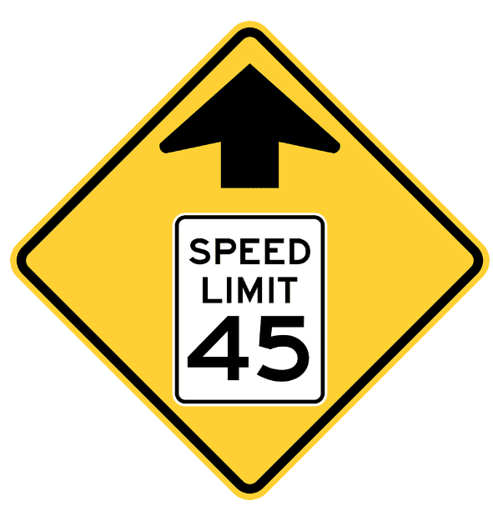
Recommended safe maximum driving speed in ideal conditions for an upcoming curve, ramp, or hazardous stretch of road.
This warning sign:
A) provides advance notice to upcoming speed limit change.
B) shows the current speed limit that all vehicles traveling in the direction of the arrow must not exceed.
C) indicates the suggested highest safe speed.
8.
Which of the following is an important benefit of ABS?
A) It improves visibility at night.
B) The driver can steer the vehicle away from hazards while braking.
C) It can be turned off by pumping the brakes.
D) All of the above.
9.
The road curves gradually to the right ahead. Reduce speed before entering the curve.
When they see this sign, drivers should:
A) increase their speed and keep well to the right.
B) slow down and keep well to the right.
C) slow down and keep well to the left.
10.
If you see red reflectors facing you on the lane lines, you:
A) are on the wrong side of the road.
B) should turn around or get into the proper lane immediately.
C) could have a head-on collision.
D) All of the above.
11.
More crashes happen _____________ than any other place.
A) at intersections
B) on highways
C) in school zones
D) near hospitals
12.
For all turning vehicles, the rear wheels follow ____________ the front wheels.
A) a shorter path than
B) a longer path than
C) a different path than
D) the same path as
13.
When making a turn, drivers should:
A) yield the right-of-way to vehicles coming from the opposite direction.
B) move into the correct lane without using turn signals.
C) increase their speed to avoid tailgating.
D) None of the above.
14.
Operators of mopeds must have the minimum of a:
A) Class B license.
B) Class C license.
C) Class M license.
D) Class E license.
15.
When they meet a truck coming from the opposite direction, drivers should:
A) swerve off the road.
B) keep as far as possible to the side to avoid a sideswipe crash.
C) introduce themselves.
D) speed up while the truck is passing.
16.
When they back up, drivers should NOT:
A) back slowly.
B) look directly through the rear window.
C) depend on rearview or side mirrors to check behind their vehicle.
D) be cautious.
17.
What does the Implied Consent Law say?
A) If you drive in Florida, you have agreed by signing your driver license to take a breath or blood alcohol test if asked by an officer.
B) You are required by law to ask an officer for permission to take a blood or alcohol test.
C) You can refuse to take a breath or blood test by exercising your Implied Consent rights.
D) An officer cannot ask for your consent to take a breath or blood test.
18.
Parking is NOT allowed:
A) when it's raining.
B) within 20 feet of an intersection.
C) on the right side of the roadway.
D) on hills.
19.
An ‘uncontrolled’ or ‘open’ intersection is an intersection where:
A) there is no speed limit.
B) no traffic lights or signs are used to indicate the right-of-way.
C) no law enforcement officer is directing traffic.
D) None of the above.
20.
Any driver under 21 years of age who is stopped by law enforcement and has a breath alcohol level of .02 or higher will have their driving privilege suspended for:
A) 12 months.
B) 6 months.
C) 3 months.
D) 1 month.
21.
Road signs that direct drivers to services are:
A) brown and white.
B) blue and white.
C) green and white.
22.
What is NOT true regarding the use of headlights?
A) High beam headlights are used when traveling behind other vehicles.
B) When driving in low visibility, drivers should use low-beam headlights.
C) High-beams can reveal objects up to a distance of 450 feet.
D) All of the above.
23.
Alcohol reaches your brain within _____ after consumption.
A) 25 seconds
B) hours
C) 5 seconds
D) minutes
24.
You should use turn signals to indicate your intention with sufficient time to allow other drivers to see the signal:
A) if it’s raining.
B) AFTER you move.
C) BEFORE you move.
25.
When drivers see the ‘Wrong Way’ sign:
A) they are going the wrong way on an expressway exit ramp.
B) they must drive past this sign and reach the next intersection.
C) they must not leave the pavement except in an emergency.
26.
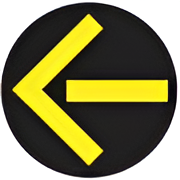
Unprotected left turns are allowed. You may turn left after yielding to oncoming traffic and pedestrians crossing the street.
What does a yellow arrow signal mean?
A) The same as the yellow light, but applies only to movement in the direction of the arrow.
B) The same as a green light.
C) Vehicles moving in all directions must stop if they can. The light will soon be red.
27.
Drivers who throw trash on public streets:
A) can be charged with a first degree misdemeanor.
B) can be fined up to a maximum of $150.
C) are probably in a rush.
D) are allowed to dump a maximum of 15 pounds of trash.
28.
When parking uphill, you should shift manual gears to:
A) neutral.
B) top.
C) reverse.
D) first.
29.
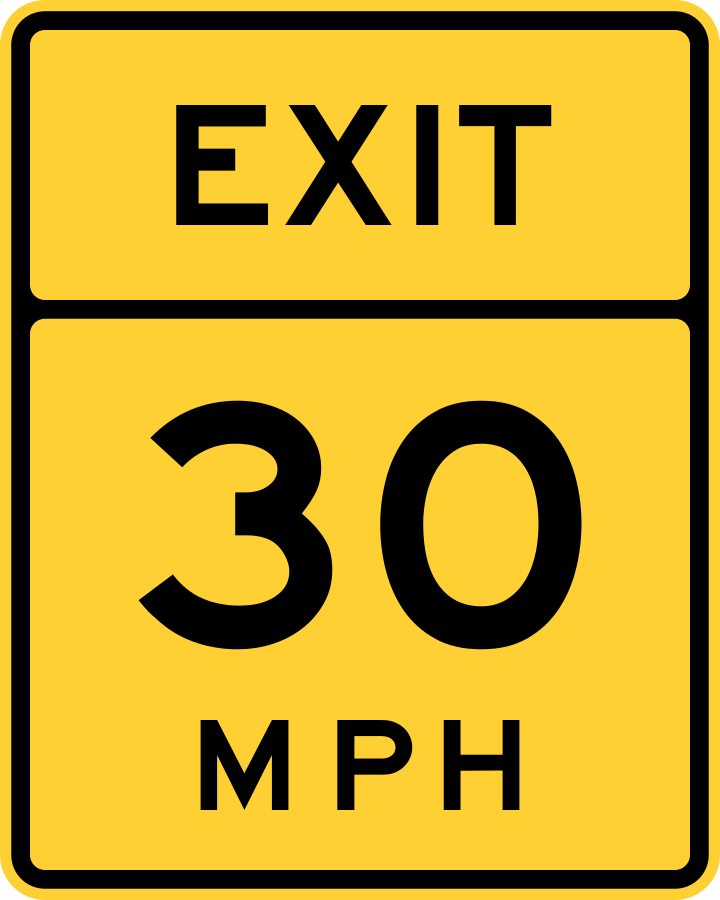
Recommends a safe speed of 30 MPH for negotiating the freeway exit ramp deceleration lane.
The sign in the picture:
A) shows the highest speed drivers can travel at the exit of the intersection.
B) is used to advise motorists of the appropriate ramp speed at the highway exit point.
C) indicates the minimum ramp speed at the highway exit point.
30.
To drive defensively, you must:
A) anticipate errors by other drivers.
B) assume that a driver who approaches a STOP sign on a side road is actually going to stop.
C) not check behind you through your mirrors.
31.
On a two-lane highway, drivers are allowed to drive on the left half of the roadway when:
A) the lane is reserved for car pool vehicles.
B) it is safe to pass and passing is allowed.
C) they are about to exit.
D) they are driving slower than the other vehicles.
32.
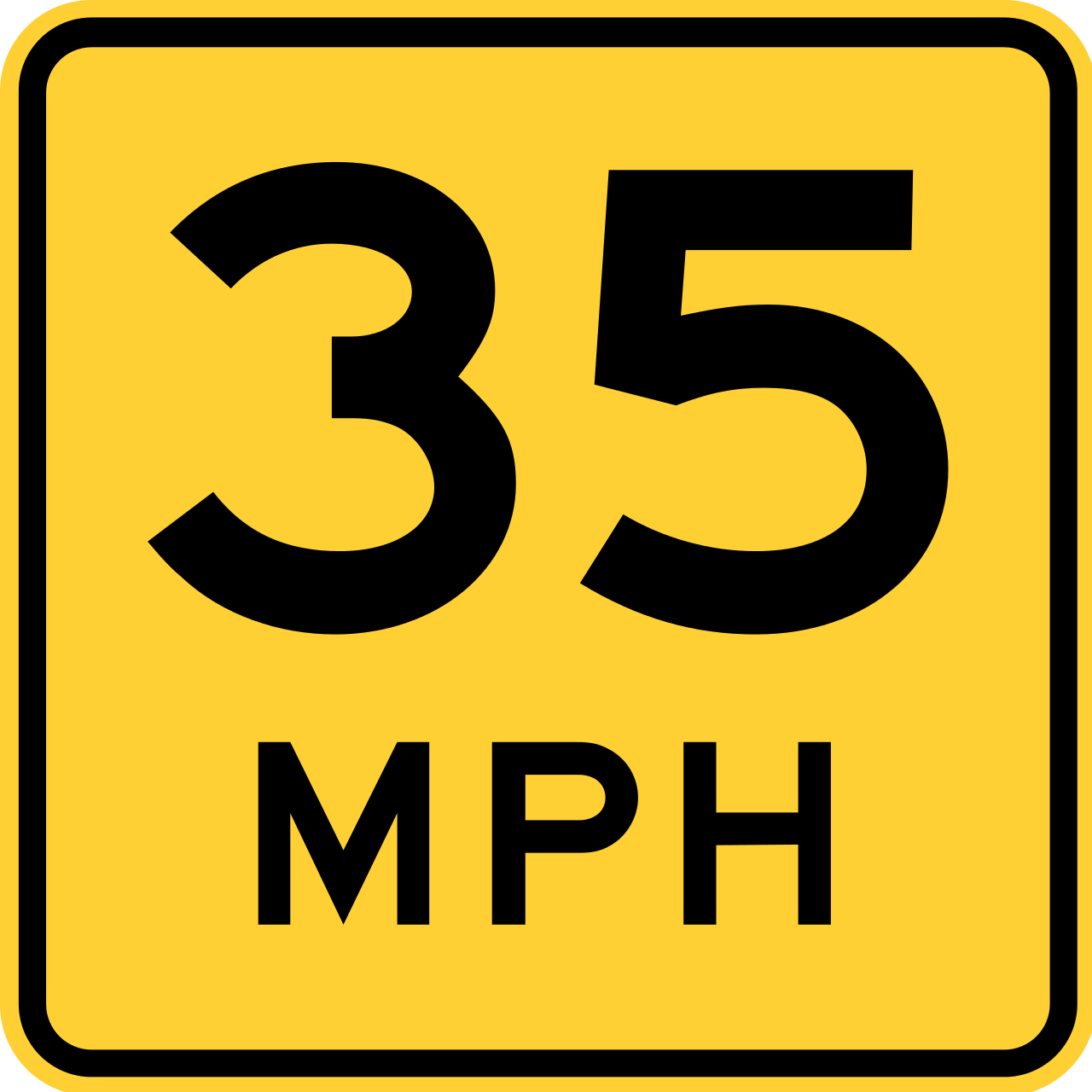
Recommends maximum safe speed for an upcoming highway curve or connector ramp.
This road sign means:
A) The maximum speed limit is 35 MPH
B) The minimum safe speed is 35 MPH
C) The maximum speed at night is 35 MPH
D) The recommended speed limit is 35 MPH
33.
Which of the following is true about the Anti-Locking Brake System?
A) It prevents skidding.
B) It allows drivers to steer during an emergency braking situation.
C) All of the above.
34.
The seat belt law applies to passenger cars manufactured beginning with the ____ model year.
A) 1968
B) 2008
C) 1978
D) 1986
35.
Which shape is a yield sign?
A) Vertical rectangle
B) Upside-down triangle
C) Diamond
36.
Parking is not allowed within __ feet of an intersection
A) 50
B) 30
C) 10
D) 20
37.
What can you do to prevent skids on snow and ice?
A) Allow the wheels to keep turning.
B) Brake early and gently.
C) All of the above.
38.
A broken white line:
A) means passing or crossing is prohibited in that lane.
B) separates two lanes traveling in the same direction.
C) marks the right edge of the roadway.
39.
When driving slower than the flow of traffic, drivers should __________ so others may safely pass.
A) come to a stop
B) keep left
C) move to the leftmost lane
D) keep right
40.
On a three-lane expressway, drivers should use the ____ lane for lower speed driving.
A) left
B) center
C) It doesn't matter.
D) right
41.
At 80 MPH, the braking distance is __ times greater than at 20 MPH.
A) 2
B) 16
C) 8
D) 4
42.
You are looking for a place to park your car and there is a space ahead, near a fire hydrant. You are not allowed to park within ____ of a fire hydrant.
A) 5 feet.
B) 35 feet.
C) 25 feet.
D) 15 feet.
43.
Reflective orange triangle displayed on vehicles traveling at 25 MPH or slower (such as farm tractors or construction machinery). Approach with caution and pass safely.
The sign in the picture:
A) is a Construction and Maintenance Traffic Control sign.
B) is found at most intersections and indicates that drivers must yield to other vehicles.
C) is displayed on the rear of slow moving vehicles.
44.
When parking on hills, drivers should:
A) set the parking brake.
B) turn the wheels so that if the car starts to move, it will roll away from traffic or into the curb.
C) turn wheels to the curb, if they are parking downhill.
D) All of the above.
45.
High beams are ___________ the fog.
A) reflected back off
B) perfect to completely remove
C) the best choice when driving in
D) better than low beams when driving in
46.
If a broken yellow line is on your side of the center line:
A) you may not pass other vehicles.
B) you may cross the line to pass other vehicles.
C) you are driving in the left lane.
D) you have the right-of-way when turning left.
47.
A _________ is the termination of a licensee’s privilege to drive a motor vehicle.
A) termination
B) suspension
C) revocation
D) restriction
48.
Slower-moving vehicles must stay in the right-hand lane to allow faster traffic to pass safely on multi-lane highways.
This regulatory road sign indicates that:
A) Vehicles must slow down and stay in the right lane.
B) The right hand lane is reserved for buses and car-pool vehicles.
C) Slower vehicles traveling on multiple lane highways must stay in the right hand lane.
49.
To lower the risk of rear-end collisions, drivers should:
A) decrease the minimum safe following distance.
B) signal well in advance for turns and stops.
C) never use their rearview mirrors.
D) avoid driving with the flow of traffic.
50.
White lane lines:
A) are only used in school zones and business areas.
B) separate lanes of traffic moving in the same direction.
C) prohibit vehicles moving in either direction from crossing the lines.
D) separate lanes of traffic moving in opposite directions.
ANSWER KEY Check answers after completing the test.
1 A
2 A
3 C
4 C
5 B
6 D
7 A
8 B
9 C
10 D
11 A
12 A
13 A
14 D
15 B
16 C
17 A
18 B
19 B
20 B
21 B
22 A
23 D
24 C
25 A
26 A
27 A
28 D
29 B
30 A
31 B
32 D
33 C
34 A
35 B
36 D
37 C
38 B
39 D
40 D
41 B
42 D
43 C
44 D
45 A
46 B
47 C
48 C
49 B
50 B