DriveQuiz drivequiz.com

FL DMV PERMİT PRACTİCE TEST 6

Florida
Duration: 45 min
|
Questions: 50
Student Name:
Date:
Correct:      Incorrect:      Score:      
1.
Warns that a one-way street or divided highway is ending, and you are entering a roadway with oncoming traffic in the opposing lane. Stay to the right.
This sign warns drivers that:
A) they cannot go straight ahead.
B) they will soon be facing oncoming traffic.
C) a shared lane starts ahead.
2.
Reflective orange triangle displayed on vehicles traveling at 25 MPH or slower (such as farm tractors or construction machinery). Approach with caution and pass safely.
This sign indicates:
A) A slow-moving vehicle
B) A no-passing zone
C) Yield
3.
Driver arm extended horizontally straight out the left window signals an intended left turn or lane change to the left.
This driver is using hand signals to show that he is about to:
A) turn left.
B) stop.
C) slow down.
D) turn right.
4.
You should signal your intentions to turn at least for the last _____ before turning.
A) 10 feet
B) 200 feet
C) 100 feet
D) 500 feet
5.
Green and white signs:
A) give information about directions and distances.
B) are mainly used at intersections and driveways.
C) warn drivers of unexpected road conditions.
6.
A white light must make the license plate visible from __ feet.
A) 200
B) 5
C) 500
D) 50
7.
In Florida, vehicle registration certificate and license plate must be obtained within __ days after beginning employment.
A) 90
B) 10
C) 30
D) 60
8.
Driving too slowly:
A) is a safe driving practice.
B) should be avoided when you are impatient.
C) is always recommended.
D) can be very dangerous.
9.
Pentagonal signs are used to indicate:
A) possible hazards on roadways.
B) no passing zones.
C) school crossings.
10.
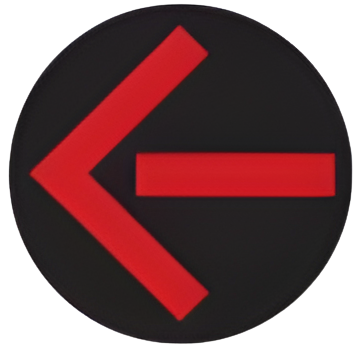
Come to a complete stop before the stop line, yield to all pedestrians and oncoming traffic, then proceed in the direction of the arrow when safe.
What does a red arrow signal mean?
A) Do not make the movement shown by the arrow until the green light appears.
B) After stopping, you may turn right if there is not a NO TURN ON RED sign and the way is clear.
C) You may turn left from a one-way street onto a one-way street that has traffic moving to the left.
D) All of the above.
11.
Bicyclists under the age of __ are required to wear helmets that meet federal safety standards.
A) 12
B) 16
C) 18
D) 21
12.
Which of the following is a serious violation of the License Law:
A) Failing to make crash reports.
B) Allowing an unlicensed person to use your car.
C) Having more than one U.S. driver license.
D) All of the above.
13.
Who must wear safety belts in Florida?
A) Only passengers under the age of 16.
B) The driver and all passengers, regardless of their age.
C) The driver and all passengers under the age of 21.
D) The driver and front seat passengers, and all passengers under 18 years old.
14.
The roadway ahead is narrowing or a lane is ending. Merge smoothly into the continuing lane.
This sign warns that:
A) traffic must merge left.
B) the bridge ahead is wide enough for only one vehicle at a time.
C) traffic must merge right.
15.
Warns of an extremely sharp 180-degree curve ahead. Decelerate significantly before entering the turn.
This sign means:
A) Hairpin corner ahead.
B) Warning: U-turn ahead.
C) Sharp right turn ahead.
16.
Which of the following is a way to avoid road rage?
A) Shouting obscenities.
B) Not getting behind the wheel if you are tired.
C) Making eye contact with other drivers.
D) All of the above.
17.
If a law enforcement officer stops a vehicle and finds a front seat passenger 17 years of age or younger not wearing a seat belt, a seat belt violation will be charged to:
A) the driver.
B) the passenger.
C) the officer.
D) both the driver and the passenger.
18.
A three-point turn is used:
A) to turn your car around in a small space.
B) on a curve, when a sign indicates that making a U-turn is prohibited.
C) to indicate your intention to turn.
D) whenever possible, to change lane.
19.
A traffic sign with a red circle around and a slash over a symbol means:
A) the maneuver shown by the symbol is not allowed.
B) Do not drive faster than the posted speed limit.
C) the maneuver shown on the sign should be executed with extreme caution.
20.
Which of the following is NOT a serious violation of the License Law:
A) Changing your license in any way.
B) Making a fraudulent application for a driver license.
C) Unlawful use of your license.
D) None of the other answers are correct.
21.
Low-beam headlights can show objects ___ feet ahead.
A) 30
B) 450
C) 50
D) 150
22.
On an upgrade, passing a truck is often:
A) easier.
B) impossible.
C) more difficult.
D) illegal.
23.
You must complete a department approved driver improvement course if you were convicted of your ____ traffic offense that caused a crash within __ months.
A) second; 12
B) fourth; 48
C) third; 36
D) second; 24
24.
Who must wear safety belts?
A) The driver and front passengers under the age of 18.
B) Only the driver.
C) The driver and all passengers under the age of 18.
D) The driver and front passengers under the age of 16.
25.
When passing a truck, you should:
A) take your time.
B) complete your pass as quickly as possible.
C) cut in between the commercial vehicle and the curb to the right.
D) avoid blinking your headlights to let the truck driver know you are passing.
26.
When are lane signals used?
A) To show that a toll booth is open or closed.
B) To show which lanes are opened or closed.
C) When the direction of the flow of traffic changes during the day.
D) All of the above.
27.
While walking along a highway without a sidewalk, you should:
A) walk on the side of the road with less traffic.
B) It does not matter.
C) always walk on the shoulder on the left side, facing traffic.
D) walk in the same direction as traffic.
28.
If, while driving, you hit a vehicle with no one in it, you must:
A) sketch the scene.
B) tell the owner.
C) not move your vehicle.
D) leave immediately.
29.
Road rage can:
A) be caused by sudden acceleration.
B) be an indirect consequence of aggressive driving.
C) result in crashes or other incidents.
D) be avoided by cutting off other drivers.
30.
A driver of a car being passed:
A) should slow down immediately.
B) must not increase speed until the pass is complete.
C) must move to the left side of his/her lane to help the other driver pass safely.
D) must increase speed before the pass is complete.
31.
When you are driving on a multi-lane road, if another vehicle moves into your lane right in front of you, cutting you off, you should:
A) Brake only if necessary to avoid a crash, and follow the other vehicle closely for a while.
B) Honk your horn and brake firmly, to quickly drop back from the other vehicle.
C) Stay calm. Slow down if necessary to avoid a crash, and gently drop back to a safe following distance.
D) brake sharply.
32.
On a two way street, a stopped school bus is picking up children. Drivers must:
A) overtake and pass the bus before the bus’ stop arm is withdrawn.
B) pass the bus.
C) stop and remain stopped until all children are clear of the roadway and the bus’ stop arm is withdrawn.
D) yield to vehicles coming in the opposite direction.
33.
Crossing guards are the ____ to enter and ____ to exit a crosswalk to indicate to drivers that pedestrians are about to cross.
A) first; first
B) first; last
C) last; first
D) last; last
34.
When parking on a public road, drivers should:
A) move as far away from traffic as possible.
B) always park on the left side of the roadway.
C) All of the above.
35.
You are driving along an expressway with a speed limit of 70 MPH. What is the minimum speed limit, unless otherwise posted?
A) 50 MPH
B) There is no minimum speed.
C) 55 MPH
D) 65 MPH
36.
When you are driving on a paved highway that does not have a paved shoulder, if your vehicle breaks down you should:
A) try to reach the next available paved shoulder.
B) try not to stop.
C) try to get your vehicle completely out of traffic lanes and off the paved surface of the highway before stopping.
D) come to a complete stop and use your emergency flashers.
37.
Most signs used in street work areas are:
A) round.
B) diamond shaped.
C) rectangle shaped.
38.
When driving in a roundabout, drivers should:
A) change lane to indicate their intention to exit.
B) travel in a clockwise direction.
C) use the left turn signal to indicate their intention to exit.
D) use the right turn signal to indicate their intention to exit.
39.
What should you do as you prepare to turn right at an intersection?
A) Honk your horn.
B) Yield to bicyclists coming from the opposite direction.
C) Signal your turn, check for bicyclists, and do not turn directly in front of a bicyclist.
40.
When infractions occur within a school zone or construction zone, the resulting fines are:
A) reduced by half.
B) the same.
C) doubled.
D) tripled.
41.
Which signs have black letters on a yellow or orange background?
A) Warning signs (diamond)
B) Regulatory signs (vertical rectangle)
C) Railroad advance warning signs (round)
42.
Expressways are:
A) single-lane roads with traffic lights, stop signs and railroad crossings.
B) single-lane roads with no traffic lights and stop signs.
C) multiple-lane roads with limited traffic.
D) multiple-lane roads with no traffic lights, stop signs or railroad crossings.
43.
A parent of a child younger than 6 years of age may NOT:
A) secure the child in the rear seat.
B) drive when it's foggy.
C) leave the child unattended in a motor vehicle for more than 15 minutes.
D) drive faster than 25 MPH under any circumstances.
44.
At 50 MPH, the impact and braking distance are __ times greater than at 25 MPH.
A) 16
B) 6
C) 4
D) 2
45.
At night, glare from oncoming cars can:
A) improve your vision.
B) reduce your vision.
C) replace hand gestures.
D) signal their intention to turn.
46.
Pedestrians approaching a railroad-highway grade crossing must stop when:
A) a human flagger is warning of an approaching train.
B) an approaching train is clearly visible.
C) warning devices are flashing.
D) All of the above.
47.
High beam headlights are most effective for speeds faster than:
A) 25 MPH
B) 90 MPH
C) 70 MPH
D) 50 MPH
48.
When entering an expressway, never stop in the acceleration lane unless:
A) you receive a very important text.
B) there are one or more vehicles behind you.
C) you need to make a U-turn.
D) traffic is too heavy for you to merge safely.
49.
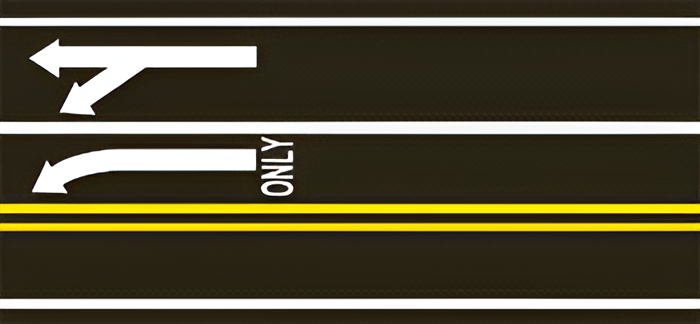
Designated mandatory turn lane marked with a solid white line. You must turn in the direction indicated by the pavement arrow.
If you are in the lane marked with a curved arrow and the word ONLY:
A) You must turn left.
B) You are the only driver in the lane who can turn left.
C) You are the only driver in the lane who MUST turn in the direction of the arrow.
D) You must turn right.
50.
What is an ideal situation for overtaking and passing another vehicle on the right?
A) Passing a vehicle on the right is never allowed.
B) When it's dark, you had more than a few drinks, you are driving 40 MPH above the speed limit and your radio is playing hard rock music.
C) When the vehicle you are passing is making a right turn.
D) When the vehicle you are passing is making or about to make a left turn.
ANSWER KEY Check answers after completing the test.
1 B
2 A
3 A
4 C
5 A
6 D
7 B
8 D
9 C
10 D
11 B
12 D
13 D
14 A
15 A
16 B
17 A
18 A
19 A
20 D
21 D
22 A
23 C
24 C
25 B
26 D
27 C
28 B
29 C
30 B
31 C
32 C
33 B
34 A
35 A
36 C
37 B
38 D
39 C
40 C
41 A
42 D
43 C
44 C
45 B
46 D
47 A
48 D
49 A
50 D