Any driver under 21 years of age who is stopped by law enforcement and has a blood alcohol level of __ or higher will automatically have their driving privilege suspended.
A)0.2
B)0.02
C)0.5
D)0.05
2.
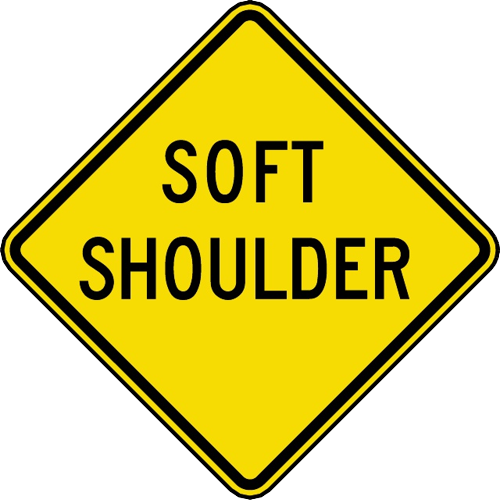
What does this ‘Soft Shoulder’ sign indicate?
A)The dirt on the side of the road is soft.
B)Drivers should leave the pavement immediately.
C)Drive on the shoulder if you have soft tyres.
D)None of the above.
3.
When entering an interstate highway, you must:
A)turn right and stop.
B)slow down immediately after leaving the acceleration lane.
C)enter the freeway at a sharp angle if possible.
D)adjust to freeway speed in the acceleration lane, then signal and move carefully into the freeway lane.
4.
When parking on a public road, drivers should NOT:
A)set the parking brake and shift to reverse with a manual transmission.
B)always check traffic behind them before getting out of the car.
C)make sure their vehicle cannot move.
D)leave the keys in their vehicle before leaving it.
5.
When they see a pedestrian with a white cane crossing the street ahead of them, drivers must:
A)Look for a trained guide dog.
B)Call the police.
C)Get out of the car and help that person.
D)Come to a complete stop.
6.
Two drivers reach an uncontrolled intersection at the same time. Who has the right of way?
A)The driver on the left.
B)No one.
C)The driver on the right.
7.
When leaving an interstate highway, you must:
A)make a last minute turn if possible.
B)slow down before turning into the deceleration lane, and check the posted safe speed for the ramp.
C)increase your speed after turning into the deceleration lane.
D)slow down as soon as you are off the expressway.
8.
Crossbucks are:
A)used to indicate railroad crossings.
B)generally used for regulatory signs.
C)used to indicate nearby cafes.
D)pentagonal signs used to indicate school crossings.
9.
Sharrows:
A)indicate to bicyclists where to ride.
B)alert drivers that bicyclists may be on the road.
C)discourage bicycling in the wrong direction.
D)All of the above.
10.
In Florida, vehicle license plates and registrations must be renewed each year or biennially:
A)on or before the birthday of the first owner listed on the registration form.
B)on the day the license plate was obtained.
C)on or before the day the vehicle was purchased.
D)on the first day of the year.
11.
The picture shows:
A)a sign alerting drivers that bicycles may be ahead.
B)a bike lane.
C)a pavement marking telling bicyclists that they must go straight.
D)a motorcyle lane.
12.
If you are found guilty of racing on the highway, your license must be:
A)revoked.
B)cancelled.
C)terminated.
D)suspended.
13.
How can you prevent fatigue on a long trip?
A)Plan to drive long trips with a companion.
B)Get enough sleep.
C)All of the above.
14.
On a two-lane road, you should:
A)yield to trucks.
B)overtake and pass other vehicles only when a solid yellow line is painted on your side of the center line.
C)overtake and pass another vehicle only to the left of the vehicle.
D)keep a minimum following distance of 30 seconds.
15.
At a railroad crossing, if your car stalls on the tracks you should:
A)keep your seat belt fastened and use your horn if you see a train approaching.
B)use four-way emergency flashers and call the emergency number.
C)immediately get yourself and the other passengers out and away from the car.
D)call the police.
16.
You are driving a vehicle with automatic transmission. When you park on a hill you should:
A)shift the transmission into park before setting the parking brake.
B)turn your wheels so that if your car starts to move, it will roll away from the curb.
C)set the parking brake before you place automatic gear shift in park.
D)None of the above.
17.
Tailgating trucks is particularly dangerous because:
A)unlike passenger cars, trucks have blind spots directly behind them.
B)trucks go slower than cars.
C)truck need to swing wide to the left in order to safely negotiate a right turn.
D)most trucks have several rearview mirrors.
18.
What should you do when the gas pedal is jammed?
A)Get all passengers out on the side away from traffic.
B)Any of the above.
C)Keep your eyes on the road.
D)Brake sharply.
19.
Parking lights must __________ on any vehicle parked on a roadway outside of cities and towns.
A)be used at night
B)be avoided
C)always be turned off
D)always be used
20.
In case of skidding, drivers should NOT:
A)take their foot off the gas pedal.
B)pump the brakes gently if they are about to hit something.
C)tap the gas pedal with their foot.
21.
Drivers convicted of running a red light:
A)need to stop at green lights for 90 days.
B)are required to complete a basic driver improvement course.
C)will automatically have their driving privilege suspended for 6 months.
D)need to spend 15 days in jail.
22.
Controlled substances do NOT include:
A)Depressants
B)Prescription drugs
C)Alcohol
D)Stimulants
23.
The yield sign means:
A)Go. The light will soon be red.
B)If the way is clear, you may move forward slowly without stopping.
C)Stop if you can.
24.
If another vehicle is passing you on the left-hand side of the road, you should:
A)honk your horn.
B)increase your speed.
C)move to the rightmost lane.
D)allow the other vehicle to pass safely.
25.
Under the The No-Fault Law, you must maintain insurance coverage:
A)for 5 years.
B)until the insurance coverage expires.
C)throughout the vehicle registration period.
D)for 10 years.
26.
What does this ‘DIP’ sign indicate?
A)Downgrade ahead. Drivers should go slowly.
B)Police DIPartment ahead.
C)There is a Drive-In Parking ahead.
D)There is a low place in the road.
27.
The inside temperature of a vehicle can rise almost __ degrees within the first __ minutes with no ventilation.
A)10; 20
B)5; 30
C)20; 10
D)20; 30
28.
When driving at night with no other vehicles ahead, a driver should use:
A)high beam lights.
B)low-beam lights.
C)parking lights.
29.
This sign warns drivers of:
A)a reduction of lanes.
B)a dip in the road. Drivers should be ready to stop if the dip is filled with water.
C)a bridge ahead, wide enough to accommodate two lanes of traffic, but with very little clearance.
30.
Aggressive driving includes:
A)quick lane changes without a signal.
B)chasing or challenging other drivers.
C)All of the above.
31.
At an open intersection, drivers have the right-of-way if:
A)they are driving faster than the other vehicles.
B)they are already in the intersection.
C)they enter a paved road from an unpaved road.
D)All of the above.
32.
What is the maximum speed limit in a residential area if there is no speed limit sign?
A)20 MPH.
B)55 MPH
C)35 MPH
D)30 MPH
33.
Drivers often fail to see a motorcycle headed toward them. Why?
A)It is difficult to judge a motorcycle's speed.
B)Motorcycles are hard to see.
C)All of the above.
34.
If an officer thinks that you are under the influence of alcohol or drugs:
A)your license will automatically be suspended for 1 year.
B)you have the right to you refuse to take any test.
C)he may send you to jail.
D)you will be asked to take a blood test, a urine test, or a breath test.
35.
What does the flashing signal in the picture indicate?
A)The same thing as a stop sign.
B)Pedestrians should finish crossing the street if started.
C)Pedestrians should start crossing the street.
36.
Vehicles must have at least one rearview mirror which gives a view of the highway at least ___ feet to the rear.
A)500
B)50
C)1000
D)200
37.
Which of the following is NOT true about ABS?
A)It improves the vehicle stability.
B)It helps increase your stopping distance.
C)It improves the steering ability.
38.
Which of the following is true about double solid yellow lines?
A)Drivers may travel in the same direction on both sides of this line.
B)Vehicles may cross these lines temporarily when passing is safe.
C)Drivers may not cross these lines unless turning left when it’s safe to do so.
D)All of the above.
39.
Yellow traffic signs:
A)guide drivers.
B)when combined with an octagonal shape, tell drivers they must come to a complete stop at the marked stop line.
C)warn drivers.
40.
Parking is not allowed within __ feet of the entrance to an ambulance station
A)35
B)20
C)75
D)50
41.
Lane signals are used:
A)to show when pedestrians may begin crossing the street.
B)to alert drivers to a warning sign.
C)to show which lanes are opened or closed.
D)None of the above.
42.
This sign means:
A)No traffic signal ahead
B)Traffic signal ahead
C)Open intersection ahead
43.
The seat belt law applies to passenger cars manufactured beginning with the ____ model year.
A)1968
B)2008
C)1978
D)1986
44.
What should you do in case of a brake failure?
A)Pull off the road into an open space, if available.
B)Apply the parking brake slowly.
C)All of the above.
45.
This road sign is:
A)a speed reduction sign.
B)a warning sign.
C)a regulatory sign.
46.
Controlled substances include:
A)marijuana
B)prescription drugs
C)alcoholic beverages
D)All of the above.
47.
Can you pass a school bus when it displays a stopped signal?
A)Yes, but you must slow down and prepare to stop.
B)Yes, but you cannot exceed 30 MPH.
C)No, you must come to a complete stop.
D)Yes, but you need to signal your intention to pass.
48.
Vertical rectangles tell drivers:
A)the law.
B)what is not allowed.
C)the direction they should travel.
49.
Left lanes on some interstate roads are reserved for:
A)pedestrians.
B)car pool vehicles.
C)large trucks.
D)vans.
50.
More than one vehicle is approaching a four-way stop sign. Who has the right of way?
A)The first driver to reach the intersection and stop.
B)The driver on the left.
C)The last driver to reach the intersection.
ANSWER KEYCheck answers after completing the test.