B)come to a complete stop and check road conditions.
C)expect the unexpected.
2.
The driver of an emergency vehicle that uses lights and a siren can legally:
A)pass red lights.
B)exceed the speed limit
C)All of the above.
3.
This road sign means:
A)Low clearance
B)Do not enter
C)A steep grade is ahead
4.
If no reduced speed limit signs are clearly posted within a work zone, you should:
A)drive faster than the posted speed limit.
B)obey the normal posted speed limit.
C)drive slower than the posted speed limit.
5.
The picture shows a _________ sign.
A)no U-turn
B)no left turn
C)sharp turn
6.
When dust is blowing across the roadway making it difficult to see other vehicles, you should drive slower and turn on your:
A)headlights.
B)parking lights.
C)emergency flashers.
7.
When approaching a construction site, drivers should:
A)accelerate to get out of the way quickly.
B)slow down and adjust their driving manner.
C)honk their horn to alert construction workers of their presence.
8.
This road sign means:
A)Slow down, slippery when wet
B)Detour ahead
C)Road curves ahead
9.
Blocking an intersection during rush hour traffic is not permitted:
A)under any circumstances.
B)unless you entered the intersection on a green light.
C)unless you have the right-of-way.
10.
Where must a pedestrian walk when there are no sidewalks?
A)On the side of the road, in the same direction of traffic.
B)In the middle of the road, facing oncoming traffic.
C)On the side of the road, facing the traffic.
11.
Where are yield signs usually placed?
A)At intersections, if there is no marked stop line.
B)Where auxiliary roads lead into major roads.
C)Where major roads lead into auxiliary roads.
12.
The yield sign means:
A)Go. The light will soon be red.
B)If the way is clear, you may move forward slowly without stopping.
C)Stop if you can.
13.
Motorcycles are harder to see than cars, therefore you should:
A)slow down when driving.
B)make constant visual checks.
C)share your lane with motorcycles.
14.
Unlike passenger cars, trucks have blind spots:
A)on the right.
B)directly behind them.
C)on the front.
15.
You reach an intersection that is not controlled at the same time as a driver on your right, and both of you prepare to go straight. Who has the right-of-way?
A)You.
B)No one.
C)The other driver.
16.
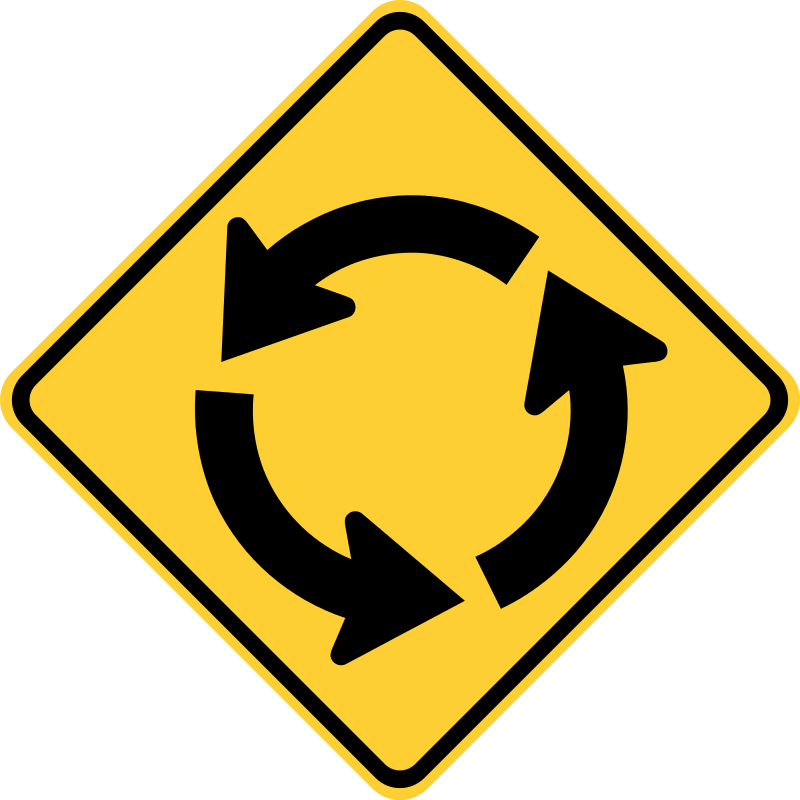
This road sign:
A)warns drivers of a sharp turn left. Drivers should slow their speed and keep to the left.
B)provides an advance notice of a roundabout.
C)warns drivers that U-turns are not permitted.
D)is a no-right-turns sign.
17.
To make a right turn, drivers should:
A)turn from the right lane.
B)turn right from any lane.
C)swing to the left before turning right.
18.
When driving on the freeway behind large trucks, you should:
A)move to the right of the truck and pass it quickly.
B)drive closer behind the truck than for a passenger vehicle.
C)increase your following distance.
19.
Warning signs normally are:
A)rectangles.
B)triangles.
C)diamond-shaped.
20.
This sign means:
A)Reversible lane ahead.
B)The divided highway ends ahead.
C)Drivers are coming to a point where another traffic lane joins the one they are on.
21.
This sign means:
A)If you are driving at 40 MPH or less you must stay in the right-hand lane
B)Curve ahead, drive at 40 MPH ot more around the curve ahead
C)Curve ahead, the recommended speed is 40 MPH or less
22.
When you see this sign you should:
A)increase your speed and try to pass other vehicles.
B)slow your speed and be prepared to stop.
C)slow your speed and do not pass other vehicles.
23.
This sign warns drivers of:
A)low clearance.
B)a narrow bridge ahead.
C)a low place in the road.
24.
A person walking with a white cane or guide dog is likely to be:
A)a deaf person.
B)a traffic enforcement officer.
C)a blind person.
25.
A solid yellow line next to a broken yellow line means that vehicles:
A)next to the solid line may pass.
B)in both directions may pass.
C)next to the broken line may pass.
ANSWER KEYCheck answers after completing the test.