DriveQuiz drivequiz.com

CA DMV PERMİT PRACTİCE TEST 15

California
Duration: 33 min
|
Questions: 36
Student Name:
Date:
Correct:      Incorrect:      Score:      
1.
You want to make a right turn at the corner. A pedestrian with a guide dog is at the corner ready to cross the street in front of you. Before making your right turn, you should:
A) wait until the person crosses the street.
B) turn off your engine until the person crosses the street.
C) tell the pedestrian when to cross the street.
2.
When a ‘Road Closed’ sign is displayed, drivers must:
A) make a U-turn.
B) look for a detour or another route.
C) come to a complete stop and wait for the lights to turn green.
3.
The median divider ends ahead, and you are returning to a two-way, two-lane undivided roadway. Watch for oncoming traffic on your left.
What does this sign indicate?
A) The highway ahead is divided into two one-way roadways.
B) Winding road ahead. Drive with caution.
C) Drivers will soon be on a roadway with two-way traffic.
4.
Driving along the right-rear side of another vehicle is:
A) dangerous because you’re probably in one of the driver’s blind spots.
B) a good way to maintain a space cushion on your left side.
C) a good defensive driving technique to avoid drivers’ blind spots.
5.
Flash your brake lights or turn on your emergency flashers if you:
A) are backing out of a parking space.
B) are temporarily parked in a traffic lane to make a delivery.
C) need to warn other drivers of a collision ahead.
6.
The bridge ahead has narrower lanes or shoulders than the preceding road. Use caution when meeting oncoming vehicles.
This sign warns drivers of:
A) a reduction of lanes.
B) a dip in the road. Drivers should be ready to stop if the dip is filled with water.
C) a bridge ahead, wide enough to accommodate two lanes of traffic, but with very little clearance.
7.
You are on a two-way road and the vehicle ahead of you is turning left into a driveway. You may legally pass the vehicle on the right:
A) if there’s enough road between the curb and the vehicle.
B) even if you must cross a solid white line painted on the road.
C) even if you must drive in a bicycle lane to do so.
8.
If you are continually being passed on the right, you should:
A) move into the right lane and allow other vehicles to pass you on the left.
B) move into the left lane and allow other vehicles to pass you on the right.
C) increase your speed immediately.
9.
Slow down and give right-of-way to all oncoming vehicles, cyclists, and pedestrians. Stop completely if necessary before entering the intersection or merging.
The yield sign means:
A) Drive with caution in wet weather.
B) You must come to a complete stop.
C) Slow down and give vehicles crossing your path the right-of-way.
10.
You should allow a four-second or more cushion when:
A) The driver behind you wants to pass.
B) Being crowded by a tailgater.
C) All of the above.
11.
Which of these statements is true about changing lanes:
A) Look over your right shoulder for a right lane change and your left shoulder for a left lane change.
B) Vehicles with two outside mirrors do not have blinds.
C) You only need to turn and look over your right shoulder for lane changes to the right or left.
12.
Driving slower than the traffic flow tends to:
A) make a collision less likely to happen.
B) make a collision more likely to happen.
C) not change the chances of having a collision.
13.
You should increase the distance between your vehicle and the vehicle ahead when you:
A) are being tailgated by another driver.
B) drive slower than the posted speed limit.
C) follow a small passenger vehicle.
14.
To turn left from a one-way street with multiple lanes onto a two-way street, start the turn in:
A) any lane.
B) the lane closest to the right curb.
C) the far left lane.
15.
Two sets of solid double yellow lines spaced 2 feet or more apart:
A) may be used to begin or end left-hand turns.
B) mark traffic lanes going in the same direction.
C) are considered a barrier.
16.
Which of the following is a defensive driving skill/technique?
A) Maintain the correct speed.
B) Do not drive if you are very weary.
C) All of the above.
17.
When approaching a crosswalk where a blind pedestrian is waiting to cross, you must stop:
A) at the crosswalk and wait for the pedestrian to cross the street.
B) more than five feet from the crosswalk so the pedestrian will not be distracted by the sound of the engine.
C) at the crosswalk and then tell the pedestrian when to cross the street.
18.
If you are towing another vehicle or trailer on a freeway with four lanes in your direction, you may travel in:
A) the far right lane only.
B) any of the traffic lanes in your direction.
C) either of the two right lanes.
19.
When is it legal to use a cellphone without a hands-free device while driving?
A) Never.
B) When making a call while stopped at a red light.
C) When making a call for emergency assistance.
20.
Which of these is a legal U-turn:
A) on a divided highway where there is a paved opening for a turn.
B) over two sets of double yellow lines in the roadway.
C) 150 feet away from a hill or curve.
21.
Treat the flashing red signal exactly like a STOP sign: come to a complete stop, yield to cross traffic and pedestrians, then proceed when safe.
What does a flashing red light mean?
A) NO TURN ON RED.
B) The same thing as a stop sign.
C) Drivers may move forward with caution.
22.
Unless otherwise posted, school zone speed limits are ___ or under.
A) 25 MPH
B) 35 MPH
C) 15 MPH
23.
A flashing yellow traffic signal at an intersection means:
A) Slow down and be alert at the upcoming intersection.
B) Stop. Yield to all cross traffic before crossing the intersection.
C) The same thing as a stop sign.
24.
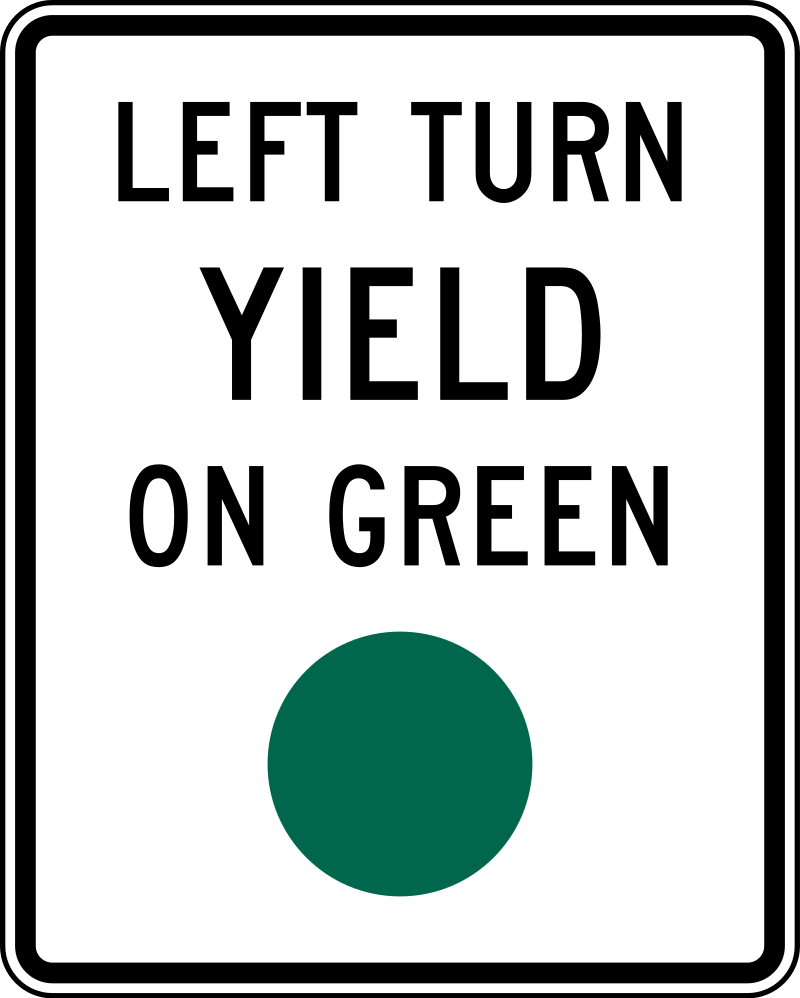
When turning left at a circular green light, you must yield right-of-way to oncoming traffic and pedestrians before completing your turn.
This white sign means drivers:
A) must wait for the solid green light before they turn left.
B) may turn left only on a green arrow.
C) may turn left on a green light when it is safe to do so.
25.
You should use your brakes to slow your vehicle on a sharp curve:
A) as you drive through a curve.
B) right after entering the curve.
C) before you enter the curve.
26.
Reflective orange triangle displayed on vehicles traveling at 25 MPH or slower (such as farm tractors or construction machinery). Approach with caution and pass safely.
This sign indicates:
A) A slow-moving vehicle
B) A no-passing zone
C) Yield
27.
Your driving lane is next to a bicycle lane. You want to make a right turn at the upcoming intersection. You:
A) may not enter the bicycle lane to make your turn.
B) should only merge into the bicycle lane if you stop before turning.
C) must merge into the bicycle lane before making your turn.
28.
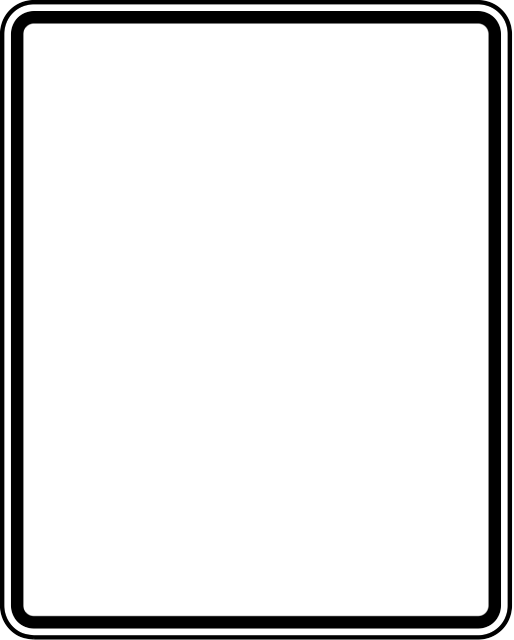
Standard rectangular shape used for general regulatory instructions and speed limits.
Vertical rectangles tell drivers:
A) the law.
B) what is not allowed.
C) the direction they should travel.
29.
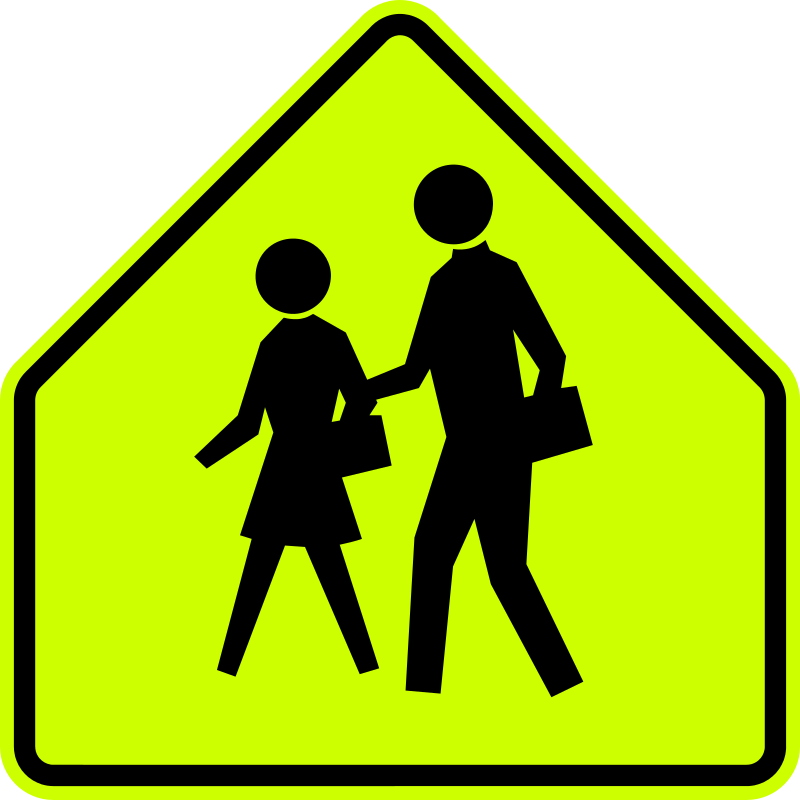
Five-sided pentagon sign indicating an upcoming school area. Watch for children crossing, school buses, and observe posted reduced school speed limits.
This sign means:
A) Business area nearby. Watch for business people.
B) There is a work zone ahead. Watch for workers.
C) The driver is near a school and should watch for children.
30.
If you are involved in a collision, you must exchange with the person(s) involved your driver license information and:
A) proof of insurance, vehicle registration, and current address.
B) proof of insurance and current address only.
C) vehicle registration only.
31.
Indicates the maximum bridge or underpass vertical clearance. Vehicles taller than the posted height must not proceed.
This sign means:
A) Narrow bridge ahead. Slow down and drive with caution.
B) Do not to enter if your vehicle is taller than the height listed on the sign.
C) No passing zone ahead.
32.
Orange-colored road signs warn you of:
A) a school zone ahead.
B) road workers or road equipment ahead.
C) a traffic signal ahead.
33.
The ‘Slower Traffic Keep Right’ sign is used:
A) at most intersections.
B) on multiple lane highways.
C) in school zones.
34.
To turn left from a multilane one-way street onto a one-way street, you should start your turn from:
A) Any lane, as long as it is safe.
B) The lane in the center of the road.
C) The lane closest to the left curb
35.
Indicates that traffic is permitted to pass on either the left or the right side of an island, median, or obstruction.
This sign tells drivers that:
A) left and right turns are not allowed.
B) a divided highway is ahead.
C) they cannot go straight ahead.
36.
The road curves gradually to the right ahead. Reduce speed before entering the curve.
This sign means:
A) The road will curve to the right.
B) Left turns are not allowed at the intersection.
C) Do not turn right.
ANSWER KEY Check answers after completing the test.
1 A
2 B
3 C
4 A
5 C
6 C
7 A
8 A
9 C
10 C
11 A
12 B
13 A
14 C
15 C
16 C
17 A
18 C
19 C
20 A
21 B
22 A
23 A
24 C
25 C
26 A
27 C
28 A
29 C
30 A
31 B
32 B
33 B
34 C
35 C
36 A