DriveQuiz drivequiz.com

CA DMV PERMİT PRACTİCE TEST 13

California
Duration: 33 min
|
Questions: 36
Student Name:
Date:
Correct:      Incorrect:      Score:      
1.
Never make a U-turn from:
A) the lane you’re in.
B) the right lane.
C) the left part of the lane nearest to the centerline of the roadway.
2.
An edge line that angles toward the center of the road indicates that:
A) the road is narrower ahead.
B) there’s a narrow bridge ahead.
C) you must turn right.
3.
When you make a left turn from a one-way road into a two-way road, you must:
A) enter the two-way road to the left of its center line.
B) make a U-turn into the two-way road.
C) enter the two-way road to the right of its center line.
4.
The roadway becomes particularly slippery during wet or rainy conditions. Reduce your speed, increase following distance, and avoid abrupt braking or steering.
This yellow sign means:
A) there is a sharp curve in the road ahead.
B) the road ahead has many curves.
C) the road ahead may be slippery.
5.
The maximum speed limit for ideal driving conditions is:
A) the posted speed.
B) the speed of other vehicles traveling in your direction.
C) the speed of oncoming vehicles.
6.
A law enforcement officer notices that one of your passengers is not wearing a seat belt and writes a citation. Which of the following is true?
A) Your passenger will receive a citation, regardless of his or her age.
B) Both you and your passenger will receive a citation.
C) You can receive the citation if the passenger is younger than 16.
7.
Another road crosses the highway ahead. Look left and right for crossing or entering vehicles.
This yellow sign means:
A) another road crosses yours ahead.
B) there is a T-intersection ahead.
C) ambulance zone ahead.
8.
Large trucks are most likely to lose speed and cause a hazard:
A) going up long or steep hills.
B) going down long gradual hills.
C) on long, gradual curves.
9.
Where must a pedestrian walk when there are no sidewalks?
A) On the side of the road, in the same direction of traffic.
B) In the middle of the road, facing oncoming traffic.
C) On the side of the road, facing the traffic.
10.
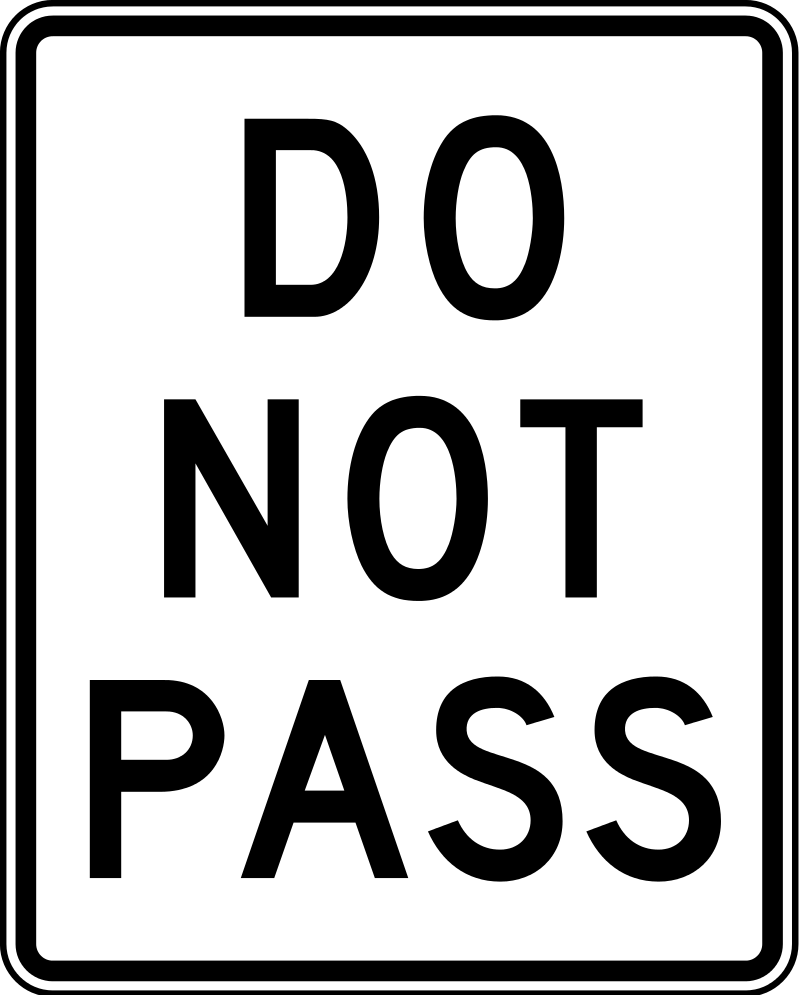
Overtaking and passing other vehicles traveling in your direction is strictly prohibited in this zone due to limited visibility or hazards.
This white sign means don’t pass:
A) unless it is safe to do so.
B) other vehicles for any reason.
C) until after you pass the sign.
11.
You just sold your vehicle. You must notify the DMV within ___ days.
A) 5
B) 15
C) 10
12.
What does it mean If an oncoming driver flashes headlights at you during a period of low visibility?
A) Your headlights are too bright. You should turn them off.
B) Your vehicle was difficult to see. You should turn on your headlights.
C) Your headlights are too bright. You should use parking lights instead.
13.
You are driving on a one-way street. You may turn left onto another one-way street:
A) if traffic on the street is moving to the right.
B) only if a sign permits the turn.
C) if traffic on the street is moving to the left.
14.
It is very important to check behind you before you:
A) Reduce your speed.
B) Change lanes.
C) All of the above.
15.
You must carefully watch for bicycles in traffic lanes because they:
A) usually have the right-of-way.
B) must ride facing oncoming traffic.
C) could be hidden in your blind spots.
16.
Object marker used to mark obstacles or bridge abutments near the edge of the road to alert drivers at night.
When they see a yellow X signal, drivers should:
A) come to a complete stop at the marked stop line.
B) turn off the ignition.
C) prepare to leave the lane safely.
17.
Your car stalls on the tracks at a railroad crossing, and a collision with a train is imminent. After getting yourself and your passengers out of the car, you should:
A) run toward the train but stay off the tracks.
B) signal the train to stop.
C) cross the tracks.
18.
What do warning signs mean?
A) Danger ahead.
B) Drivers are approaching a location where there is a special rule.
C) All of the above.
19.
Which of these is true about other drivers?
A) Drivers always obey traffic signs and signals.
B) Drivers using turn signals always turn in the direction indicated.
C) Never assume other drivers will give you the right-of-way.
20.
If you are arrested for driving with a blood alcohol concentration (BAC) above the legal limit:
A) you will be sentenced to up to six months in jail.
B) DMV can take an administrative action against your driving privilege.
C) you'll be required to take an alcohol-test every 3 months for up to 2 years.
21.
The road curves gradually to the right ahead. Reduce speed before entering the curve.
When they see this sign, drivers should:
A) increase their speed and keep well to the right.
B) slow down and keep well to the right.
C) slow down and keep well to the left.
22.
Drivers can not pass a vehicle on the left if:
A) they approach the top of a hill on a two-way road and can not see over it.
B) they can not safely return to the right lane before they reach a solid yellow center line for the right lane.
C) All of the above.
23.
Which of these statements is true about driving and taking medications:
A) Medications are safe to take at any time if prescribed by a doctor.
B) Most cold medications can make a person drowsy.
C) Over-the-counter medications cannot impair driving ability if taken in the recommended dosages.
24.
Always stop before you cross railroad tracks when:
A) you are not wearing safety belts.
B) you are following a bicyclist or motorcyclist across railroad tracks.
C) you don't have room on the other side to completely cross the tracks.
25.
Based on the DMV handbook, you should never park your vehicle within __ feet of a railroad track.
A) 7 ½
B) 15
C) 20
26.
Warns drivers that two separate lanes moving in the same direction are merging into one. Drivers in the right lane must adjust speed and merge smoothly with existing traffic.
This yellow sign means:
A) merging traffic ahead.
B) lane ends ahead.
C) one-lane road ahead.
27.
Driver arm extended downward out the left window with palm facing rearward signals an intention to slow down or stop completely.
This signal means:
A) Stop
B) Move to the left
C) Slow down
D) Proceed
28.
Which of the following is NOT true? When driving near pedestrians:
A) If a pedestrian makes eye contact with you, he or she is inviting you to cross the intersection.
B) Always stop for any pedestrian crossing at corners.
C) Do not drive on a sidewalk.
29.
__________ are blue with white letters and symbols.
A) Warning signs
B) Service signs
C) Destination signs (guide signs)
30.
Before getting out of your parked vehicle on the traffic side of the street, you should:
A) look for passing vehicles, bicyclists, and motorcyclists.
B) give arm signal that you are exiting your vehicle.
C) turn on your left turn signal.
31.
If you approach an intersection without a stop sign or signal, you:
A) should slow down and be ready to stop, if necessary.
B) should always stop before driving through the intersection.
C) must yield the right-of-way to all other vehicles.
32.
You wheels should be pointed straight ahead, unless you are:
A) parked on the side of a level roadway and there is no curb.
B) parked on a hill or sloping driveway.
C) waiting to make a left turn at a traffic light.
33.
Where should you stop your vehicle if there is no crosswalk or limit line?
A) Twenty feet before the corner.
B) Just pass the corner.
C) At the corner.
34.
What should you do when an aggressive driver confronts you?
A) Avoid eye contact with the aggressive driver.
B) Make eye contact.
C) Challenge the aggressive driver with increased speed.
35.
You want to park downhill on a two-way road and there is no curb. Which way do you turn your front wheels?
A) So they face straight ahead.
B) Left - towards the center of the road.
C) Right - towards the side of the road.
36.
You should adjust your rearview and side mirrors:
A) before you get into the vehicle.
B) before you start driving.
C) after you start driving.
ANSWER KEY Check answers after completing the test.
1 B
2 A
3 C
4 C
5 A
6 C
7 A
8 A
9 C
10 B
11 A
12 B
13 C
14 C
15 C
16 C
17 A
18 C
19 C
20 B
21 C
22 C
23 B
24 C
25 A
26 A
27 A
28 A
29 B
30 A
31 A
32 B
33 C
34 A
35 C
36 B