When looking ahead of your vehicle while driving, you should:
A)scan your surroundings.
B)look only at the vehicles ahead of you.
C)look straight ahead at all time.
2.
When parking uphill on a two-way street with no curb, your front wheels should be:
A)turned to the left (toward the street).
B)parallel with the pavement.
C)turned to the right (away from the street).
3.
This sign warns drivers that:
A)they must turn either to the right or left.
B)there is a double curve ahead.
C)there is a winding road ahead.
4.
On rainy, snowy or foggy days, you should turn on your windshield wipers and:
A)pump your brakes when driving on wet pavement.
B)come to a complete stop.
C)use your headlights so other drivers can see you.
5.
When a school bus flashes yellow lights:
A)you must follow the directions of the school crossing guard.
B)you must stop immediately.
C)the bus is preparing to stop to let children off the bus.
6.
Before you change lanes, you should:
A)glance over your shoulder into the lane you want to enter.
B)always turn your head and look over your right shoulder.
C)look into your outside mirror only.
7.
This sign warns of a ________ ahead.
A)hill
B)no passing zone
C)soft shoulder
8.
If you want to reduce the risk of skidding on slippery surfaces, it is advisable to:
A)Drive close to the vehicle ahead being ready for a sudden stop.
B)shift to a lower gear after starting down a steep hill.
C)slow down before entering curves and intersections.
9.
You must use your seat belt:
A)unless you are riding in a vehicle built before 1978.
B)and failure to do so will result in a traffic ticket.
C)unless you are riding in a limousine.
10.
This red and white sign means you should:
A)stop and check traffic both ways before proceeding.
B)keep a steady speed and check traffic both ways.
C)give the right-of-way to traffic on the road you wish to enter or cross.
11.
At intersections where two or more drivers stop at STOP signs at the same time and they are at right angles:
A)the driver on the left must yield to the driver on the right.
B)the driver who is late for work has the right-of-way.
C)the driver on the right must yield to the driver on the left.
12.
This sign means:
A)Bicycles should yield to vehicles ahead.
B)Warning: a bikeway crosses the roadway ahead.
C)The lane ahead is reserved for bicycles.
13.
Most signs used in street work areas are:
A)round.
B)diamond shaped.
C)rectangle shaped.
14.
A yellow arrow means:
A)Do not go in the direction of the arrow.
B)If you intend to turn in the direction of the arrow, be prepared to stop.
C)The same as a steady yellow light.
15.
There are two traffic lanes in your direction. You are driving in the left lane and many vehicles are passing you on the right, and the driver behind you wishes to drive faster. You should:
A)stay in your lane and maintain your current speed.
B)drive onto the left shoulder to let the other driver pass.
C)move over into the right lane when safe to do so.
16.
Directions given by traffic officers ___________ signs, signals or pavement markings.
A)take precedence over
B)are less important than
C)must obey
17.
Road signs that point out scenic areas and parks are:
A)brown and white.
B)black and orange.
C)green and white.
18.
When stopped at railroad tracks with multiple tracks, cross:
A)as soon as the train has passed your roadway.
B)only when other vehicles begin crossing.
C)only when you can see clearly in both directions.
19.
Following another vehicle too closely is known as:
A)speedgating.
B)closetailing.
C)tailgating.
20.
Generally speaking, you are in a large truck’s blind spot if you:
A)cannot see the truck driver in the truck’s side mirror.
B)drive close to the large truck’s left front wheel.
C)follow no closer than ten feet behind the large truck.
21.
Who has the right-of-way at an intersection with no crosswalks?
A)Pedestrians, but only with the green “WALK” signal.
B)Pedestrian always have the right-of-way.
C)Vehicles, but they should slow down and be careful.
22.
What should you do if your brakes fail?
A)Hook your shoe under the pedal and see if you can free it.
B)Turn on your cruise control.
C)Try pumping the brake pedal to increase pressure.
23.
When changing lanes on a freeway, you should:
A)signal for at least five seconds.
B)slow down before you start to change lanes.
C)assume there is enough space for your vehicle, if you signal first.
24.
Always driving slower than other traffic:
A)is a good defensive driving technique.
B)is always safer than driving faster than other traffic.
C)can block traffic.
25.
You reach an intersection that is not controlled at the same time as a driver on your right, and both of you prepare to go straight. Who has the right-of-way?
A)You.
B)No one.
C)The other driver.
26.
You must yield the right-of-way to an emergency vehicle by:
A)moving into the right lane and driving slowly until it has passed.
B)stopping immediately, even if you are in an intersection.
C)driving as near to the right edge of the road as possible and stopping.
27.
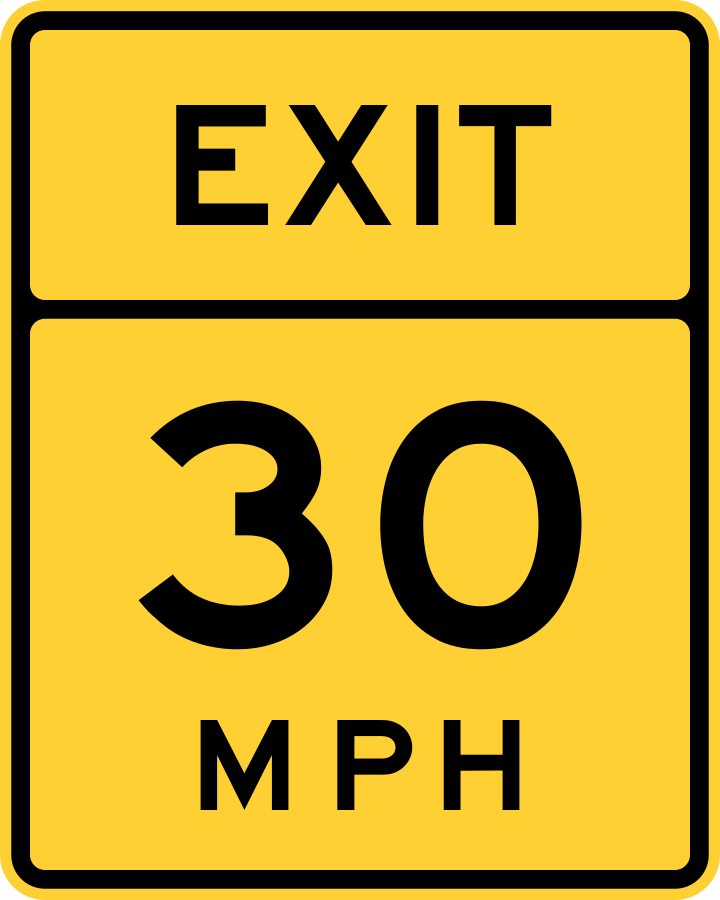
The sign in the picture:
A)shows the highest speed drivers can travel at the exit of the intersection.
B)is used to advise motorists of the appropriate ramp speed at the highway exit point.
C)indicates the minimum ramp speed at the highway exit point.
28.
You are being chased by a police vehicle with its lights and sirens activated. You ignore the warning to stop and speed away. During the chase, a person is seriously injured. You are subject to:
A)Attending an anger-management class.
B)Imprisonment in a state prison for up to seven years.
C)A fine not less than $5,000.
29.
This road sign warns drivers that:
A)they are coming to a point where another traffic lane joins the one they are on.
B)a divided highway is ahead.
C)the one-way street or roadway is about to change to two-way traffic.
30.
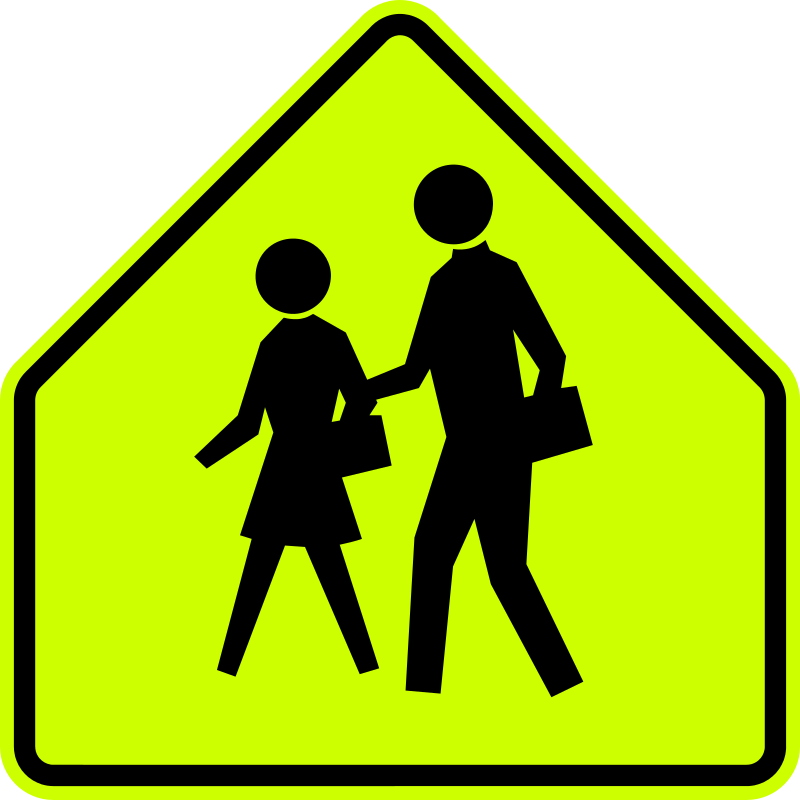
When you see this yellow sign, you should:
A)always stop at the crosswalk
B)stop at the crosswalk until a crossing guard signals you to go.
C)be prepared to stop if children are in the crosswalk.
31.
Two sets of solid double yellow lines spaced 2 feet or more apart:
A)may not be crossed for any reason.
B)separate traffic lanes on roads with two or more lanes in the same direction.
C)may only be crossed to make a U-turn when it is safe to do so.
32.
At a stop sign there is no stop line, you must stop:
A)before you enter the intersection.
B)before you enter the crosswalk.
C)after you enter the crosswalk.
33.
A crosshatched area adjacent to a designated disabled parking space means:
A)Stop no longer than the time posted to load or unload passengers.
B)Park for a limited time.
C)No parking area
34.
It is legal to drive with an alcoholic beverage container that has been opened if the container is:
A)in the glove compartment.
B)in the trunk.
C)under the front seat.
35.
At dawn or dusk, or in rain or snow, it can be hard to see and be seen. A good way to let other drivers know you are there is to turn:
A)up the instrumental panel lights.
B)on your parking light.
C)on your headlights.
36.
What should you do in case of a steering failure?
A)Pump your gas pedal a few times to increase the pressure.
B)Don't panic. Turn on your emergency lights to let other drivers know you are having car problems. Move toward the side of the road and bring the car to a gradual stop.
C)Leave the road immediately.
ANSWER KEYCheck answers after completing the test.