DriveQuiz drivequiz.com

CA DMV PERMİT PRACTİCE TEST 11

California
Duration: 33 min
|
Questions: 36
Student Name:
Date:
Correct:      Incorrect:      Score:      
1.
If you continually pass the other vehicles on a road with one lane in each direction, you will:
A) help prevent the chances of a crash occurring due to traffic congestion.
B) get to your destination much faster.
C) increase your chances of being involved in an accident.
2.
Vehicles entering or exiting a roundabout:
A) must slow down.
B) must yield to all traffic.
C) have the right-of-way.
3.
Which of the following is true about railroad crossings?
A) Trains cannot swerve out of the way. Never stop on the railroad tracks.
B) Flashing red lights indicate you must stop and wait.
C) All of the above.
4.
If you see orange construction signs or cones on a freeway, you must:
A) make a U-turn because the lane ends ahead.
B) be prepared for workers and equipment ahead.
C) maintain your current speed while changing lanes.
5.
When making a right turn from a highway with two lanes in your direction, you may turn from:
A) the lane closest to the center of the road.
B) the lane nearest the curb or edge of the roadway.
C) either lane, depending on oncoming traffic.
6.
What should you do when you see a Wrong Way sign?
A) Come to a complete stop and call law enforcement.
B) Immediately make a U-turn.
C) Drive to the side of the road and stop. When safe, back out or turn around and return to the road you were on.
7.
The roadway becomes particularly slippery during wet or rainy conditions. Reduce your speed, increase following distance, and avoid abrupt braking or steering.
When they see this sign, drivers:
A) should be prepared to make sharp turns at a high speed.
B) need to be prepared to turn right and then left quickly.
C) should not speed up or brake quickly.
8.
California’s “Basic Speed Law” says you must:
A) keep your speed close to that of other traffic.
B) always drive at the posted speed limit.
C) never drive faster than is safe for current conditions.
9.
Warns of an upcoming STOP sign that may not be immediately visible. Begin slowing down to prepare for a complete stop.
When drivers come to this sign, they must:
A) be ready to stop at the stop sign.
B) warn other drivers that a stop sign is ahead.
C) brake sharply and come to a complete stop.
10.
It is night. A vehicle coming towards you has its high beams on, which makes it hard to see the road ahead. You should:
A) look straight ahead in your lane.
B) look ahead towards the right edge of your lane.
C) look ahead towards the left edge of your lane.
11.
Whose responsibility is it to know how your medications affect your driving?
A) Yours
B) Your physician’s
C) Your pharmacist’s
12.
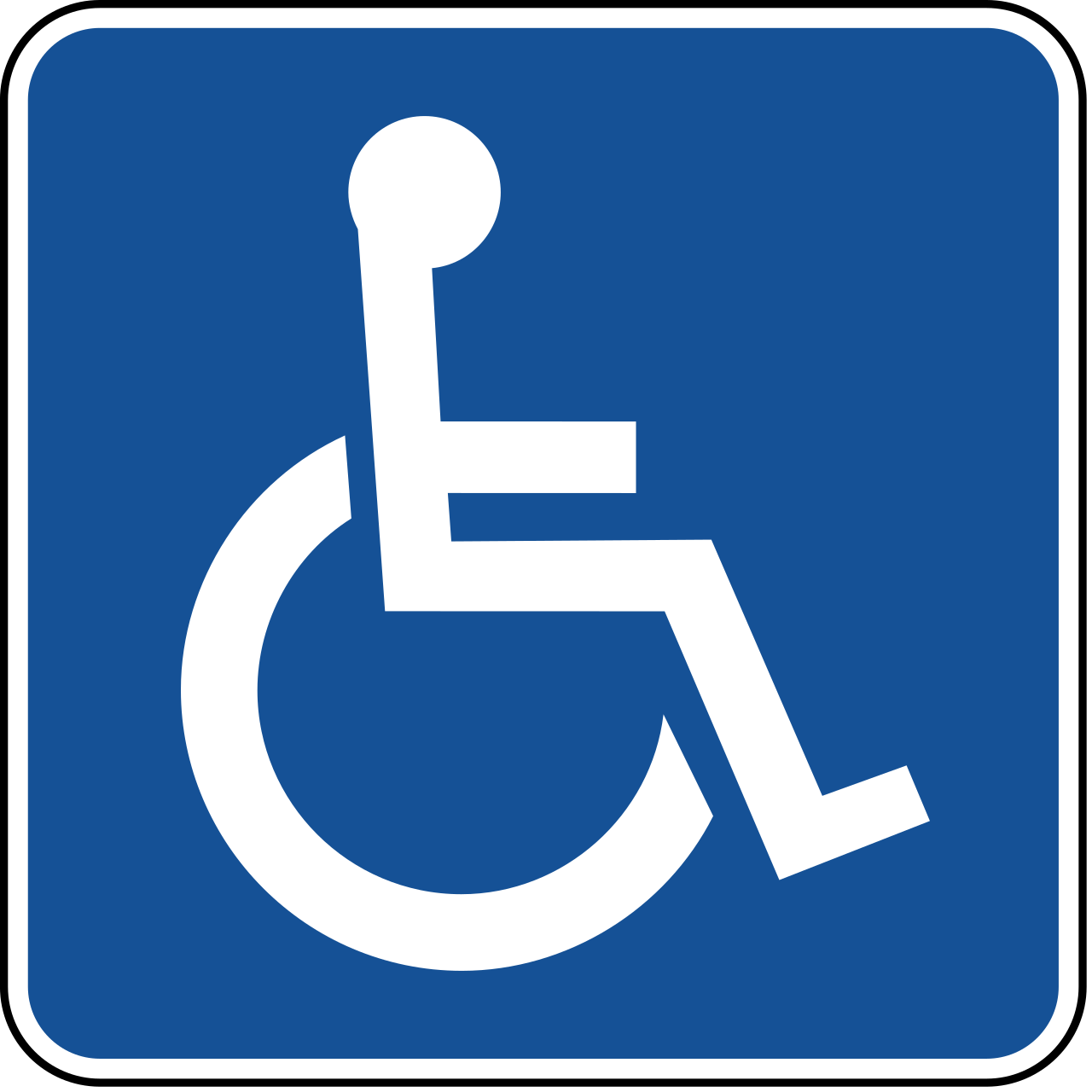
Parking space reserved exclusively for vehicles displaying an authorized disabled placard or license plate. Unauthorized parking results in heavy fines and towing.
This blue sign means parking is allowed:
A) for disabled persons without a special placard or plate.
B) only for persons in wheelchairs.
C) only for disabled persons with a special placard or plate.
13.
You may cross a double yellow line to pass another vehicle, if the yellow line next to:
A) your side of the road is a broken line.
B) the other side of the road is a solid line.
C) the other side of the road is a broken line.
14.
While driving, it is important to slow down:
A) when the road is slippery.
B) at railroad crossings.
C) The other answers are correct.
15.
When an aggressive driver confronts you, you should:
A) Try to move away safely.
B) Remain calm and relaxed.
C) All of the above.
16.
Do not cross double solid yellow lines in the center of the roadway to:
A) make a left turn.
B) enter a private driveway.
C) pass other vehicles.
17.
The maximum speed limit on most California highways is:
A) 55 MPH
B) 70 MPH
C) 65 MPH
18.
When passing another vehicle, it is safe to return to your lane if you:
A) have passed the the other vehicle’s front bumper.
B) cannot see the vehicle directly to your right.
C) see the vehicle’s headlights in your rearview mirror.
19.
When should you use your headlights?
A) one hour before sunset until one hour after sunrise.
B) any time you can’t see at least two miles ahead.
C) any time you have trouble seeing others or being seen.
20.
Which way do you turn your front wheels to park downhill next to a curb?
A) Away from the curb
B) Parallel to the curb.
C) Into the curb
21.
When may you legally go around or under a railroad crossing gate?
A) Under no circumstances.
B) When the warning lights are not flashing.
C) When you can see clearly in both directions.
22.
Diamond-shaped signs:
A) are used to warn of hazards on roadways.
B) indicate no pass zones.
C) typically provide guidance to drivers.
23.
California has a Basic Speed Law, which means that:
A) drivers must always drive the standard (basic) speed limit.
B) weather and road conditions should never affect the speed at which you drive.
C) drivers may never drive faster than is safe for the prevailing road and weather conditions.
24.
The roadway ahead is narrowing or a lane is ending. Merge smoothly into the continuing lane.
This sign warns that:
A) traffic must merge left.
B) the bridge ahead is wide enough for only one vehicle at a time.
C) traffic must merge right.
25.
Which shape is a warning sign?
A) Diamond
B) Triangle
C) Pennant
26.
At night, if an oncoming vehicle fails to dim its high beams, look:
A) toward the center of the roadway.
B) toward the right edge of the roadway.
C) straight ahead in your lane.
27.
If a pedestrian is in a crosswalk in the middle of a block:
A) The pedestrian must yield the right-of-way.
B) The pedestrian has the right-of-way.
C) Vehicles have the right-of-way, but drivers must legally take care for the pedestrian’s safety.
28.
Regulation signs normally are ____ rectangles with ____ letters or symbols.
A) yellow; black
B) white; black
C) green; white
29.
The speed limit for a school zone where children are present is ____, unless otherwise posted.
A) 15 MPH
B) 25 MPH
C) 20 MPH
30.
You are required to wear your safety belt in a moving vehicle:
A) and failure to do so will result in a traffic ticket.
B) unless you are riding the back of a pickup/camper.
C) unless the vehicle was manufactured before 1975.
31.
When the road is slippery, you should:
A) pump your brakes to test the traction of your tires.
B) decrease the distance that you look ahead of your vehicle.
C) avoid making fast turns and fast stops.
32.
If there is no crosswalk and you see a pedestrian crossing your lane, you should:
A) Make sure the pedestrian can see you before proceeding.
B) Cautiously drive around the pedestrian.
C) Stop and let the pedestrian finish.
33.
To assist the officer in conducting a traffic break, you should:
A) activate your emergency flashers to warn other drivers there is a hazard ahead.
B) attempt to drive past the patrol vehicle.
C) accelerate until the patrol vehicle has turned off its emergency lights
34.
You are approaching an intersection at the posted speed limit when the signal light turns yellow. You should:
A) stop before entering the intersection, if you can do so safely.
B) slow down and proceed through the intersection without caution.
C) speed up to cross the intersection before the light turns red.
35.
At an intersection with a flashing yellow signal light, you should:
A) Slow down and cross carefully.
B) Watch for other vehicles and maintain your current speed.
C) Stop before crossing the intersection.
36.
When merging onto a freeway, you should be driving:
A) at the legal freeway speed limit.
B) at or near the same speed as the freeway traffic.
C) slower than the freeway traffic.
ANSWER KEY Check answers after completing the test.
1 C
2 B
3 C
4 B
5 B
6 C
7 C
8 C
9 A
10 B
11 A
12 C
13 A
14 C
15 C
16 C
17 C
18 C
19 C
20 C
21 A
22 A
23 C
24 A
25 A
26 B
27 B
28 B
29 B
30 A
31 C
32 C
33 A
34 A
35 A
36 B