DriveQuiz drivequiz.com

AL DMV PERMİT PRACTİCE TEST 6

Alabama
Duration: 36 min
|
Questions: 40
Student Name:
Date:
Correct:      Incorrect:      Score:      
1.
If you meet a stopped school bus with the lights flashing and the signal arm extended, you should:
A) proceed at 15 MPH or less, if no children are present.
B) stop.
C) watch for children and proceed at normal speed.
2.
Which of the following drugs could affect your ability to drive?
A) A cold remedy.
B) Marijuana.
C) All of the above.
3.
To drive defensively, you must:
A) avoid scanning the road ahead.
B) keep one hand on the steering wheel.
C) keep your eyes moving.
4.
If you get on a wrong expressway exit, you must:
A) get off at the next exit and look for signs that tell you how to return to the expressway.
B) use the the exit ramp to accelerate to expressway speed and blend with traffic.
C) drive in reverse to return to the expressway.
5.
Left turns on a red light are allowed:
A) from a one-way street into a one-way street.
B) Never.
C) at intersections, after stopping, if the way is clear.
6.
If your car becomes disabled on a highway, you should:
A) stop in the right lane.
B) park with all four wheels off the highway, if possible.
C) stop where you are.
7.
Drivers should always be looking:
A) at the left lane.
B) beside, ahead and to the rear of the vehicle.
C) directly in front of the car.
8.
Indicates an upcoming bicycle crossing or shared road zone. Always leave at least 3 feet of clearance when passing cyclists.
This road sign means:
A) Watch for bicycles
B) Bicycle parking ahead
C) Bicycles are not allowed in this area
9.
Which sign has white letters on a red background?
A) Stop
B) School zone
C) Yield
10.
The traffic light is green and you want to drive straight through an intersection. If a car is already in the intersection and is making a turn, you must:
A) enter the intersection and then stop.
B) drive through the intersection. You have the right-of-way.
C) let that car complete its turn before you enter the intersection.
11.
Blind spots are:
A) Dangerous intersection where the maximum speed limit is 15 MPH or less.
B) At night, the darkest areas of a road, where emergency flashers should be used.
C) Areas to the side or rear of a vehicle that the driver cannot see with use of mirrors.
12.
In work zones, barriers such as drums, panels and cones are used to:
A) reduce the flow of traffic.
B) keep traffic out of hazardous work zones.
C) keep workers out of the work zone.
13.
Stopping distances:
A) are not affected by vehicle speed.
B) decrease as vehicle speed increases.
C) increase as vehicle speed increases.
14.
A curb painted red means:
A) No parking or stopping
B) Parking is for disabled persons with a special placard or plate.
C) Reserved for passengers pick up or drop off
15.
What is the meaning of orange traffic signs?
A) Yield.
B) Warning of school, pedestrian, and bicycling activity.
C) Construction and maintenance warning.
16.
After passing a vehicle, it is safe to return to your lane:
A) when you can no longer see the vehicle over your right shoulder.
B) after about five seconds.
C) when you see the front bumper of the other vehicle in your mirror.
17.
When driving at night, drivers should:
A) always use their high beams.
B) increase their following distance.
C) look directly into the oncoming headlights of approaching vehicles.
18.
A steady green light at intersections means:
A) You may drive through the intersection if the road is clear
B) You must increase your speed
C) You may not turn right
19.
Driver arm extended horizontally straight out the left window signals an intended left turn or lane change to the left.
The driver is about to:
A) turn right.
B) turn left.
C) stop.
20.
When changing lanes, you should remember that:
A) vehicles with two outside mirrors have no blind spots.
B) You only need to turn and look over your right shoulder for lane changes to the right or left.
C) you should look over your left shoulder for a left lane change and your right shoulder for a right lane change.
21.
Warning signs normally are:
A) rectangles.
B) triangles.
C) diamond-shaped.
22.
Driving at night is more dangerous because:
A) the road is more slippery.
B) your reaction time is slower.
C) you cannot see as far ahead at night.
23.
You ________ traffic headed toward you when you turn left.
A) must not yield to
B) must interrupt
C) must yield to
24.
Prohibits drivers from making a 180-degree turn to travel in the opposite direction at this intersection or stretch of road.
This road sign means:
A) No left turn
B) No U-turn
C) Detour ahead
25.
If a vehicle is coming towards you at night with its high beams on, making it hard to see the road ahead, you should:
A) look straight ahead towards the middle of the lane.
B) look ahead towards the left edge of your lane.
C) look ahead towards the right edge of your lane.
26.
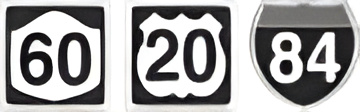
Interstate or State Route numbered highway marker used for route navigation and guide information.
These are:
A) route signs.
B) miles-left signs.
C) speed limit signs.
27.
Aggressive driving includes:
A) quick lane changes without a signal.
B) chasing or challenging other drivers.
C) All of the above.
28.
A vehicle that enters a road from a driveway:
A) has the right-of-way.
B) must yield to traffic approaching from the right, while it has the right-of-way over vehicles approaching from the left.
C) must stop and yield the right-of-way to traffic on the roadway and to pedestrians.
29.
Another road crosses the highway ahead. Look left and right for crossing or entering vehicles.
This road sign means:
A) A four-way intersection is ahead
B) Do not pass
C) A steep grade is ahead
30.
If traffic on the other side of an intersection is backed up and you cannot get completely through, you must:
A) enter the intersection and try to avoid blocking it.
B) enter the intersection and proceed with caution.
C) wait until traffic ahead is clear.
31.
When the road is slippery you should:
A) decrease the following distance.
B) slow and pro-ceed with caution.
C) check your brakes.
32.
Some roadway surfaces are more slippery during certain times or at certain places. Which of the following is more likely to be slippery on cold, wet days?
A) Roundabouts and traffic circles.
B) Roads in shady areas.
C) Asphalt rather than concrete roads.
33.
The road is the most slippery:
A) when it first starts to rain.
B) after it rains.
C) All of the above.
34.
Yellow diamond warning that pedestrians may be crossing ahead. Exercise caution and yield.
This road sign means:
A) School zone ahead
B) Pedestrians must not cross here
C) Pedestrian crossing ahead
35.
The roadway ahead is narrowing or a lane is ending. Merge smoothly into the continuing lane.
This road sign means:
A) Right lane ends
B) Highway entrance ramp ahead
C) Left lane widens
36.
When you change lanes:
A) look over your shoulder in the direction you plan to move.
B) look into the rearview mirror.
C) look in the left side mirror.
37.
Drivers should not sound their horn when:
A) near blind pedestrians.
B) visibility ahead is limited.
C) they may hit another vehicle.
38.
In case of skidding, drivers should NOT:
A) take their foot off the gas pedal.
B) pump the brakes gently if they are about to hit something.
C) tap the gas pedal with their foot.
39.
Who is most at risk?
A) Drivers who have overslept.
B) Drivers who are driving long distances without rest breaks.
C) Experienced drivers.
40.
Which shape is a yield sign?
A) Vertical rectangle
B) Upside-down triangle
C) Diamond
ANSWER KEY Check answers after completing the test.
1 B
2 C
3 C
4 A
5 A
6 B
7 B
8 A
9 A
10 C
11 C
12 B
13 C
14 A
15 C
16 C
17 B
18 A
19 B
20 C
21 C
22 C
23 C
24 B
25 C
26 A
27 C
28 C
29 A
30 C
31 B
32 B
33 A
34 C
35 A
36 A
37 A
38 C
39 B
40 B