DriveQuiz drivequiz.com

AL DMV PERMİT PRACTİCE TEST 11

Alabama
Duration: 36 min
|
Questions: 40
Student Name:
Date:
Correct:      Incorrect:      Score:      
1.
Following another vehicle too closely is known as:
A) speedgating.
B) closetailing.
C) tailgating.
2.
You should never depend on your mirrors when you prepare to change lanes. Why?
A) Mirrors leave “blind spots” behind both sides of vehicles.
B) Mirrors need to be adjusted.
C) Mirrors are useless.
3.
At a crosswalk:
A) construction workers must yield to drivers.
B) drivers must yield to pedestrians.
C) pedestrians must yield to drivers.
4.
Right turns are strictly prohibited at this intersection under all circumstances.
This road sign means:
A) No left turn
B) No right turn
C) No U-turns
5.
Which of the following is true about the Anti-Locking Brake System?
A) It prevents skidding.
B) It allows drivers to steer during an emergency braking situation.
C) All of the above.
6.
When you prepare to make a left turn from a one-way road into a two-way road, you must:
A) enter the two-way road to the left of its center line.
B) approach the turn in the right lane or from the right side of a single lane.
C) approach the turn in the left lane or from the left side of a single lane.
7.
You have stopped for a train at a railroad crossing. After the train passes, you must:
A) look to see if another train is coming, then cross the tracks if it is safe to do so.
B) watch for vehicles that must stop at railroad crossings (school buses, vehicles carrying hazardous materials, etc.).
C) All of the above.
8.
If one of your tires blows out while driving, you should:
A) apply the brakes firmly and steer toward the right edge of the road.
B) pump the brakes.
C) hold the steering wheel firmly, slow down, and steer smoothly.
9.
A solid yellow line next to a broken yellow line means that vehicles:
A) next to the solid line may pass.
B) in both directions may pass.
C) next to the broken line may pass.
10.
When you make a left turn from a one-way road into a two-way road, you must:
A) enter the two-way road to the left of its center line.
B) make a U-turn into the two-way road.
C) enter the two-way road to the right of its center line.
11.
A steep downhill grade is ahead. Trucks and heavy vehicles should downshift to a lower gear to prevent brake overheating.
This road sign means:
A) Truck stop ahead
B) No trucks allowed
C) Hill or downgrade up ahead
12.
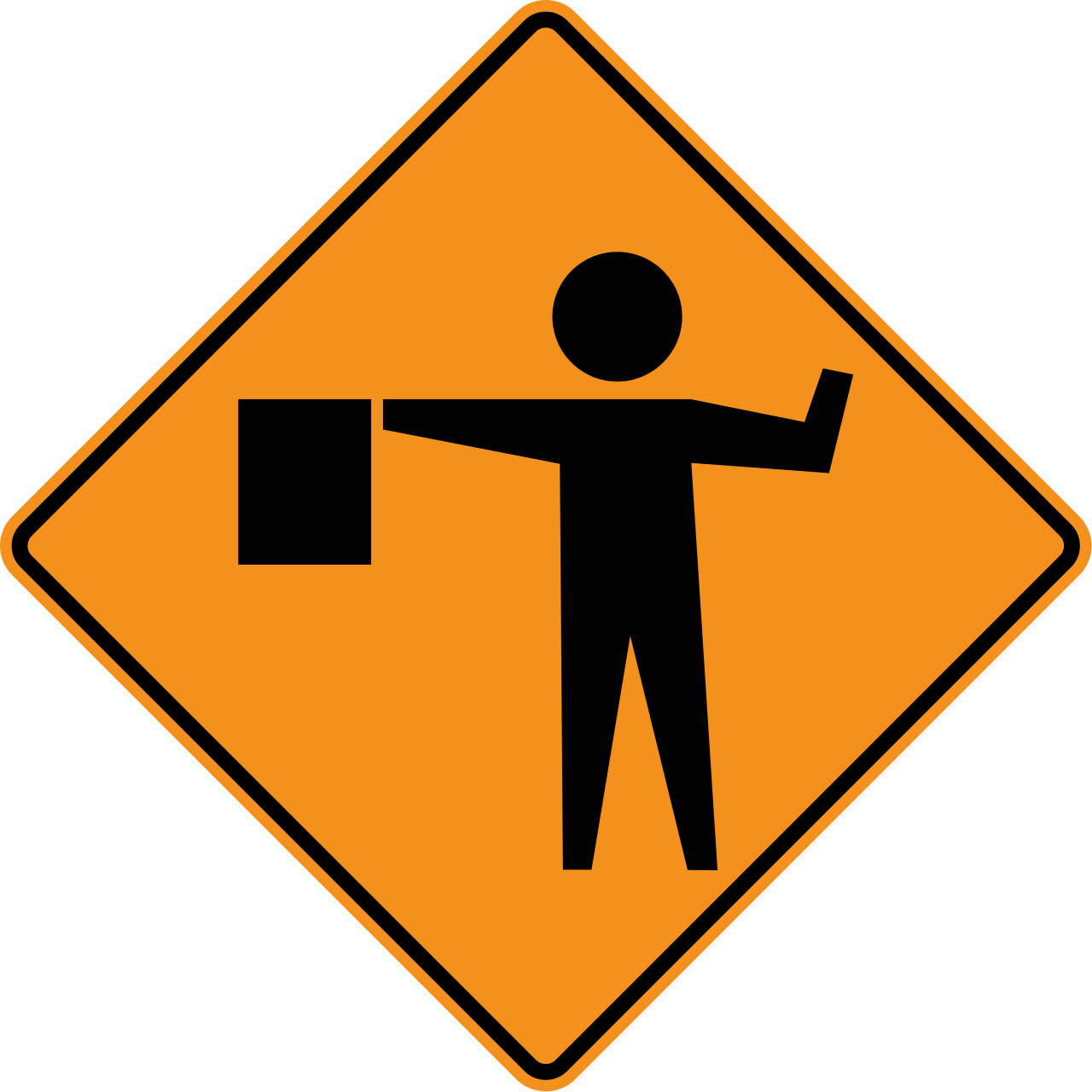
A human traffic control flagger is stationed ahead in a construction or utility work zone. Follow their hand and paddle signals strictly.
This road sign means:
A) Right lane closed
B) Do not block intersection
C) Flagger ahead
13.
A broken yellow line to the right of a solid yellow center line means:
A) you may pass other vehicles if no oncoming traffic is present.
B) passing is prohibited.
C) you are only allowed to make left turns in this area.
14.
When you back up:
A) always look through the rear window.
B) you should rely only on your rearview mirror.
C) do it as fast as possible.
15.
If your car goes into water, you should:
A) wait for water to rush in and let it out in small breaths through your nose.
B) call the fire department immediately.
C) remove yourself before it starts to sink.
16.
Drivers turning left must yield to:
A) None of the above.
B) oncoming vehicles going straight.
C) oncoming vehicles turning left.
17.
What is the slow moving vehicle symbol?
A) A reflective yellow diamond
B) A reflective white triangle
C) A reflective orange triangle
18.
A school bus ahead of you in your lane is stopped with red lights flashing. You must:
A) stop until all the children have left the bus.
B) stop until the lights stop flashing.
C) reduce your speed, change lanes and pass.
19.
If another vehicle passes you on the left, you must:
A) increase your speed slightly and keep to the right.
B) decrease your speed, then pull over to the right and stop.
C) decrease your speed slightly and keep to the right.
20.
When passing a vehicle, it is safe to return to your lane when:
A) you look over your shoulder and see no vehicle behind you.
B) you can see both headlights of the vehicle you passed in your rearview mirror.
C) the driver you just passed signals you over.
21.
What is the meaning of red traffic signs?
A) High emphasis warning.
B) Stop, do not enter or wrong way.
C) Regulatory.
22.
When a pedestrian carrying a white cane is at the corner ready to cross the street in front of you, before making your right turn, you should:
A) use your horn to help the pedestrian cross the street.
B) turn off the ignition until the person crosses the street.
C) yield the right-of-way and wait until the pedestrian crosses the street.
23.
ABS is the acronym for:
A) Anti-Braking System
B) Average-Beam System
C) Anti-Locking Brake System
24.
To drive defensively you should:
A) always put one car length between you and the car ahead.
B) keep your eyes moving to look for possible hazards.
C) look only at the car in front of you while driving.
25.
Don't be afraid to sound a sharp blast on your horn when:
A) when a child is about to run into the street.
B) another vehicle is in danger of hitting you.
C) All of the above.
26.
A flashing red light means:
A) The same as a STOP sign.
B) The light will soon change to steady red.
C) Drive with caution.
27.
The roadway ahead is narrowing or a lane is ending. Merge smoothly into the continuing lane.
This road sign means:
A) Lane reduction - the left lane ends soon
B) Highway entrance ramp ahead
C) Lane reduction - the right lane ends soon
28.
Which statement about taking medications and driving is true?
A) Cold medications can make a person drowsy.
B) Prescribed drugs are safe to take at any time.
C) Over the counter drugs do not affect driving ability.
29.
If a traffic officer signals you to drive through a red light:
A) you must do it.
B) you must wait for the red light to turn green.
C) you must not obey the officer. Signs and signals take precedence over directions given by traffic officers.
30.
There are two traffic lanes in your direction. You are driving in the left lane and many vehicles are passing you on the right, and the driver behind you wishes to drive faster. You should:
A) stay in your lane and maintain your current speed.
B) drive onto the left shoulder to let the other driver pass.
C) move over into the right lane when safe to do so.
31.
What is the purpose of minimum speed limits?
A) To keep a smooth traffic flow.
B) To halt the traffic flow.
C) To allow emergency vehicles with red flashing lights to safely pass other vehicles.
32.
The road ahead is divided by a median strip or physical barrier into two separate one-way roadways. Keep to the right of the divider.
This road sign means:
A) Divided highway ahead
B) Merging traffic
C) Flagger ahead
33.
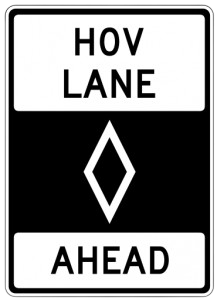
High-Occupancy Vehicle (HOV) diamond lane ahead. Only vehicles carrying the minimum required number of passengers (usually 2 or more) may use this lane.
This road sign indicates that:
A) a lane is reserved for certain purposes or certain vehicles.
B) buses and car pools may not travel in the restricted lane.
C) vehicles cannot go straight ahead. Cars must turn either to the right or left.
34.
Warns that a one-way street or divided highway is ending, and you are entering a roadway with oncoming traffic in the opposing lane. Stay to the right.
This road sign warns drivers that:
A) they are coming to a point where another traffic lane joins the one they are on.
B) a divided highway is ahead.
C) the one-way street or roadway is about to change to two-way traffic.
35.
The golden rule of driving is to:
A) treat others the way you want to be treated.
B) put on your emergency flashers when driving at night.
C) drive faster than the vehicle behind you.
36.
BAC is:
A) the acronym for Beer ACcumulation.
B) the number of ounces of alcohol in your blood.
C) the percentage of alcohol in your blood.
37.
What is the only effective method to reduce your BAC?
A) Eating before or while you drink.
B) Not drinking over a period of time.
C) Drinking coffee.
38.
A broken yellow line on your side of the roadway only means:
A) Passing is permitted on both sides.
B) Passing is permitted on your side of the roadway.
C) Passing is not permitted on either side.
39.
A sharp curve is ahead with a recommended safe speed plate. Slow down before entering the curve to prevent vehicle rollover.
This sign indicates that:
A) the highest safe speed drivers should travel around the curve ahead is 25 MPH.
B) the safe speed around the curve ahead is at least 25 MPH.
C) drivers may not turn right if traveling at 25 MPH or less.
40.
When driving in foggy weather, drivers should:
A) put their lights on low beam.
B) put their lights on high beam.
C) put their emergency flashers on.
ANSWER KEY Check answers after completing the test.
1 C
2 A
3 B
4 B
5 C
6 C
7 C
8 C
9 C
10 C
11 C
12 C
13 A
14 A
15 C
16 B
17 C
18 B
19 C
20 B
21 B
22 C
23 C
24 B
25 C
26 A
27 C
28 A
29 A
30 C
31 A
32 A
33 A
34 C
35 A
36 C
37 B
38 B
39 A
40 A