DriveQuiz drivequiz.com

WY DMV PERMİT PRACTİCE TEST 7

Wyoming
Duration: 45 min
|
Questions: 50
Student Name:
Date:
Correct:      Incorrect:      Score:      
1.
Posted on the far side of a sharp curve or T-intersection to indicate a sharp change in direction of travel.
This sign means:
A) Not enter
B) Detour to the right
C) The road to the right is for one-way traffic only
2.
It is unlawful­ to:
A) pass within 250 feet of any intersection.
B) exceed the posted speed limit when passing.
C) pass within 150 feet of any railroad crossing.
3.
To avoid hydroplaning, drivers should:
A) slow down.
B) apply the brakes firmly.
C) drive at a constant speed.
4.
The first thing affected after drinking alcohol is:
A) balance.
B) judgment.
C) speech.
5.
Reflective orange triangle displayed on vehicles traveling at 25 MPH or slower (such as farm tractors or construction machinery). Approach with caution and pass safely.
The sign in the picture:
A) is a Construction and Maintenance Traffic Control sign.
B) is found at most intersections and indicates that drivers must yield to other vehicles.
C) is displayed on the rear of slow moving vehicles.
6.
Which of the following factors affect the absorption of alcohol?
A) Your race.
B) Your weight.
C) Your height.
7.
When approaching a construction site, drivers should:
A) accelerate to get out of the way quickly.
B) slow down and adjust their driving manner.
C) honk their horn to alert construction workers of their presence.
8.
You may not turn right (or left from a one-way onto a one-way) while the traffic signal is red. Wait for the green signal before turning.
This sign tells drivers:
A) they must wait for the traffic signal to turn green before turning right or left.
B) they may not turn right or left during the red light.
C) All of the above.
9.
Warns of an upcoming YIELD sign. Prepare to slow down and check for cross traffic before proceeding.
This road sign means:
A) Yield sign ahead
B) Side road entering from the left
C) Side road
10.
Drivers should adjust their rearview and side mirrors:
A) whenever they need to use them.
B) before they get into the car.
C) before they start driving.
11.
Which statement about taking medications and driving is true?
A) Cold medications can make a person drowsy.
B) Prescribed drugs are safe to take at any time.
C) Over the counter drugs do not affect driving ability.
12.
A driver distraction is anything that:
A) causes aggressive behavior while driving.
B) causes excessive concentration while driving.
C) takes the attention away from driving.
13.
Designated school crosswalk location. You must yield to all schoolchildren and pedestrians in the crossing.
When they approach this sign, drivers must:
A) slow down and watch for children crossing the road.
B) obey signals from crossing guards.
C) stop if necessary.
D) All of the above.
14.
The roadway becomes particularly slippery during wet or rainy conditions. Reduce your speed, increase following distance, and avoid abrupt braking or steering.
This sign indicates:
A) Warning: drunk drivers.
B) Winding road. Drive with caution.
C) The road may be slippery when wet. Drive slowly.
15.
Your driving ability can be affected by:
A) just one drink.
B) three drinks or more.
C) at least two drinks.
16.
What is the first thing you should do if your wheels move off the pavement?
A) Pull the steering wheel back.
B) Pull over to the right and sound your horn to warn the other drivers.
C) Ease your foot off the gas pedal and brake gently.
17.
For protection, motorcyclists are required to:
A) keep their headlights and taillights on at all times.
B) signal turns, lane changes and stops.
C) wear approved helmets.
18.
___________ are green with white letters and symbols.
A) Warning signs
B) Destination signs (guide signs)
C) Regulation signs (regulatory signs)
19.
If traffic on the other side of an intersection is backed up and you cannot get completely through, you must:
A) enter the intersection and try to avoid blocking it.
B) enter the intersection and proceed with caution.
C) wait until traffic ahead is clear.
20.
If there is no crosswalk and you see a pedestrian crossing your lane, you should:
A) stop and let the pedestrian finish crossing.
B) make sure the pedestrian can see you before proceeding.
C) honk your horn and proceed with caution.
21.
Drivers under the age of 21 are subject to a specific restriction prohibiting them from driving:
A) before consuming alcohol.
B) with alcohol in their system.
C) before midnight.
22.
When a ‘Road Closed’ sign is displayed, drivers must:
A) make a U-turn.
B) look for a detour or another route.
C) come to a complete stop and wait for the lights to turn green.
23.
When you make a left turn from a one-way road into a two-way road, you must:
A) enter the two-way road to the left of its center line.
B) make a U-turn into the two-way road.
C) enter the two-way road to the right of its center line.
24.
Where are yield signs usually placed?
A) At intersections, if there is no marked stop line.
B) Where auxiliary roads lead into major roads.
C) Where major roads lead into auxiliary roads.
25.
As the percentage of alcohol in your blood (BAC) increases, you become:
A) more reactive.
B) more intoxicated.
C) more sober.
26.
The extra space in front of a large truck is needed for:
A) other drivers when merging onto a freeway.
B) the truck driver to stop the vehicle.
C) other drivers when they want to pass the truck.
27.
If a bus needs to make a right turn and you are also turning right:
A) squeeze between the bus and the curb.
B) try to turn right before the bus does.
C) wait until the bus turns before turning right.
28.
Before stopping your vehicle on the roadway, drivers should:
A) check their mirrors for traffic.
B) place their foot on the accelerator.
C) pump the brakes to check if they work properly.
29.
If you are continually being passed on the right, you should:
A) move into the right lane and allow other vehicles to pass you on the left.
B) move into the left lane and allow other vehicles to pass you on the right.
C) increase your speed immediately.
30.
When turning, drivers should:
A) always move to the right lane.
B) check traffic in all directions.
C) increase their speed to improve stability.
31.
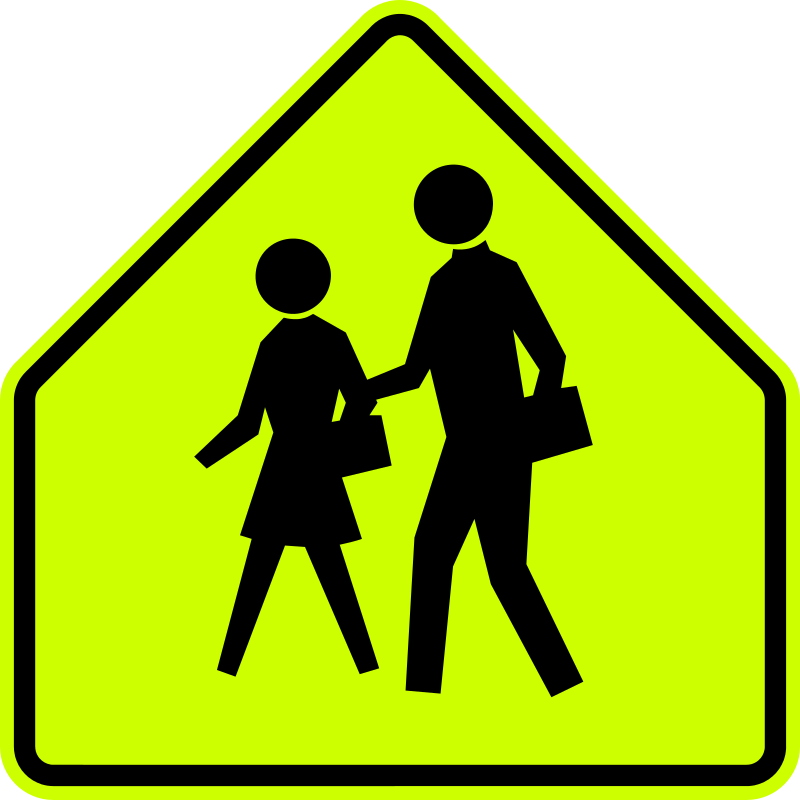
Five-sided pentagon sign indicating an upcoming school area. Watch for children crossing, school buses, and observe posted reduced school speed limits.
When you see this sign, you should:
A) be prepared to stop if children are in the crosswalk.
B) slow down, proceed with caution and watch for blind people.
C) always stop at the crosswalk.
32.
You ________ traffic headed toward you when you turn left.
A) must not yield to
B) must interrupt
C) must yield to
33.
Parking is not allowed:
A) in an intersection, unless permitted by signs.
B) within 300 feet of a pedestrian safety area.
C) on public roads
34.
When driving in work zones, drivers should:
A) tailgate the vehicle ahead while reducing their speed.
B) pass the vehicle ahead when safe.
C) keep a safe following distance.
35.
To avoid panic stops, you should:
A) scan the road ahead for hazards.
B) drive with your window down.
C) pump your brakes to make sure they work.
36.
A solid yellow line next to a broken yellow line means that vehicles:
A) next to the solid line may pass.
B) in both directions may pass.
C) next to the broken line may pass.
37.
Any use of a cell phone while operating a motor vehicle is considered a distraction because:
A) it occupies the driver's mind, hands and eyes.
B) it draws the attention of other drivers.
C) it causes the driver to be concerned about the latest news.
38.
Five-sided pentagon sign indicating an upcoming school area. Watch for children crossing, school buses, and observe posted reduced school speed limits.
This road sign means:
A) School crossing
B) Playground ahead
C) Pedestrian crossing
39.
Paved road surface ends and transitions to gravel, dirt, or unpaved roadway. Reduce speed and prepare for reduced traction.
This road sign warns drivers that:
A) the road surface ahead changes to a low-type surface or earth road.
B) vehicles must leave the pavement immediately.
C) the dirt on the side of the road is soft.
40.
You arrive at an intersection where you have a green light, but the path ahead is blocked, you should:
A) turn left and find another route.
B) stay out of the intersection until traffic clears.
C) enter the intersection and wait until traffic clears.
41.
The first sign drivers see when approaching a highway-rail intersection is usually:
A) a crossbuck sign.
B) an advance warning sign.
C) a speed limit sign.
42.
When driving in heavy rain, drivers should use:
A) parking lights.
B) low beam headlights.
C) high beam headlights.
43.
Warns of two consecutive curves in opposite directions (e.g., curves right then left). Slow down to maintain control.
This road sign means:
A) There is a series of sharp turns up ahead on the road
B) Sharp right turn ahead.
C) A road joins from the right
44.
When passing a pedestrian who is walking on the road and an oncoming vehicle is approaching, you should:
A) keep driving, you have the right-of-way.
B) honk your horn to warn the pedestrian.
C) slow down and let the vehicle pass first.
45.
Blind spots are:
A) Areas to the side or rear of a vehicle that are easy to spot.
B) areas of the road that cannot be seen even when looking into mirrors.
C) traffic control devices.
46.
Who is most at risk?
A) Drivers who are fatigued.
B) Drivers who are driving on long, boring roads.
C) All of the above.
47.
What should you do as you prepare to turn right at an intersection?
A) Honk your horn.
B) Yield to bicyclists coming from the opposite direction.
C) Signal your turn, check for bicyclists, and do not turn directly in front of a bicyclist.
48.
The traffic light is green and you want to drive straight through an intersection. If a car is already in the intersection and is making a turn, you must:
A) enter the intersection and then stop.
B) drive through the intersection. You have the right-of-way.
C) let that car complete its turn before you enter the intersection.
49.
Drivers turning left must yield to:
A) None of the above.
B) oncoming vehicles going straight.
C) oncoming vehicles turning left.
50.
As you enter a roundabout you should slow down and:
A) yield to pedestrians and bicyclist crossing before entering the roundabout.
B) yield to any vehicle coming from your left in the roundabout.
C) All of the above.
ANSWER KEY Check answers after completing the test.
1 B
2 B
3 A
4 B
5 C
6 B
7 B
8 C
9 A
10 C
11 A
12 C
13 D
14 C
15 A
16 C
17 C
18 B
19 C
20 A
21 B
22 B
23 C
24 B
25 B
26 B
27 C
28 A
29 A
30 B
31 A
32 C
33 A
34 C
35 A
36 C
37 A
38 A
39 A
40 B
41 B
42 B
43 A
44 C
45 B
46 C
47 C
48 C
49 B
50 C