DriveQuiz drivequiz.com

WY DMV PERMİT PRACTİCE TEST 3

Wyoming
Duration: 45 min
|
Questions: 50
Student Name:
Date:
Correct:      Incorrect:      Score:      
1.
To drive defensively, you must:
A) avoid scanning the road ahead.
B) keep one hand on the steering wheel.
C) keep your eyes moving.
2.
When you prepare to make a left turn from a one-way road into a two-way road, you must:
A) enter the two-way road to the left of its center line.
B) approach the turn in the right lane or from the right side of a single lane.
C) approach the turn in the left lane or from the left side of a single lane.
3.
When approaching any intersection or driveway, drivers should:
A) look both ways and be ready to stop.
B) pass other vehicles and then stop.
C) drive at the fastest speed just before entering the intersection.
4.
If your car goes into water, you should:
A) wait for water to rush in and let it out in small breaths through your nose.
B) call the fire department immediately.
C) remove yourself before it starts to sink.
5.
A signalized intersection is ahead. Prepare to stop if the light turns yellow or red.
This sign means:
A) No traffic signal ahead
B) Traffic signal ahead
C) Open intersection ahead
6.
Drivers should check their rearview mirrors:
A) often to see how traffic is moving behind them.
B) only when slowing down.
C) to see if a truck is in their blind spot.
7.
When entering an interstate highway, drivers should:
A) check for cars and slow down to 25 MPH before merging with the flow of traffic.
B) wait for an opening in traffic on the entrance ramp.
C) adjust speed to meet a traffic gap, then merge at a safe speed.
8.
Indicates that traffic is permitted to pass on either the left or the right side of an island, median, or obstruction.
This sign tells drivers that:
A) left and right turns are not allowed.
B) a divided highway is ahead.
C) they cannot go straight ahead.
9.
Drivers should use high beam headlights when:
A) following another vehicle.
B) when they come within 50 feet of an oncoming vehicle.
C) there are no oncoming vehicles approaching.
10.
When a pedestrian carrying a white cane is at the corner ready to cross the street in front of you, before making your right turn, you should:
A) use your horn to help the pedestrian cross the street.
B) turn off the ignition until the person crosses the street.
C) yield the right-of-way and wait until the pedestrian crosses the street.
11.
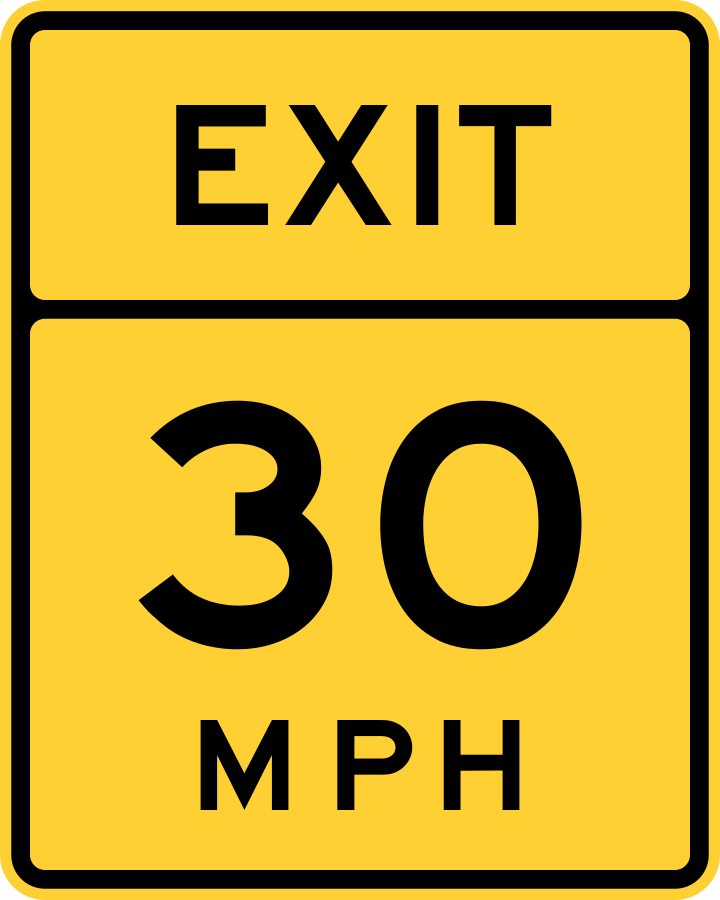
Recommends a safe speed of 30 MPH for negotiating the freeway exit ramp deceleration lane.
The sign in the picture:
A) shows the highest speed drivers can travel at the exit of the intersection.
B) is used to advise motorists of the appropriate ramp speed at the highway exit point.
C) indicates the minimum ramp speed at the highway exit point.
12.
At intersections, crosswalks, and railroad crossings, drivers should always:
A) look to the sides of their vehicle to see what is coming.
B) slowly pass vehicles the vehicles ahead.
C) stop, listen for oncoming traffic, and proceed with caution.
13.
Your BAC depends on:
A) how much alcohol you drink.
B) how much time passes between drinks.
C) All of the above.
14.
If it safe to do so, you can pass a vehicle ahead when:
A) you are on a hill or curve.
B) there is a broken line on your side of the road.
C) there is a solid line on your side of the road.
15.
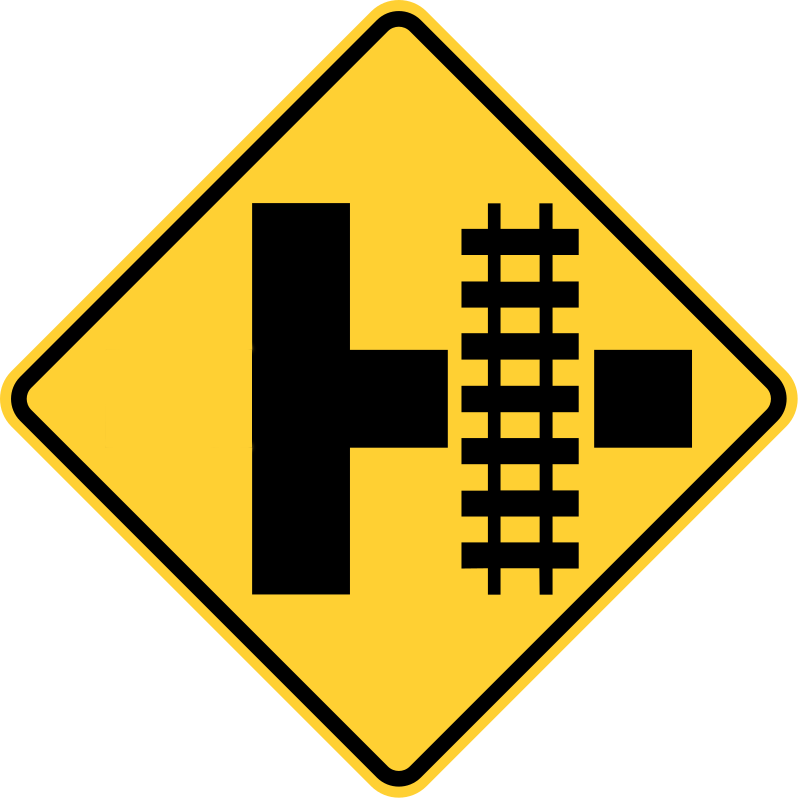
Four-way intersection ahead. Be prepared to yield right-of-way according to traffic control devices.
What does this sign indicate?
A) Parallel railroad crossing (side road)
B) Low ground clearance railroad crossing
C) Parallel railroad crossing (crossroad)
16.
When following a motorcycle, drivers must remember that motorcycles can ____________ than other vehicles.
A) accelerate much faster
B) stop much more quickly
C) stop much more slowly
17.
What type of pavement marking shows you which lane you must use for a turn?
A) Edge line
B) Diamond
C) Crosswalk Lines
D) Arrows
18.
To drive defensively you should:
A) always put one car length between you and the car ahead.
B) keep your eyes moving to look for possible hazards.
C) look only at the car in front of you while driving.
19.
A steep downhill grade is ahead. Trucks and heavy vehicles should downshift to a lower gear to prevent brake overheating.
This sign warns of a ________ ahead.
A) hill
B) no passing zone
C) soft shoulder
20.
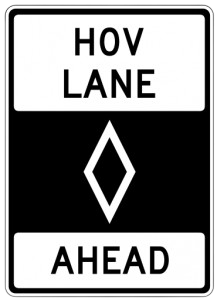
High-Occupancy Vehicle (HOV) diamond lane ahead. Only vehicles carrying the minimum required number of passengers (usually 2 or more) may use this lane.
This road sign indicates that:
A) a lane is reserved for certain purposes or certain vehicles.
B) buses and car pools may not travel in the restricted lane.
C) vehicles cannot go straight ahead. Cars must turn either to the right or left.
21.
To avoid glare from headlights of an approaching car:
A) stay focused on the center line on the road.
B) don't look directly into the oncoming headlights, look toward the right edge of your lane.
C) flash your high beams.
22.
No Zones are areas around trucks where cars:
A) disappear into blind spots or are so close to the truck that the driver's ability to stop or maneuver safely is restricted.
B) can turn safely because several car lengths have been left between the truck and car.
C) can travel behind trucks at constant speed and have no risks of being involved in a collision.
23.
Blind spots are:
A) Dangerous intersection where the maximum speed limit is 15 MPH or less.
B) At night, the darkest areas of a road, where emergency flashers should be used.
C) Areas to the side or rear of a vehicle that the driver cannot see with use of mirrors.
24.
Another road crosses the highway ahead. Look left and right for crossing or entering vehicles.
This road sign means:
A) A four-way intersection is ahead
B) Do not pass
C) A steep grade is ahead
25.
You are stopped at a stop sign and you are going to go straight through the intersection. A car on the cross road has stopped at a stop sign on your right and is going to go straight. Who has the right-of-way?
A) Whoever enters the intersection first.
B) You.
C) The car on your right.
26.
Warns that a one-way street or divided highway is ending, and you are entering a roadway with oncoming traffic in the opposing lane. Stay to the right.
This road sign means:
A) School zone ahead
B) Keep right
C) Two-way Traffic
27.
The road ahead is divided by a median strip or physical barrier into two separate one-way roadways. Keep to the right of the divider.
This sign means:
A) The highway ahead is divided into two one-way roadways.
B) Roundabout ahead. Slow down.
C) The divided highway on which drivers are traveling ends ahead.
28.
If your wheels drop off the pavement edge, you should:
A) stop.
B) turn back onto the roadway immediately.
C) turn gradually back onto the roadway when safe.
29.
It is legal to make a left turn at a red light after stopping if:
A) you are traveling on a two-way street and turning onto a two-way street.
B) you are traveling on a one-way street and turning onto another one-way street.
C) you yield to all other traffic at the intersection before proceeding.
30.
Prohibits drivers from making a 180-degree turn to travel in the opposite direction at this intersection or stretch of road.
This road sign means:
A) No left turn
B) No U-turn
C) Detour ahead
31.
Drivers should make room for cars entering freeways by:
A) maintaining their speed and position.
B) moving over a lane if there is no other vehicle next to them.
C) slowing down.
32.
What should drivers do when the red lights begin to flash?
A) Stop.
B) Yield.
C) Slow down.
33.
Proceed with caution. You do not need to stop unless pedestrians or hazards are present in the intersection.
A flashing yellow light:
A) warns drivers to proceed with caution.
B) is used at dangerous intersections.
C) All of the above.
34.
A person walking with a white cane or guide dog is likely to be:
A) a deaf person.
B) a traffic enforcement officer.
C) a blind person.
35.
To make a proper right turn:
A) swing to the left before turning right.
B) slow down and get into the lane nearest the centerline.
C) give the proper signal and get into the lane nearest the right curb.
36.
Standard yellow warning sign outline used across the US for all caution, hazard, and roadway change notifications.
This sign is a:
A) regulatory sign.
B) warning sign.
C) guide sign.
37.
Construction zone signs are generally:
A) rectangular with white red coloring.
B) triangular with black and yellow coloring.
C) diamond or rectangular with orange and black coloring.
38.
At an intersection without stop or yield signs, you should:
A) yield to the vehicle to your left.
B) wait until there are no vehicles at the intersection.
C) yield to the vehicle to your right.
39.
Warns of an upcoming STOP sign that may not be immediately visible. Begin slowing down to prepare for a complete stop.
When drivers come to this sign, they must:
A) be ready to stop at the stop sign.
B) warn other drivers that a stop sign is ahead.
C) brake sharply and come to a complete stop.
40.
When you come to a flashing yellow light, you must:
A) slow down and cross carefully.
B) stop before crossing.
C) speed up to beat the red light.
41.
A steep downhill grade is ahead. Trucks and heavy vehicles should downshift to a lower gear to prevent brake overheating.
When they see this sign, drivers should:
A) be ready to brake sharply and stop.
B) be ready to shift to lower gear.
C) yield to trucks coming from the hill on the right.
42.
When you prepare to make a left turn from a one-way road into a one-way road, you must:
A) move into the right lane, or to the left side of a single lane.
B) move into the right lane, or to the right side of a single lane.
C) move into the left lane, or to the left side of a single lane.
43.
This lane is exclusively designated for making U-turns. Through traffic and right turns are not allowed from this lane.
This sign means:
A) You may make a U-turn.
B) Hairpin corner ahead.
C) You must make a U-turn.
44.
When driving on gravel roads:
A) your tires do not have as much traction.
B) you should use cruise control to increase traction.
C) you should keep your eyes moving.
45.
Warns drivers that two separate lanes moving in the same direction are merging into one. Drivers in the right lane must adjust speed and merge smoothly with existing traffic.
This yellow sign means:
A) Lane ends ahead
B) Undivided highway ahead
C) Merging traffic ahead
46.
When driving in fog, you should never use your high beams because:
A) the light will reflect back into your eyes.
B) vehicles behind you may follow too closely.
C) oncoming vehicles might not see you.
47.
Following another vehicle too closely is known as:
A) speedgating.
B) closetailing.
C) tailgating.
48.
If your gas pedal is stuck, you should:
A) hook your shoe under the pedal and see if you can free it. If not, shift into neutral and use the brake to slow your vehicle and get off the road.
B) ease your foot off the gas pedal and brake gently.
C) turn off the ignition if your vehicle has power steering.
49.
If the roadway is wet, you should:
A) increase your speed.
B) reduce your speed.
C) maintain the same speed.
50.
The roadway becomes particularly slippery during wet or rainy conditions. Reduce your speed, increase following distance, and avoid abrupt braking or steering.
This road sign means:
A) Winding road
B) Side road ahead
C) Slippery when wet
ANSWER KEY Check answers after completing the test.
1 C
2 C
3 A
4 C
5 B
6 A
7 C
8 C
9 C
10 C
11 B
12 A
13 C
14 B
15 A
16 B
17 D
18 B
19 A
20 A
21 B
22 A
23 C
24 A
25 C
26 C
27 A
28 C
29 B
30 B
31 B
32 A
33 C
34 C
35 C
36 B
37 C
38 C
39 A
40 A
41 B
42 C
43 C
44 A
45 C
46 A
47 C
48 A
49 B
50 C