DriveQuiz drivequiz.com

WI DMV PERMİT PRACTİCE TEST 8

Wisconsin
Duration: 45 min
|
Questions: 50
Student Name:
Date:
Correct:      Incorrect:      Score:      
1.
Indicates a series of three or more consecutive sharp turns or curves ahead. Reduce speed and maintain lane control.
This road sign means:
A) Pavement ends
B) Winding road
C) Double curve ahead
2.
A steep downhill grade is ahead. Trucks and heavy vehicles should downshift to a lower gear to prevent brake overheating.
This road sign means:
A) Trucks have the right-of-way
B) Hill
C) Trucks merging from the right
3.
What should you do if you see smoke come from under the hood?
A) Call the fire department and then pull off the road and park your vehicle.
B) Pull off the road and park your vehicle. Turn off the ignition, get away from the car and call the fire department.
C) Try to fight the fire yourself.
4.
The roadway ahead is narrowing or a lane is ending. Merge smoothly into the continuing lane.
This road sign means:
A) Right lane ends
B) Highway entrance ramp ahead
C) Left lane widens
5.
When driving in fog, you should never use your high beams because:
A) the light will reflect back into your eyes.
B) vehicles behind you may follow too closely.
C) oncoming vehicles might not see you.
6.
When being passed by another vehicle, drivers should:
A) slow down.
B) slightly increase their speed.
C) maintain a constant speed.
7.
To avoid being in a truck driver’s blind spot, you should:
A) never pass the truck and put your headlights on.
B) avoid driving on either side of the truck and don’t tailgate.
C) flash your lights.
D) sound your horn.
8.
The bridge ahead has narrower lanes or shoulders than the preceding road. Use caution when meeting oncoming vehicles.
This sign warns drivers of:
A) low clearance.
B) a narrow bridge ahead.
C) a low place in the road.
9.
Two drivers reach an uncontrolled intersection at the same time. Who has the right of way?
A) The driver on the left.
B) No one.
C) The driver on the right.
10.
A signalized intersection is ahead. Prepare to stop if the light turns yellow or red.
This road sign means:
A) Traffic signal ahead
B) Stop
C) Yield the right-of-way
11.
You should increase your following distance when:
A) exiting a freeway.
B) following a motorcycle.
C) driving behind a large vehicle that blocks your vision.
D) All of the above.
12.
Where must you position your vehicle when you prepare to make a left turn from a two-way roadway into a one-way roadway?
A) As far to the right as possible.
B) On the right curb.
C) As close as possible to the center line.
13.
Drivers should use the horn:
A) if a driver is moving slowly, and you want them to drive faster.
B) only when necessary, to avoid collisions.
C) when feeling angry or upset.
D) to alert other drivers that they made a mistake.
14.
Who is most at risk?
A) Drivers who are fatigued.
B) Drivers who are driving on long, boring roads.
C) All of the above.
15.
Lane markings that separate traffic moving in opposite direction are:
A) yellow.
B) white.
C) yellow and white.
D) black and white.
16.
The best way to deal with tailgaters is to:
A) let them pass if it's safe to do so.
B) flash your brake lights.
C) always keep your eyes focused ahead of your car.
17.
Road signs that direct drivers to services are:
A) brown and white.
B) blue and white.
C) green and white.
18.
As you drive on the expressway, make sure:
A) you cut off vehicles behind you when you change lanes.
B) to signal all lane changes.
C) your directional signal goes off before you change lanes.
19.
Drivers are required to stop:
A) when a traffic officer orders them to stop.
B) where there is a red light.
C) at an intersection with a stop sign.
D) All of the above.
20.
The first sign drivers see when approaching a highway-rail intersection is usually:
A) a crossbuck sign.
B) an advance warning sign.
C) a speed limit sign.
21.
While driving, it is important to slow down:
A) when the road is wet.
B) on narrow roads.
C) at intersections.
D) All of the above.
22.
All approaching traffic must stop completely. The first vehicle to reach the intersection and stop has right-of-way; if two vehicles arrive simultaneously, the vehicle on the right goes first.
A four-way stop sign means:
A) traffic from all four directions must stop.
B) if two vehicles reach the intersection at the same time, the driver on the left yields to the driver on the right.
C) All of the above.
23.
A flashing yellow light means:
A) The light will soon change from green to red.
B) Drive with caution.
C) Yield the right-of-way to other traffic at the intersection.
24.
What should you do as you prepare to turn right at an intersection?
A) Honk your horn.
B) Yield to bicyclists coming from the opposite direction.
C) Signal your turn, check for bicyclists, and do not turn directly in front of a bicyclist.
25.
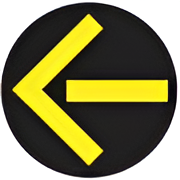
Unprotected left turns are allowed. You may turn left after yielding to oncoming traffic and pedestrians crossing the street.
What does a yellow arrow signal mean?
A) The same as the yellow light, but applies only to movement in the direction of the arrow.
B) The same as a green light.
C) Vehicles moving in all directions must stop if they can. The light will soon be red.
26.
Right turns are strictly prohibited at this intersection under all circumstances.
This road sign means:
A) No left turn
B) No right turn
C) No U-turns
27.
Who is most at risk?
A) Drivers who have overslept.
B) Drivers who are driving long distances without rest breaks.
C) Experienced drivers.
28.
When parking on a public road, drivers should:
A) move as far away from traffic as possible.
B) always park on the left side of the roadway.
C) All of the above.
29.
Flashing Upraised Hand signal indicates pedestrians should finish crossing if already in the crosswalk, but not start crossing.
What does the flashing signal in the picture indicate?
A) The same thing as a stop sign.
B) Pedestrians should finish crossing the street if started.
C) Pedestrians should start crossing the street.
30.
Another road crosses the highway ahead. Look left and right for crossing or entering vehicles.
This road sign means:
A) Warning, crossroad ahead
B) All traffic must turn
C) Yield sign ahead
31.
Warns drivers that two separate lanes moving in the same direction are merging into one. Drivers in the right lane must adjust speed and merge smoothly with existing traffic.
When you see this sign you should:
A) turn right.
B) merge left.
C) watch for traffic to the right.
32.
A steep downhill grade is ahead. Trucks and heavy vehicles should downshift to a lower gear to prevent brake overheating.
This road sign means:
A) No right turn
B) No left turn
C) Narrow Bridge
D) Steep downgrade
33.
Regulatory signs are:
A) Suggestions
B) Warnings
C) Law
34.
What is the main reason night driving is more difficult than daytime driving?
A) The use of headlight is required by law.
B) Reduced visibility.
C) Driving within the range.
35.
In case of skidding, drivers should NOT:
A) take their foot off the gas pedal.
B) pump the brakes gently if they are about to hit something.
C) tap the gas pedal with their foot.
36.
__________________ is a safe driving technique.
A) Using your high beam lights in the fog
B) Starring at the road ahead of your vehicle
C) Checking your rearview mirrors frequently
37.
When an approaching driver at night blinds you by failing to dim their high beams, you should look:
A) straight down the middle of the road.
B) towards the left side of the road.
C) None of the other answers is correct.
D) towards the right side of the road.
38.
You must pull over to the edge of the road and allow an emergency vehicle to pass:
A) only if the emergency vehicle is following you.
B) regardless of your direction.
C) only if the emergency vehicle is approaching.
D) None of the above.
39.
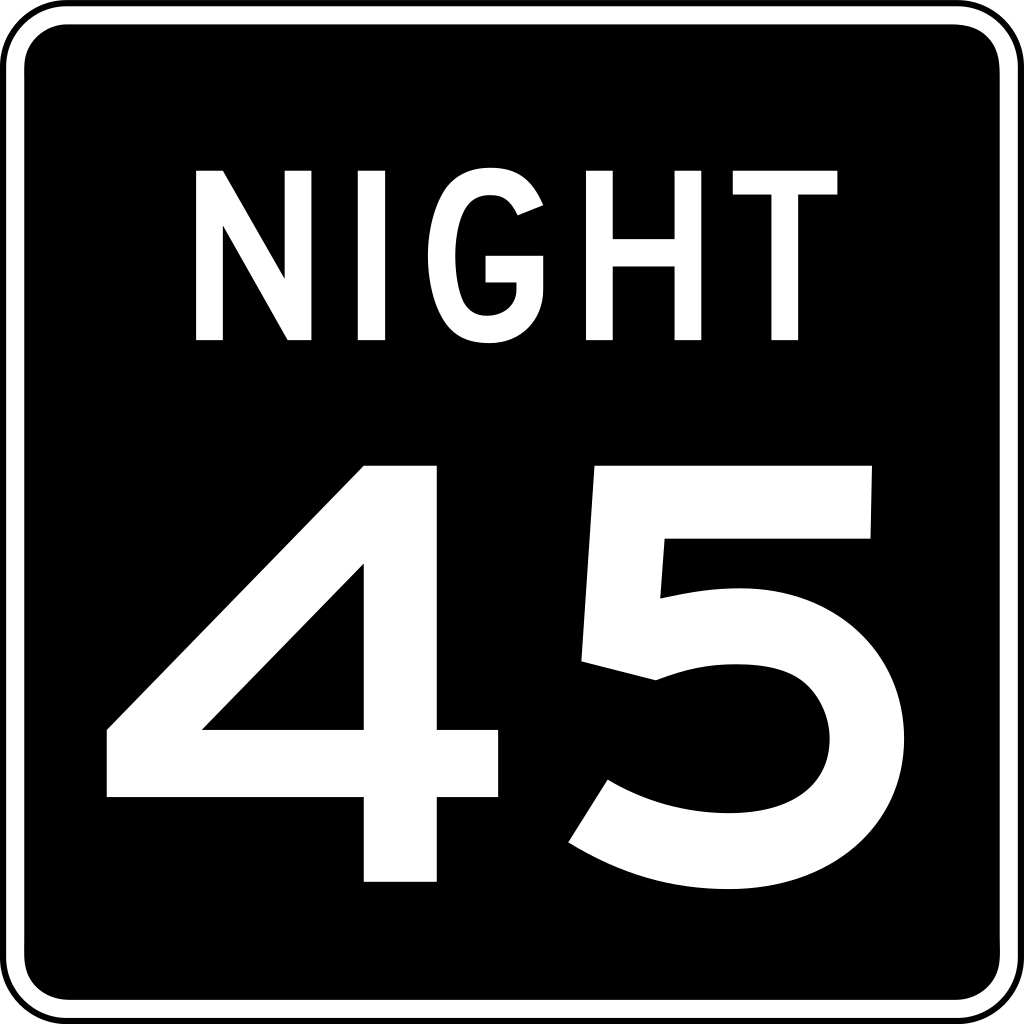
Indicates a lower maximum legal speed limit that applies only during nighttime hours for safety.
This sign means:
A) Take route 45 if you are driving at night.
B) The night-time speed limit is 45 MPH.
C) The minimum speed limit is 45 MPH.
40.
The roadway becomes particularly slippery during wet or rainy conditions. Reduce your speed, increase following distance, and avoid abrupt braking or steering.
When they see this sign, drivers:
A) should be prepared to make sharp turns at a high speed.
B) need to be prepared to turn right and then left quickly.
C) should not speed up or brake quickly.
41.
Two motorcyclists are allowed to:
A) ride side-by-side in a single lane.
B) share the lane with another vehicle.
C) race on empty roads.
42.
The roadway ahead is narrowing or a lane is ending. Merge smoothly into the continuing lane.
This road sign means:
A) Lane reduction - the left lane ends soon
B) Highway entrance ramp ahead
C) Lane reduction - the right lane ends soon
43.
Before driving after a snowfall, you should clear snow from your car's:
A) headlights.
B) turn signals.
C) windows.
D) All of the above.
44.
The roadway ahead is narrowing or a lane is ending. Merge smoothly into the continuing lane.
This road sign means:
A) No right turn
B) Divided highway ends
C) Lane ends
D) Two way Traffic
45.
Indicates a series of three or more consecutive sharp turns or curves ahead. Reduce speed and maintain lane control.
This road sign means:
A) Winding Road Ahead
B) No turns are allowed on this road
C) Right lane closed
D) Do Not Enter
46.
An edge line that angles toward the center of the road indicates that:
A) the road is narrower ahead.
B) there’s a narrow bridge ahead.
C) you must turn right.
47.
If you stop at a railroad crossing with more than one track:
A) proceed with caution until you see a train.
B) go through when one of the tracks is free.
C) go through as soon as the first train passes.
D) wait until you have a clear view of both tracks.
48.
The road makes a sharp 90-degree right turn ahead. Slow down considerably before entering the turn.
This sign warns drivers that:
A) the road will make a sharp turn to the right.
B) right turns are not allowed.
C) another road enters the highway from the direction shown.
49.
Indicates the maximum bridge or underpass vertical clearance. Vehicles taller than the posted height must not proceed.
This sign means:
A) Narrow bridge ahead. Slow down and drive with caution.
B) Do not to enter if your vehicle is taller than the height listed on the sign.
C) No passing zone ahead.
50.
Which of the following is a defensive driving skill/technique?
A) Maintain the correct speed.
B) Do not drive if you are very weary.
C) All of the above.
ANSWER KEY Check answers after completing the test.
1 B
2 B
3 B
4 A
5 A
6 C
7 B
8 B
9 C
10 A
11 D
12 C
13 B
14 C
15 A
16 A
17 B
18 B
19 D
20 B
21 D
22 C
23 B
24 C
25 A
26 B
27 B
28 A
29 B
30 A
31 C
32 D
33 C
34 B
35 C
36 C
37 D
38 B
39 B
40 C
41 A
42 C
43 D
44 C
45 A
46 A
47 D
48 A
49 B
50 C