←
Back to Test
Hide Answer Key
Print / Save as PDF
Print / PDF
drive
quiz
.com
WI DMV PERMİT PRACTİCE TEST 12
Wisconsin
Duration: 44 min
|
Questions: 48
Student Name:
Date:
Correct:
Incorrect:
Score:
1.
Work zone signs:
A)
mean that road conditions will improve soon.
B)
mean that drivers must come to a complete stop and back up.
C)
provide information on road work or other temporary road conditions.
D)
mean that drivers should drive faster to get out of the work zone.
2.
A flashing red light:
A)
is used at dangerous intersections.
B)
means the same thing as a stop sign.
C)
All of the above.
3.
Lanes of traffic moving in the same direction are divided by ____ lines.
A)
orange
B)
yellow
C)
black
D)
white
4.
This road sign means:
A)
The left lane ends soon
B)
one-way street ahead.
C)
The right lane ends soon
D)
Highway entrance ramp ahead
5.
Drivers often fail to see a motorcycle headed toward them. Why?
A)
It is difficult to judge a motorcycle's speed.
B)
Motorcycles are hard to see.
C)
All of the above.
6.
This sign means:
A)
You can only park between 8:30 AM and 5:30 PM.
B)
Parking is not allowed at 8:30 AM and at 5:30 PM
C)
No parking between 8:30 AM and 5:30 PM.
7.
You are approaching an intersection with a yellow flashing light. You should:
A)
stop and wait for the light to change.
B)
speed up to beat the red light.
C)
prepare to stop; the light is about to turn red.
D)
proceed with caution through the intersection.
8.
If you need to make an emergency stop:
A)
sound your horn at passing vehicles to alert other drivers.
B)
turn on your emergency flashers and stay in your vehicle if safe.
C)
get out of the vehicle once you have stopped.
9.
This road sign means:
A)
Divided highway ahead
B)
Two-way traffic ahead
C)
Four-lane traffic ahead
10.
When passing another vehicle, you should:
A)
assume the other vehicle will maintain a constant speed.
B)
check your mirrors and blind spots.
C)
drive at the same speed as the vehicle you are passing.
11.
This sign indicates that:
A)
there is a steep hill ahead.
B)
trucks are merging from the right
C)
there's a side road ahead
12.
When riding in a vehicle equipped with air bags is, children ages 12 and under are safer:
A)
buckled up in the back seat.
B)
in the bed of a pick-up truck.
C)
buckled up in the front seat.
13.
This road sign means:
A)
No left turn
B)
No U-turn
C)
Detour ahead
14.
You hear a siren close by but can not see where the emergency vehicle is. What do you do?
A)
Keep driving until you are sure the emergency vehicle is headed toward you.
B)
Stop immediately and activate your emergency flashers.
C)
Pull over to the right side of the road and stop until you are sure the emergency vehicle is not headed toward you.
15.
What is a likely effect when you take another drug while you drink alcohol?
A)
The effects of the alcohol and the drug are enhanced.
B)
There are no effects, unless the drug is prescription only.
C)
If the drug is over-the-counter, there are no effects.
16.
When changing lanes, you should remember that:
A)
vehicles with two outside mirrors have no blind spots.
B)
You only need to turn and look over your right shoulder for lane changes to the right or left.
C)
you should look over your left shoulder for a left lane change and your right shoulder for a right lane change.
17.
This sign means:
A)
divided highway ahead.
B)
narrow bridge ahead.
C)
road construction.
D)
lane ends, merge left.
18.
Your first response to reduced visibility should be:
A)
to look for road edge markings to guide you.
B)
to turn on your windshield wipers.
C)
to reduce your speed.
D)
to turn on your headlights.
19.
When they see a crossbuck sign, drivers:
A)
must slow down and wait for the red lights to flash.
B)
must always come to a complete stop.
C)
are legally required to yield the right of way to trains.
20.
When a hazard is seen ahead, reaction distance:
A)
is the sum of perception distance and braking distance.
B)
equals total stopping distance minus perception distance.
C)
is how far a vehicle will continue to travel, in ideal conditions, before the driver hits the brakes.
21.
This sign indicates:
A)
a side road.
B)
a cross road.
C)
a church zone ahead.
22.
Drivers who eat and drink while driving:
A)
have no driving errors.
B)
may have trouble controlling their vehicles.
C)
must yield the right-of-way.
D)
tend to be more aggressive.
23.
It is illegal to park within _____ feet of a fire hydrant.
A)
25
B)
15
C)
10
D)
20
24.
This sign means:
A)
Bicycles should yield to vehicles ahead.
B)
Warning: a bikeway crosses the roadway ahead.
C)
The lane ahead is reserved for bicycles.
25.
The following symptoms are associated with drowsy driving:
A)
You continue to yawn.
B)
You don’t remember driving the last few miles.
C)
All of the above.
26.
Gauging the speed of a motorcycle may be difficult because:
A)
motorcycles take up less of your field of vision.
B)
motorcycles often slow down by downshifting.
C)
many motorcyclists do not activate the brake light.
27.
What should you do if your headlights suddenly go out?
A)
Brake immediately and activate your emergency lights.
B)
Use your emergency lights, parking lights or directional signals.
C)
Ease your foot off the gas pedal and brake gently.
28.
When approaching any intersection or driveway, drivers should:
A)
look both ways and be ready to stop.
B)
pass other vehicles and then stop.
C)
drive at the fastest speed just before entering the intersection.
29.
What should you do if a vehicle is approaching head-on in your lane?
A)
Pull over to the left and use your emergency lights to stop the other driver.
B)
Decrease speed, pull over to the right and sound your horn to warn the other driver.
C)
Turn off the ignition if your vehicle has power steering.
30.
You need extra following distance when:
A)
following a motorcycle.
B)
there are no vehicles behind you.
C)
following a passenger car.
D)
None of the above.
31.
To reduce road rage, you should:
A)
always signal your intention when changing lanes.
B)
use your horn frequently to warn other drivers.
C)
talk on your cell phone while driving.
32.
When changing lanes:
A)
slow down and check your left mirror.
B)
look over your shoulder to make sure no one is in the blind spot.
C)
change lane before checking the inside rearview mirror.
33.
When approaching a railroad crossing drivers should:
A)
slow down.
B)
be ready to stop.
C)
look for a train.
D)
All of the above.
34.
Select the most effective safety restraint(s) in a traffic crash.
A)
Lap and shoulder belt only
B)
Air bag only
C)
Pumping brakes.
D)
A combination of lap/shoulder belt and air bag.
35.
As you enter a roundabout you should slow down and:
A)
yield to pedestrians and bicyclist crossing before entering the roundabout.
B)
yield to any vehicle coming from your left in the roundabout.
C)
All of the above.
36.
Which of the following does NOT affect the distance that it takes to stop your vehicle?
A)
Perception time.
B)
Braking distance.
C)
Reaction distance.
D)
Steering ability.
37.
This sign means:
A)
The road will curve to the right, then to the left.
B)
Road slippery when wet. Drive slowly.
C)
Winding road ahead. Drive with caution.
38.
Speed limit signs are:
A)
service signs
B)
regulation signs (regulatory signs)
C)
warning signs
39.
A driver cuts off another vehicle, or threatens another motorist or a pedestrian. These are examples of:
A)
excessive driving
B)
road rage
C)
defensive driving
40.
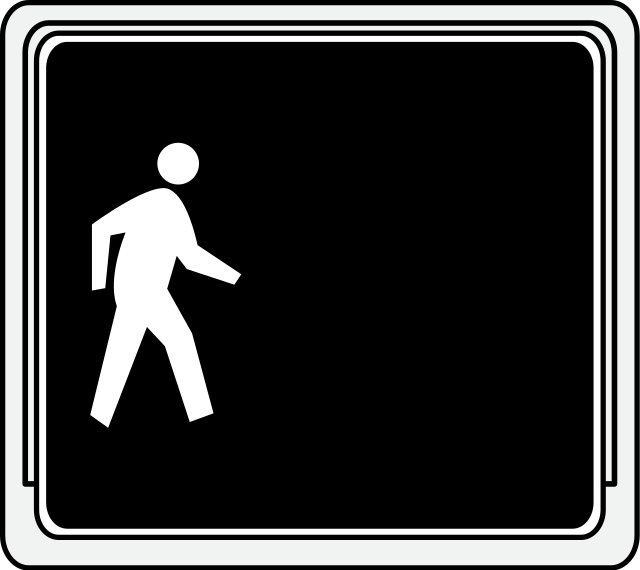
What does the pictured signal indicate?
A)
A pedestrian may begin crossing the street.
B)
Pedestrians may turn right.
C)
A pedestrian may not not begin crossing the street.
41.
This road sign means:
A)
No left turn
B)
No right turn
C)
No U-turns
42.
Bicyclists must:
A)
ride in a bicycle lane, if available.
B)
remain to the right when they prepare for a left turn.
C)
remain near the left edge of the road.
43.
When a driver is turning and a pedestrian is crossing without a traffic light, __________ must yield the right-of-way.
A)
the pedestrian
B)
the driver
C)
both
D)
whoever is slower
44.
To avoid the risk of being involved in an alcohol-related crash, you should:
A)
decide before you start drinking that you are not going to drive.
B)
say 'No, thanks' if someone offers you alcohol.
C)
call a taxi if you've been drinking.
D)
All of the above.
45.
This road sign warns drivers that:
A)
left turns are not allowed at the intersection.
B)
the road will make a sharp turn to the right.
C)
another road enters the highway from the direction shown.
46.
It's 10 AM. This sign tells you that:
A)
you are allowed to park until 5:30 PM.
B)
you must display a special permit in order to park here.
C)
you are not allowed to park here.
47.
This road sign means:
A)
You have the right of way
B)
No Passing Zone
C)
Yield the right-of-way
48.
This road sign means:
A)
School zone ahead
B)
Side road
C)
Construction zone ahead
D)
Sharp turn, slow down
ANSWER KEY
Check answers after completing the test.
1
C
2
C
3
D
4
C
5
C
6
C
7
D
8
B
9
B
10
B
11
A
12
A
13
B
14
C
15
A
16
C
17
D
18
C
19
C
20
C
21
B
22
B
23
C
24
B
25
C
26
A
27
B
28
A
29
B
30
A
31
A
32
B
33
D
34
D
35
C
36
D
37
B
38
B
39
B
40
A
41
B
42
A
43
B
44
D
45
C
46
C
47
C
48
D