←
Back to Test
Hide Answer Key
Print / Save as PDF
Print / PDF
drive
quiz
.com
WI DMV PERMİT PRACTİCE TEST 11
Wisconsin
Duration: 44 min
|
Questions: 48
Student Name:
Date:
Correct:
Incorrect:
Score:
1.
If a traffic officer signals you to drive through a red light:
A)
you must do it.
B)
you must wait for the red light to turn green.
C)
you must not obey the officer. Signs and signals take precedence over directions given by traffic officers.
2.
When following another vehicle at night, drivers should use:
A)
low beam headlights.
B)
emergency flashers.
C)
high beam headlights.
3.
When two cars arrive at an intersection with no signs or signals at the same time, which car has the right-of-way?
A)
The car that is traveling faster.
B)
The car approaching from the right.
C)
The car approaching from the left.
D)
The car in which the driver sounds the horn.
4.
__________ limit(s) your concentration, perception, judgment, and memory.
A)
Even the smallest amount of alcohol
B)
Only a blood alcohol level greater than .05
C)
Alcohol does not
D)
Only a blood alcohol level greater than the legal limit
5.
What does a flashing red light mean?
A)
NO TURN ON RED.
B)
The same thing as a stop sign.
C)
Drivers may move forward with caution.
6.
This road sign means:
A)
No left turn
B)
No right turn
C)
No U-turns
7.
This road sign means:
A)
Divided highway ahead - stay to the right
B)
Do not enter
C)
Do not pass
8.
When drivers see the ‘Wrong Way’ sign:
A)
they are going the wrong way on an expressway exit ramp.
B)
they must drive past this sign and reach the next intersection.
C)
they must not leave the pavement except in an emergency.
9.
More than one vehicle is approaching a four-way stop sign. Who has the right of way?
A)
The first driver to reach the intersection and stop.
B)
The driver on the left.
C)
The last driver to reach the intersection.
10.
If you are pulled over by law enforcement, you should:
A)
stay in the driver’s seat with both hands clearly in sight on the steering wheel.
B)
unbuckle your seat belt and lower your window.
C)
get out of your vehicle and walk toward the patrol car.
D)
turn off on your interior light if stopped at night.
11.
___________ are green with white letters and symbols.
A)
Warning signs
B)
Destination signs (guide signs)
C)
Regulation signs (regulatory signs)
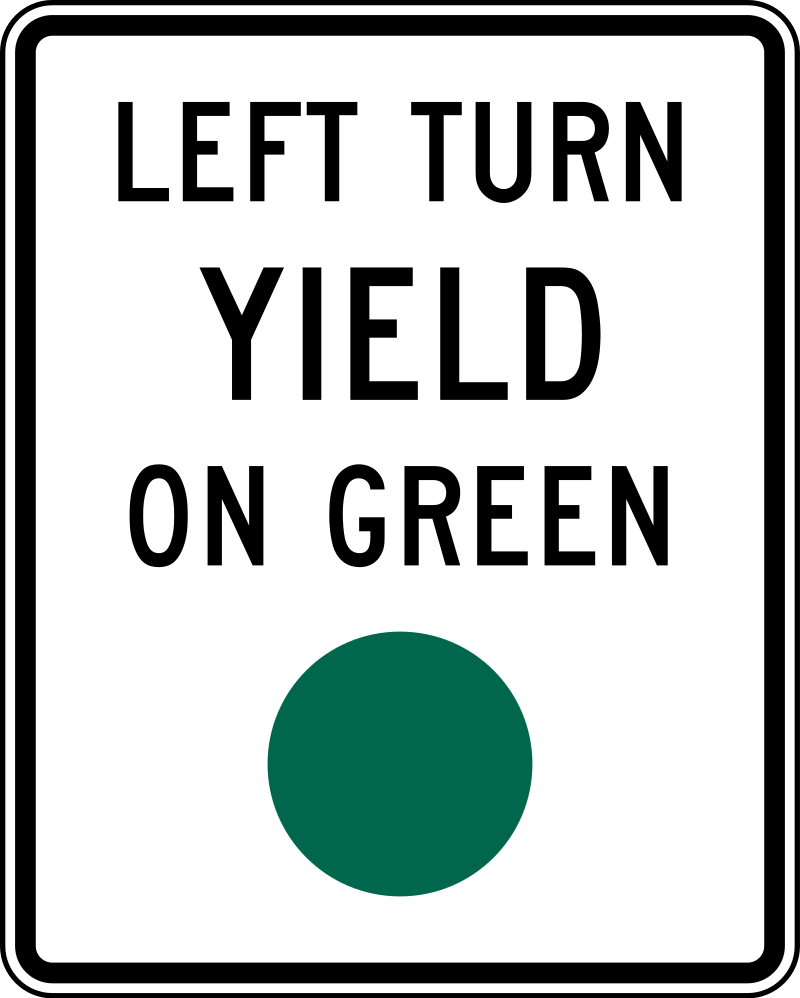
12.
This white sign means you:
A)
may turn left on a green light when it is safe to do so.
B)
may turn left only on a green arrow.
C)
must wait for the solid green light before you turn left.
13.
What does this sign indicate?
A)
The highway ahead is divided into two one-way roadways.
B)
Winding road ahead. Drive with caution.
C)
Drivers will soon be on a roadway with two-way traffic.
14.
Drinking alcohol while taking drugs:
A)
reduces the effects of the alcohol.
B)
reduces the effects of the drug or medicine.
C)
has no effect, they are different substances.
D)
could multiply the effects of the alcohol.
15.
What is the first thing you should do if your wheels move off the pavement?
A)
Pull the steering wheel back.
B)
Pull over to the right and sound your horn to warn the other drivers.
C)
Ease your foot off the gas pedal and brake gently.
16.
What does BAC stand for?
A)
Blood Alcohol Commission
B)
Blood Alcohol Concentration
C)
Blood Alcohol Content
17.
When you make a left turn from a one-way road into a one-way road, if the road you enter has two lanes, you:
A)
must turn into its right lane.
B)
can not turn left.
C)
must turn into its left lane.
18.
Driving at excessive speed:
A)
improves your reaction time.
B)
often leads to high-risk decision-making.
C)
does not increase the chance of a crash.
19.
This sign indicates:
A)
Warning: drunk drivers.
B)
Winding road. Drive with caution.
C)
The road may be slippery when wet. Drive slowly.
20.
When approaching a curve, remember to:
A)
accelerate slightly before entering the curve.
B)
drive at the posted speed limit throughout the curve.
C)
slow down before entering the curve.
D)
drive at the posted speed limit as you enter the curve, then slow down gradually.
21.
You are driving in the left lane and want to change to the right lane. Before changing lanes, you should check your mirrors, signal and:
A)
look over your left shoulder.
B)
look over both shoulders for vehicles in front of you.
C)
accelerate slightly before looking around your vehicle.
D)
look over your right shoulder.
22.
Before entering a traffic circle, drivers must slow down and yield to ___________ in the traffic circle.
A)
pedestrians
B)
vehicles
C)
bicyclists
D)
All of the above.
23.
The speed limit in outlying parts of cities with no posted speed limit is:
A)
65 MPH
B)
35 MPH
C)
15 MPH
D)
None of the above.
24.
From top to bottom, traffic lights are:
A)
green, red and yellow.
B)
green, yellow and red.
C)
red, yellow and green.
25.
Any use of a cell phone while operating a motor vehicle is considered a distraction because:
A)
it occupies the driver's mind, hands and eyes.
B)
it draws the attention of other drivers.
C)
it causes the driver to be concerned about the latest news.
26.
Before making a left turn from a one-way street, you must:
A)
be in the lane closest to the left curb.
B)
be in the lane closest to the right curb.
C)
be in the lane closest to the center of the street.
27.
When you make a left turn from a two-way road into a four-lane highway, you must:
A)
enter the left lane, to the right of the center line.
B)
enter the right lane, to the left of the center line.
C)
go straight through the intersection, and then make the turn.
28.
When you come to an intersection with a flashing red light, you must:
A)
stop at the intersection, then proceed when safe and observe the right-of-way rules.
B)
slow down and drive carefully through the intersection.
C)
stop at the intersection and wait for a flashing green light.
D)
stop only if cars are approaching the intersection.
29.
Never make a U-turn from:
A)
the lane you’re in.
B)
the right lane.
C)
the left part of the lane nearest to the centerline of the roadway.
30.
A single, dashed yellow line separating traffic means:
A)
Both lanes go in the same direction.
B)
Passing is not allowed.
C)
You may pass if it is safe to do so.
D)
All of the above.
31.
This sign indicates:
A)
Winding road
B)
Merging traffic
C)
Divided highway ends
32.
The driver is about to:
A)
turn right.
B)
turn left.
C)
stop.
33.
When getting ready to change lanes, you should:
A)
check your rearview mirror.
B)
quickly turn your head to check for other vehicles.
C)
check your side view mirror.
D)
All of the above.
34.
Anything that requires you to _______ could cause you to crash.
A)
take your hands off the wheel
B)
take your attention away from driving
C)
take your eyes off the road
D)
All of the above.
35.
The yield sign is ___ and white, with ___ letters.
A)
yellow; black
B)
red; red
C)
red; white
36.
When children are close, what should you do before you back out of a driveway?
A)
Rely on your mirrors.
B)
Get out of the car and check behind the car.
C)
Look through your back window for children.
37.
This sign warns of a ________ ahead.
A)
hill
B)
no passing zone
C)
soft shoulder
38.
This road sign warns drivers that:
A)
the road surface ahead changes to a low-type surface or earth road.
B)
vehicles must leave the pavement immediately.
C)
the dirt on the side of the road is soft.
39.
When turning, drivers should:
A)
always move to the right lane.
B)
check traffic in all directions.
C)
increase their speed to improve stability.
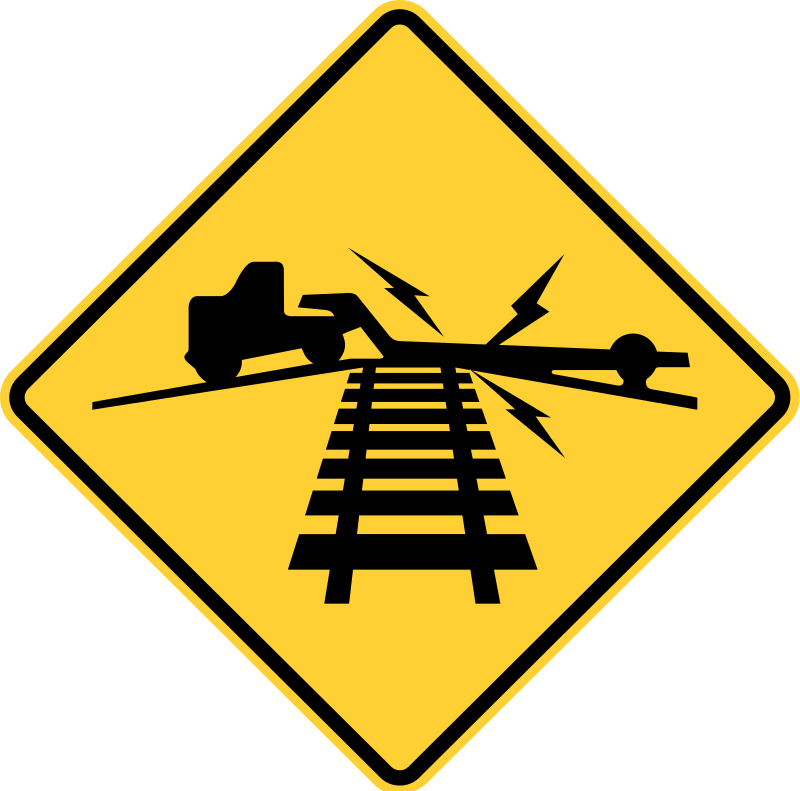
40.
This road sign means:
A)
Winding road ahead
B)
Pedestrian crossing
C)
Low ground railroad crossing
D)
No-passing zone
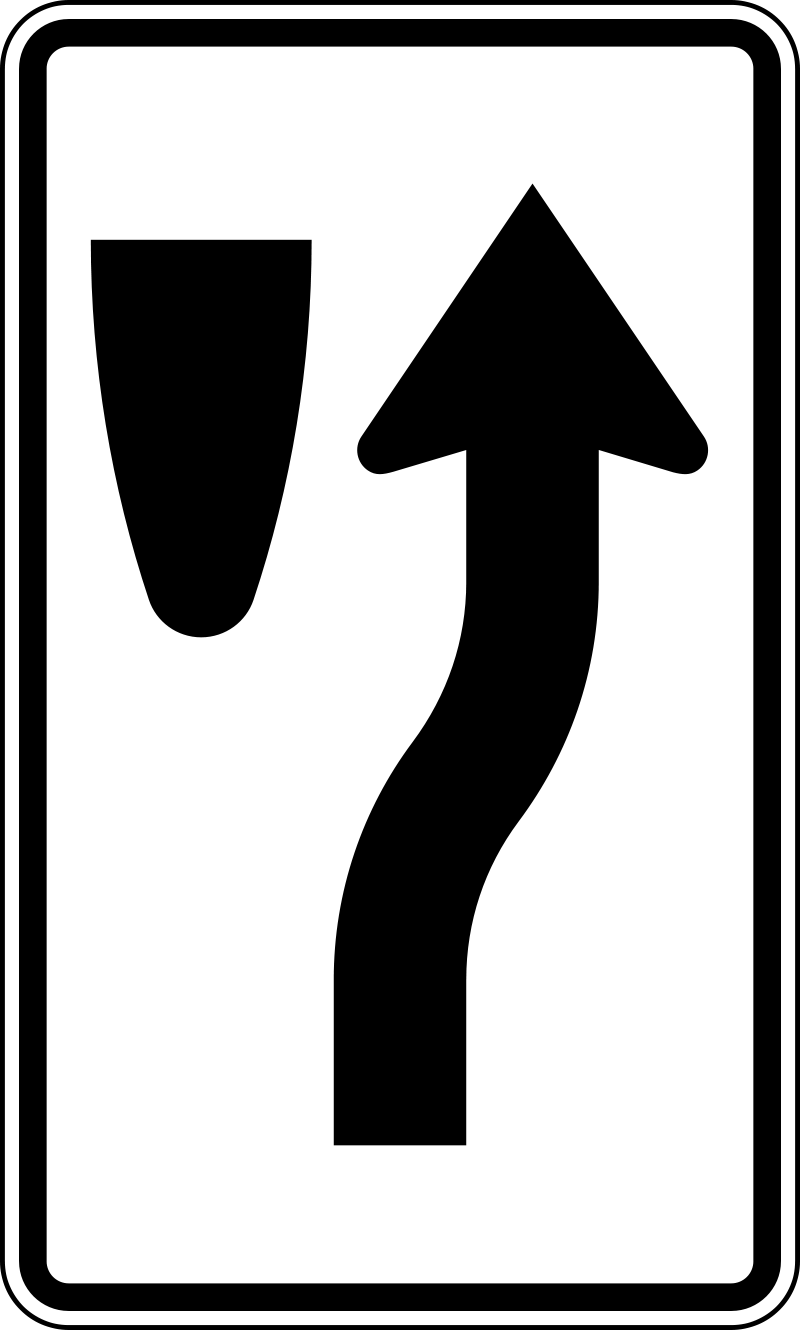
41.
This sign tells drivers that:
A)
there is a right turn ahead.
B)
they must stay on the right side of the divider
C)
a divided highway ends ahead.
42.
If a vehicle using high beams comes toward you, look towards __________ of the road.
A)
either side
B)
the center
C)
the right side
D)
the left side
43.
When turning left at an intersection:
A)
you should never yield to oncoming traffic and pedestrians.
B)
oncoming traffic and pedestrians should yield to you.
C)
you should always yield to oncoming traffic and pedestrians.
44.
If you meet a stopped school bus with the lights flashing and the signal arm extended, you should:
A)
proceed at 15 MPH or less, if no children are present.
B)
stop.
C)
watch for children and proceed at normal speed.
45.
If you are under 18, to qualify for a probationary license you must:
A)
have no moving traffic convictions in the past 6 months.
B)
have an instruction permit for at least 6 months.
C)
complete and approved driver education course.
D)
All of the above.
46.
Your blind spot is the area of the road:
A)
you see in your rearview mirror.
B)
directly behind your vehicle.
C)
you cannot see without moving your head.
D)
you see in your side mirror.
47.
This is:
A)
a side road sign.
B)
a merging traffic sign.
C)
a right curve sign.
48.
If traffic on the other side of an intersection is backed up and you cannot get completely through, you must:
A)
enter the intersection and try to avoid blocking it.
B)
enter the intersection and proceed with caution.
C)
wait until traffic ahead is clear.
ANSWER KEY
Check answers after completing the test.
1
A
2
A
3
B
4
A
5
B
6
B
7
A
8
A
9
A
10
A
11
B
12
A
13
C
14
D
15
C
16
B
17
C
18
B
19
C
20
C
21
D
22
D
23
B
24
C
25
A
26
A
27
A
28
A
29
B
30
C
31
B
32
B
33
D
34
D
35
B
36
B
37
A
38
A
39
B
40
C
41
B
42
C
43
C
44
B
45
D
46
C
47
A
48
C