DriveQuiz drivequiz.com

WA DMV PERMİT PRACTİCE TEST 7

Washington
Duration: 36 min
|
Questions: 40
Student Name:
Date:
Correct:      Incorrect:      Score:      
1.
Object marker used to mark obstacles or bridge abutments near the edge of the road to alert drivers at night.
When they see a yellow X signal, drivers should:
A) come to a complete stop at the marked stop line.
B) turn off the ignition.
C) prepare to leave the lane safely.
2.
When you pass another vehicle, before you return to the right lane, you must:
A) look at your interior rear-view mirror.
B) signal.
C) All of the above.
3.
If your front wheels start to skid, the first thing you should do is:
A) Take your foot off the gas pedal and shift to neutral.
B) Immediately turn in the direction you want to go.
C) Speed up, pump your brakes and steer in the direction the vehicle is trying to go.
4.
Who has a greater risk of being involved in a traffic crash?
A) Drivers who are driving alone.
B) Young people.
C) All of the above.
5.
Which shape is a yield sign?
A) Vertical rectangle
B) Upside-down triangle
C) Diamond
6.
You ________ traffic headed toward you when you turn left.
A) must not yield to
B) must interrupt
C) must yield to
7.
Which of the following is NOT true about ABS?
A) It improves the vehicle stability.
B) It helps increase your stopping distance.
C) It improves the steering ability.
8.
If your gas pedal is stuck, you should:
A) hook your shoe under the pedal and see if you can free it. If not, shift into neutral and use the brake to slow your vehicle and get off the road.
B) ease your foot off the gas pedal and brake gently.
C) turn off the ignition if your vehicle has power steering.
9.
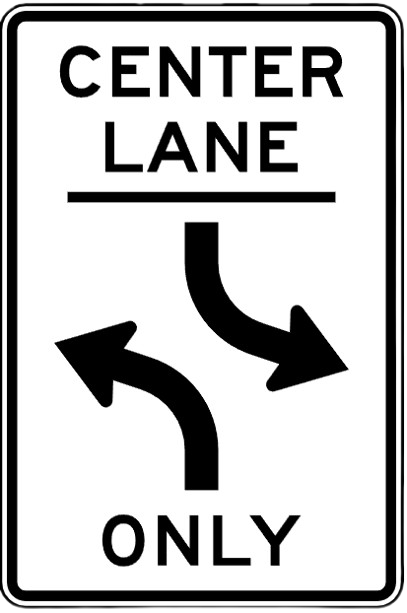
Indicates a two-way left-turn lane in the center of the road. Must only be used to make left turns or U-turns (where permitted), not for regular travel or passing.
This sign means:
A) The center lane is shared for left turns.
B) Left turns in both directions of travel are not permitted.
C) Vehicles may only turn left.
10.
The road curves gradually to the right ahead. Reduce speed before entering the curve.
When they see this sign, drivers should:
A) increase their speed and keep well to the right.
B) slow down and keep well to the right.
C) slow down and keep well to the left.
11.
More than one vehicle is approaching a four-way stop sign. Who has the right of way?
A) The first driver to reach the intersection and stop.
B) The driver on the left.
C) The last driver to reach the intersection.
12.
A solid yellow line to the right of a broken yellow center line means:
A) vehicles may cross these lines when changing lanes.
B) passing or crossing is prohibited in that lane, except when turning left.
C) shared lane ahead.
D) HOV lane.
13.
A flashing yellow light means:
A) Stop and look, then proceed through the intersection
B) Speed up to clear the intersection as soon as possible
C) Stop and wait for the green light
D) Slow down and proceed with caution
14.
When changing lanes, you should:
A) check your mirrors, signal and change lanes.
B) signal, change lanes and check your mirrors.
C) signal, check your mirrors and blind spot in the direction you plan to move, then change lanes.
D) signal and change lanes.
15.
Indicates that traffic is permitted to pass on either the left or the right side of an island, median, or obstruction.
This sign tells drivers that:
A) left and right turns are not allowed.
B) a divided highway is ahead.
C) they cannot go straight ahead.
16.
Another road crosses the highway ahead. Look left and right for crossing or entering vehicles.
This sign indicates:
A) a side road.
B) a cross road.
C) a church zone ahead.
17.
A steady red traffic light means:
A) Stop. Don’t travel straight ahead until the light turns green.
B) Stop, then proceed slowly through the intersection.
C) Drive through the intersection with extreme caution.
D) Slow down and yield to other traffic in the intersection, then proceed with caution.
18.
Parking is permitted only during specified hours and days as posted on the sign. Vehicles parked outside these hours are subject to ticketing or towing.
It's 10 AM. This sign tells you that:
A) you are allowed to park until 5:30 PM.
B) you must display a special permit in order to park here.
C) you are not allowed to park here.
19.
You may not turn right (or left from a one-way onto a one-way) while the traffic signal is red. Wait for the green signal before turning.
This sign tells drivers:
A) they must wait for the traffic signal to turn green before turning right or left.
B) they may not turn right or left during the red light.
C) All of the above.
20.
Unless otherwise posted, the maximum speed limit on streets in cities and towns is:
A) 30 MPH
B) 40 MPH
C) 25 MPH
D) 15 MPH
21.
Alerts drivers to an upcoming crosswalk where pedestrians frequently cross. Slow down and yield right-of-way to anyone in or about to enter the roadway.
This road sign means:
A) Railroad Crossing
B) One Way
C) Limited parking
22.
To check your blind spot before changing lanes:
A) look into the right side mirror.
B) look into the rearview mirror.
C) look over your shoulder in the direction you plan to move.
D) look into the left side mirror.
23.
When the driver behind you wants to pass, you should:
A) change lanes.
B) speed up.
C) use your brake lights.
D) slow down to allow room for the other driver to complete the pass safely.
24.
What is a likely effect when you take another drug while you drink alcohol?
A) The effects of the alcohol and the drug are enhanced.
B) There are no effects, unless the drug is prescription only.
C) If the drug is over-the-counter, there are no effects.
25.
A flashing red light means:
A) The same as a STOP sign.
B) The light will soon change to steady red.
C) Drive with caution.
26.
Come to a complete stop before the stop line, crosswalk, or intersection. Look left, right, and left again, and proceed only when it is safe and right-of-way is clear.
This road sign means:
A) Yield the right-of-way to oncoming vehicles
B) Stop if necessary
C) You must make a complete stop
D) Slow down or stop
27.
To reduce their chances of colliding with an animal, drivers should:
A) scan the sides of the road to watch for the reflection of vehicle headlights in the eyes of animals.
B) look well down the road and far off to each side.
C) All of the above.
28.
Perception distance is:
A) how far a vehicle travels, in ideal conditions, from the time the driver sees a hazard until his/her brain recognizes it.
B) how long it takes a driver to physically hit the brakes.
C) how far a drunk person can travel before coming to a complete stop in response to a hazard ahead.
D) how far a driver will continue to travel, in ideal conditions; before he/she physically hits the brakes.
29.
Are bicyclists required to obey traffic laws and signs?
A) No, bicyclists are considered pedestrians when it comes to the rules of the road.
B) Yes.
C) Yes, but only if they are riding in a bicycle lane.
30.
While inside the roundabout, you should:
A) remain in your lane until you are ready to exit.
B) change lanes before you check for vehicles behind you.
C) use your left turn signal if you are in position to exit now.
31.
Drivers may need more space in front of their vehicle:
A) when following motorcycles.
B) when carrying a heavy load or pulling a trailer.
C) All of the above.
32.
Alcohol:
A) is a stimulant.
B) improves your judgment.
C) slows your reaction time.
D) improves your focus.
33.
What do warning signs mean?
A) Danger ahead.
B) Drivers are approaching a location where there is a special rule.
C) All of the above.
34.
A flashing yellow light means:
A) The light will soon change from green to red.
B) Drive with caution.
C) Yield the right-of-way to other traffic at the intersection.
35.
Warns drivers that two separate lanes moving in the same direction are merging into one. Drivers in the right lane must adjust speed and merge smoothly with existing traffic.
This sign means:
A) A road crosses the main highway ahead.
B) The divided highway on which drivers are traveling ends ahead.
C) Drivers are coming to a point where another traffic lane joins the one they are on.
36.
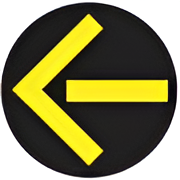
Unprotected left turns are allowed. You may turn left after yielding to oncoming traffic and pedestrians crossing the street.
What does a yellow arrow signal mean?
A) The same as the yellow light, but applies only to movement in the direction of the arrow.
B) The same as a green light.
C) Vehicles moving in all directions must stop if they can. The light will soon be red.
37.
The roadway becomes particularly slippery during wet or rainy conditions. Reduce your speed, increase following distance, and avoid abrupt braking or steering.
This sign means:
A) The road will curve to the right, then to the left.
B) Road slippery when wet. Drive slowly.
C) Winding road ahead. Drive with caution.
38.
A driver cuts off another vehicle, or threatens another motorist or a pedestrian. These are examples of:
A) excessive driving
B) road rage
C) defensive driving
39.
Right turns are strictly prohibited at this intersection under all circumstances.
This road sign means:
A) No left turn
B) No right turn
C) No U-turns
40.
Indicates a series of three or more consecutive sharp turns or curves ahead. Reduce speed and maintain lane control.
This road sign means:
A) Pavement ends
B) Winding road
C) Double curve ahead
ANSWER KEY Check answers after completing the test.
1 C
2 C
3 A
4 C
5 B
6 C
7 B
8 A
9 A
10 C
11 A
12 B
13 D
14 C
15 C
16 B
17 A
18 C
19 C
20 C
21 A
22 C
23 D
24 A
25 A
26 C
27 C
28 A
29 B
30 A
31 C
32 C
33 C
34 B
35 C
36 A
37 B
38 B
39 B
40 B