←
Back to Test
Hide Answer Key
Print / Save as PDF
Print / PDF
drive
quiz
.com
WA DMV PERMİT PRACTİCE TEST 2
Washington
Duration: 36 min
|
Questions: 40
Student Name:
Date:
Correct:
Incorrect:
Score:
1.
If the entrance lane is too short to allow acceleration to highway speed, you should:
A)
go to the next entrance ramp.
B)
stop and wait for a large gap in traffic, then enter the highway and accelerate quickly.
C)
merge into highway traffic as soon as possible.
2.
When following motorcycles, drivers should:
A)
reduce the minimum following distance.
B)
try to pass them as they have different braking capabilities than other motor vehicles.
C)
keep more space in front of their vehicle.
3.
When you make a left turn from a one-way road into a one-way road, if the road you enter has two lanes, you:
A)
must turn into its right lane.
B)
can not turn left.
C)
must turn into its left lane.
4.
Vehicles must be parked within ___ inches of the curb.
A)
6
B)
24
C)
12
D)
18
5.
Which shape is a speed limit sign?
A)
Round
B)
Pentagon
C)
Vertical rectangle
6.
You must notify the Department of Licensing within _________ of an address change.
A)
10 days
B)
3 weeks
C)
30 days
D)
3 months
7.
Drivers should be aware that a motorcyclist may:
A)
decrease speed and rise off the seat when approaching a railroad crossing.
B)
quickly change speed or lane position.
C)
All of the above.
8.
Aggressive driving includes:
A)
quick lane changes without a signal.
B)
chasing or challenging other drivers.
C)
All of the above.
9.
Your red traffic signal changes to green while a pedestrian is crossing in your traffic lane. The right of way should be given:
A)
by the pedestrian, but only when vehicles are turning left.
B)
by the pedestrian.
C)
to the pedestrian.
10.
A vehicle is stopped at a crosswalk to permit a pedestrian to cross the roadway. The driver of the vehicle approaching from the rear should:
A)
sound the horn.
B)
overtake and pass the stopped vehicle.
C)
not overtake and pass the stopped vehicle.
11.
A steady yellow light means:
A)
Be prepared to stop for the red light.
B)
Drive with caution.
C)
Be prepared to go. The light will soon be green.
12.
What is the purpose of minimum speed limits?
A)
To keep a smooth traffic flow.
B)
To halt the traffic flow.
C)
To allow emergency vehicles with red flashing lights to safely pass other vehicles.
13.
What is the meaning of red traffic signs?
A)
High emphasis warning.
B)
Stop, do not enter or wrong way.
C)
Regulatory.
14.
Bicyclists have the choice to ride on:
A)
the roadway.
B)
the shoulder of a road.
C)
All the other answers are correct.
D)
in a bicycle lane.
15.
This sign warns drivers that:
A)
the road will make a sharp turn to the right.
B)
right turns are not allowed.
C)
another road enters the highway from the direction shown.
16.
The ‘Slower Traffic Keep Right’ sign is used:
A)
at most intersections.
B)
on multiple lane highways.
C)
in school zones.
17.
Doing all you can to prevent crashes is called:
A)
Anti-Collision Driving
B)
Crash-Prevention Driving
C)
Defensive Driving
D)
ABS Driving
18.
___________ normally are white rectangles with black letters or symbols.
A)
Warning signs
B)
Destination signs (guide signs)
C)
Regulation signs (regulatory signs)
19.
When driving in travel lanes on the roadway:
A)
you may make a U-turn if you get on the wrong entrance ramp of the freeway.
B)
you may stop to let out passengers.
C)
do not stop for any reason, keep moving until you can safely pull off the road.
D)
you may make back up quickly if there are no vehicles behind.
20.
If your brakes are wet, you can dry them by:
A)
riding the pedal lightly.
B)
pull over to the right and wait until it stops raining.
C)
having them checked by a mechanic.
21.
This sign means drivers should:
A)
not drive in this lane.
B)
give the right-of-way to traffic on the road they wish to enter.
C)
proceed at normal speed through the upcoming intersection.
D)
come to a complete stop and check for oncoming traffic before proceeding.
22.
When approaching any intersection or driveway, drivers should:
A)
look both ways and be ready to stop.
B)
pass other vehicles and then stop.
C)
drive at the fastest speed just before entering the intersection.
23.
When approaching a highway-rail intersection, the first sign drivers see is usually:
A)
an RXR round sign on a yellow background.
B)
a stop sign.
C)
a yield sign.
24.
Diamond-shaped signs:
A)
are used to warn of hazards on roadways.
B)
indicate no pass zones.
C)
typically provide guidance to drivers.
25.
What should you do if your headlights suddenly go out?
A)
Brake immediately and activate your emergency lights.
B)
Use your emergency lights, parking lights or directional signals.
C)
Ease your foot off the gas pedal and brake gently.
26.
What should you do in case of a brake failure?
A)
Pull off the road into an open space, if available.
B)
Apply the parking brake slowly.
C)
All of the above.
27.
This sign tells drivers that:
A)
they must make a left turn at the intersection.
B)
U-turns are not allowed.
C)
they must not make a right turn.
D)
None of the above.
28.
Where must a pedestrian walk when there are no sidewalks?
A)
On the side of the road, in the same direction of traffic.
B)
In the middle of the road, facing oncoming traffic.
C)
On the side of the road, facing the traffic.
29.
Your body gets rid of ____ alcoholic drink an hour.
A)
three
B)
one
C)
two
D)
None of the above.
30.
When you drive near parks and playgrounds, you should expect children:
A)
not to cross unless they are with an adult.
B)
to know when it is safe to cross.
C)
to stop at the curb before crossing the street.
D)
to suddenly run into the street.
31.
When driving in heavy rain, drivers should use:
A)
parking lights.
B)
low beam headlights.
C)
high beam headlights.
32.
A vehicle that enters a road from a driveway:
A)
has the right-of-way.
B)
must yield to traffic approaching from the right, while it has the right-of-way over vehicles approaching from the left.
C)
must stop and yield the right-of-way to traffic on the roadway and to pedestrians.
33.
If a broken yellow line is on your side of the center line:
A)
you may not pass other vehicles.
B)
you may cross the line to pass other vehicles.
C)
you are driving in the left lane.
D)
you have the right-of-way when turning left.
34.
This sign means:
A)
Bicycles should yield to vehicles ahead.
B)
Warning: a bikeway crosses the roadway ahead.
C)
The lane ahead is reserved for bicycles.
35.
What do pennant-shaped signs indicate?
A)
A school crossing
B)
Yield
C)
A No Passing Zone
36.
To drive defensively, you must:
A)
avoid scanning the road ahead.
B)
keep one hand on the steering wheel.
C)
keep your eyes moving.
37.
A broken white line:
A)
means passing or crossing is prohibited in that lane.
B)
separates two lanes traveling in the same direction.
C)
marks the right edge of the roadway.
38.
Left turns on a red light are allowed:
A)
from a one-way street into a one-way street.
B)
Never.
C)
at intersections, after stopping, if the way is clear.
39.
Road signs that direct drivers to services are:
A)
brown and white.
B)
blue and white.
C)
green and white.
40.
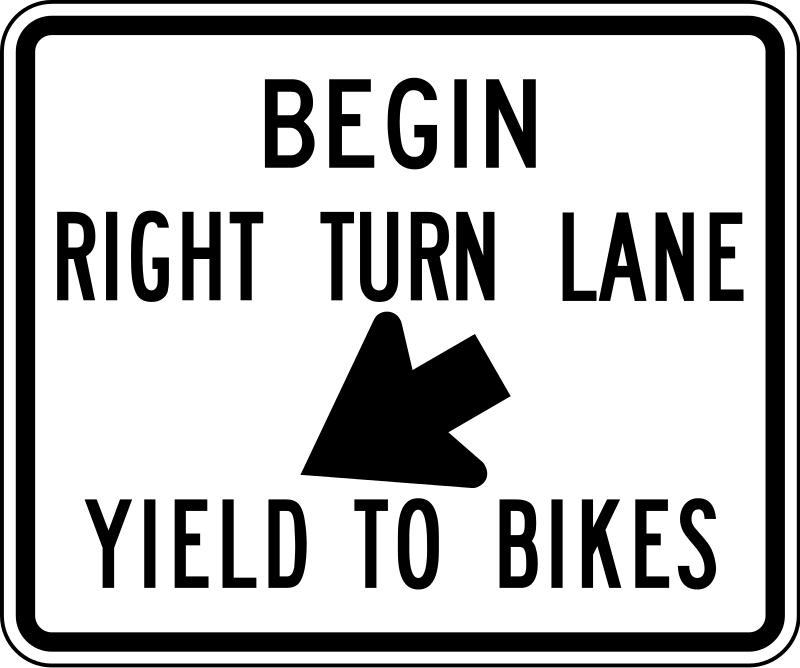
What does this road sign indicate?
A)
Drivers have the right of way over bikes turning left.
B)
Vehicles turning left must yield to bikes entering a right turn lane.
C)
Motor vehicles entering an exclusive right-turn lane must weave across bicycle traffic in bicycle lanes.
ANSWER KEY
Check answers after completing the test.
1
B
2
C
3
C
4
C
5
C
6
A
7
C
8
C
9
C
10
C
11
A
12
A
13
B
14
C
15
A
16
B
17
C
18
C
19
C
20
A
21
B
22
A
23
A
24
A
25
B
26
C
27
C
28
C
29
B
30
D
31
B
32
C
33
B
34
B
35
C
36
C
37
B
38
A
39
B
40
C