DriveQuiz drivequiz.com

UT DMV PERMİT PRACTİCE TEST 8

Utah
Duration: 23 min
|
Questions: 25
Student Name:
Date:
Correct:      Incorrect:      Score:      
1.
When driving on slippery roads, drivers should:
A) increase their following distance.
B) avoid crossing bridges or intersections.
C) brake harder than usual.
D) change lanes quickly.
2.
Slow down and give right-of-way to all oncoming vehicles, cyclists, and pedestrians. Stop completely if necessary before entering the intersection or merging.
This road sign means:
A) You must come to a complete stop
B) Do not enter
C) Slow down, stop if necessary and yield the right-of-way
D) Merging traffic
3.
An edge line that angles toward the center of the road indicates that:
A) the road is narrower ahead.
B) there’s a narrow bridge ahead.
C) you must turn right.
4.
When driving in heavy traffic, you should:
A) drive with the flow of traffic.
B) maintain a constant speed.
C) drive faster than the flow of traffic.
D) drive slower than the flow of traffic.
5.
Which of the following does NOT affect the distance that it takes to stop your vehicle?
A) Perception time.
B) Braking distance.
C) Reaction distance.
D) Steering ability.
6.
Treat the flashing red signal exactly like a STOP sign: come to a complete stop, yield to cross traffic and pedestrians, then proceed when safe.
A flashing red light:
A) is used at dangerous intersections.
B) means the same thing as a stop sign.
C) All of the above.
7.
Double solid lines on the roadway mean:
A) you cannot pass.
B) you can not go across the lines except to turn left to enter or leave the highway.
C) All of the above.
8.
Studies show that wearing seat belts:
A) reduces your chances of serious injury in a crash.
B) increases your chances of fatality in a crash.
C) reduces your chances of damaging your car in a crash.
D) All of the above.
9.
Motor crashes are caused by:
A) experienced drivers.
B) errors on the part of the driver.
C) wet pavement.
D) large trucks.
10.
Which of the following must you obey over the others?
A) A flashing red light.
B) A stop sign.
C) A steady red light.
D) A police officer.
11.
When a ‘Road Closed’ sign is displayed, drivers must:
A) make a U-turn.
B) look for a detour or another route.
C) come to a complete stop and wait for the lights to turn green.
12.
Indicates an upcoming bicycle crossing or shared road zone. Always leave at least 3 feet of clearance when passing cyclists.
This road sign means:
A) Watch for bicycles
B) Bicycle parking ahead
C) Bicycles are not allowed in this area
13.
Are bicyclists required to obey traffic laws and signs?
A) No, bicyclists are considered pedestrians when it comes to the rules of the road.
B) Yes.
C) Yes, but only if they are riding in a bicycle lane.
14.
Drivers may continue carefully through a yellow light if:
A) there are no pedestrians crossing.
B) they are turning right.
C) they already are within the intersection.
D) an emergency vehicle is crossing your lane.
15.
As you approach an intersection, the traffic light changes from green to yellow. You should:
A) apply the brakes sharply and come to a complete stop.
B) be prepared to stop before the intersection.
C) be prepared to stop in the middle of the intersection.
D) speed up to beat the red light.
16.
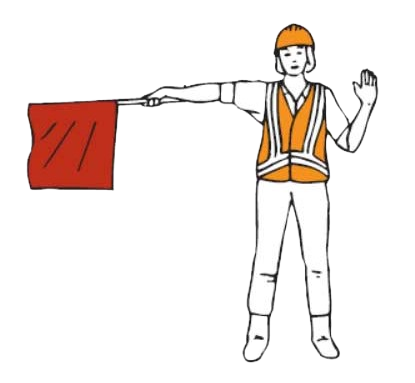
Driver arm extended downward out the left window with palm facing rearward signals an intention to slow down or stop completely.
This signal means:
A) Stop
B) Move to the left
C) Slow down
D) Proceed
17.
Regulation signs normally are ____ rectangles with ____ letters or symbols.
A) yellow; black
B) white; black
C) green; white
18.
Aggressive drivers:
A) run stop signs.
B) are high risk drivers.
C) tailgate other vehicles and make improper lane changes.
D) All of the above.
19.
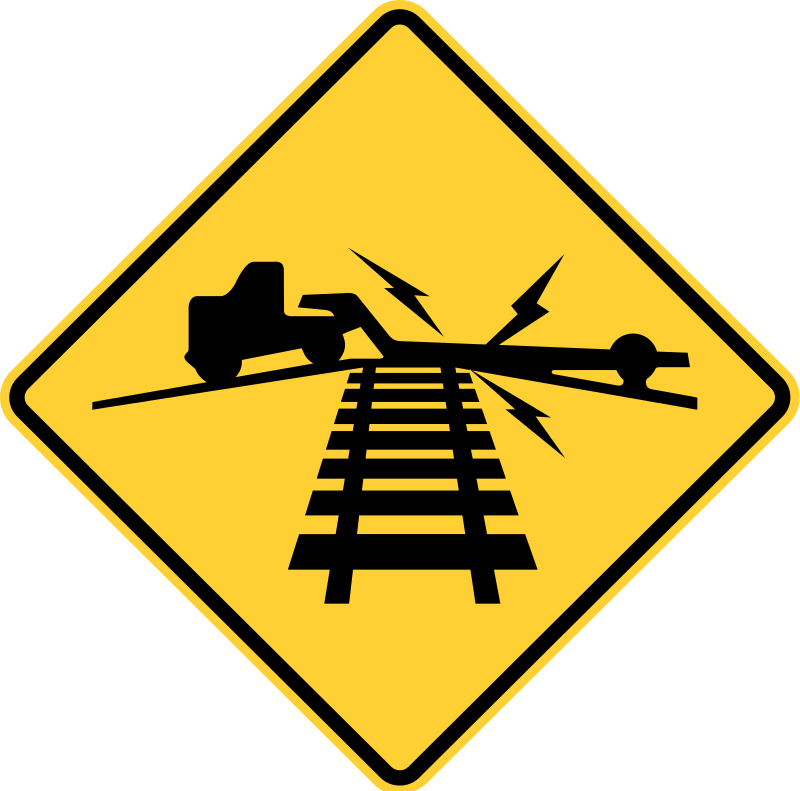
Warns of a high-centered or steep railroad hump crossing where long-wheelbase or low-slung vehicles may become stuck on the tracks.
This road sign means:
A) Winding road ahead
B) Pedestrian crossing
C) Low ground railroad crossing
D) No-passing zone
20.
A driver approaching a flashing red traffic signal must:
A) merge to the left.
B) stop before the intersection.
C) carefully drive through the intersection without stopping.
D) slow down at the traffic signal.
21.
You are stopped at a stop sign and you are going to go straight through the intersection. A car on the cross road has stopped at a stop sign on your right and is going to go straight. Who has the right-of-way?
A) Whoever enters the intersection first.
B) You.
C) The car on your right.
22.
Drivers approaching a green traffic light:
A) must yield to oncoming traffic before making a left hand turn.
B) always have the right of way.
C) must merge to the left, if possible.
D) must stop before proceeding through the intersection.
23.
Tailgating:
A) cannot result in a traffic citation.
B) helps reduce traffic congestion.
C) is a defensive driving tecnique.
D) can frustrate other drivers and make them angry.
24.
The road ahead is divided by a median strip or physical barrier into two separate one-way roadways. Keep to the right of the divider.
This sign means:
A) Divided highway ahead.
B) Divided highway ends.
C) Drivers will soon be on a roadway with two-way traffic.
25.
The amount of space you need to cross traffic depends on the:
A) road and weather conditions and oncoming traffic.
B) number of cars behind you.
C) presence of a yield sign.
D) number of cars in front of you.
ANSWER KEY Check answers after completing the test.
1 A
2 C
3 A
4 A
5 D
6 C
7 C
8 A
9 B
10 D
11 B
12 A
13 B
14 C
15 B
16 A
17 B
18 D
19 C
20 B
21 C
22 A
23 D
24 A
25 A