The best way to avoid loss of control in wet conditions is pump your brakes.
A)False
B)True
3.
Drivers must yield for emergency vehicles:
A)Never.
B)only when other vehicles yield.
C)when they see a flashing red or blue light or hear a siren.
D)None of the above.
4.
This road sign means:
A)Divided highway ahead
B)Two-way traffic ahead
C)Four-lane traffic ahead
5.
Drinking alcohol while taking drugs:
A)reduces the effects of the alcohol.
B)reduces the effects of the drug or medicine.
C)has no effect, they are different substances.
D)could multiply the effects of the alcohol.
6.
On what three conditions does your blood alcohol content (BAC) depend?
A)Your weight. How much alcohol you drink. How much time passes between drinks.
B)Your weight. The type of beverage you drink. How fit you are.
C)Your height. How much alcohol you drink. The type of beverage you drink.
7.
You may not pass another vehicle on either side of a _______ centerline.
A)solid or broken yellow
B)single broken white
C)double solid yellow
D)single broken yellow
8.
A steady yellow light means:
A)Be prepared to stop for the red light.
B)Drive with caution.
C)Be prepared to go. The light will soon be green.
9.
What is the meaning of orange traffic signs?
A)Yield.
B)Warning of school, pedestrian, and bicycling activity.
C)Construction and maintenance warning.
10.
This sign means drivers should:
A)not drive in this lane.
B)give the right-of-way to traffic on the road they wish to enter.
C)proceed at normal speed through the upcoming intersection.
D)come to a complete stop and check for oncoming traffic before proceeding.
11.
This road sign means:
A)Divided highway ahead - stay to the right
B)Do not enter
C)Do not pass
12.
Your BAC depends on:
A)how fit you are.
B)the type of beverage you drink.
C)the amount of alcohol you drink.
13.
You ________ traffic headed toward you when you turn left.
A)must not yield to
B)must interrupt
C)must yield to
14.
When approaching a highway-rail intersection, the first sign drivers see is usually:
A)an RXR round sign on a yellow background.
B)a stop sign.
C)a yield sign.
15.
You can reduce the chance of a collision with a large vehicle if you:
A)delay near it.
B)cut abruptly in front of it.
C)pay close attention to the turn signals.
16.
Motorcyclists are entitled to use the full width of a traffic lane; therefore, a driver should pass a motorcycle the same way as passing another vehicle.
A)False
B)True
17.
When parking uphill on a road with a curb, turn the front wheels:
A)towards the curb.
B)parallel to the curb.
C)straight ahead.
D)away from the curb.
18.
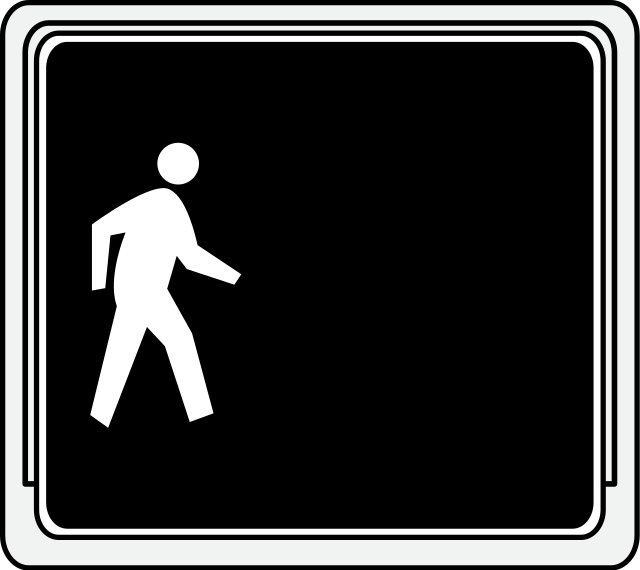
What does the pictured signal indicate?
A)A pedestrian may begin crossing the street.
B)Pedestrians may turn right.
C)A pedestrian may not not begin crossing the street.
19.
___________ are green with white letters and symbols.
A)Warning signs
B)Destination signs (guide signs)
C)Regulation signs (regulatory signs)
20.
When driving behind a motorcycle, drivers must:
A)remembers that motorcyclists have the right to use a complete traffic lane.
B)pass the motorcycle in the same lane.
C)drive on the shoulder beside the motorcycle.
D)share the lane with the motorcycle.
21.
When following motorcycles, drivers should:
A)reduce the minimum following distance.
B)try to pass them as they have different braking capabilities than other motor vehicles.
C)keep more space in front of their vehicle.
22.
Who has a greater risk of being involved in a traffic crash?
A)Drivers who are driving alone.
B)Young people.
C)All of the above.
23.
When getting ready to change lanes, you should:
A)check your rearview mirror.
B)quickly turn your head to check for other vehicles.
C)check your side view mirror.
D)All of the above.
24.
This sign warns drivers of:
A)a side road.
B)a sharp turn.
C)a cross road.
25.
Before a school bus stops to load passengers, the driver will usually flash:
A)yellow warning lights.
B)red warning lights.
C)red lights.
ANSWER KEYCheck answers after completing the test.