←
Back to Test
Hide Answer Key
Print / Save as PDF
Print / PDF
drive
quiz
.com
TX DMV PERMİT PRACTİCE TEST 4
Texas
Duration: 27 min
|
Questions: 30
Student Name:
Date:
Correct:
Incorrect:
Score:
1.
What type of pavement marking shows you which lane you must use for a turn?
A)
Edge line
B)
Diamond
C)
Crosswalk Lines
D)
Arrows
2.
Who is most at risk?
A)
Drivers who have overslept.
B)
Drivers who are driving long distances without rest breaks.
C)
Experienced drivers.
3.
If your car breaks down on the highway, you should:
A)
use your four-way flashers to warn other drivers.
B)
sound your horn to warn passing vehicles.
C)
flash your headlights at oncoming traffic.
D)
stop in the right lane.
4.
Your brake lights tell other drivers that you:
A)
are changing lanes.
B)
are slowing down or stopping.
C)
are making a turn.
D)
have your emergency brake on.
5.
Most signs used in street work areas are:
A)
round.
B)
diamond shaped.
C)
rectangle shaped.
6.
Green and white signs:
A)
give information about directions and distances.
B)
are mainly used at intersections and driveways.
C)
warn drivers of unexpected road conditions.
7.
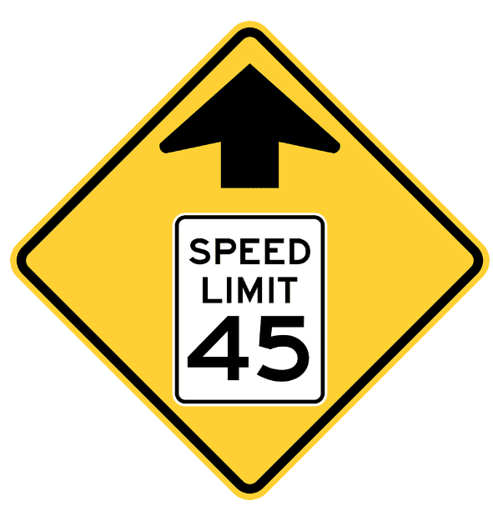
This warning sign:
A)
provides advance notice to upcoming speed limit change.
B)
shows the current speed limit that all vehicles traveling in the direction of the arrow must not exceed.
C)
indicates the suggested highest safe speed.
8.
To avoid being in a truck driver’s blind spot, you should:
A)
never pass the truck and put your headlights on.
B)
avoid driving on either side of the truck and don’t tailgate.
C)
flash your lights.
D)
sound your horn.
9.
While inside the roundabout, you should:
A)
remain in your lane until you are ready to exit.
B)
change lanes before you check for vehicles behind you.
C)
use your left turn signal if you are in position to exit now.
10.
Blind spots are:
A)
Dangerous intersection where the maximum speed limit is 15 MPH or less.
B)
At night, the darkest areas of a road, where emergency flashers should be used.
C)
Areas to the side or rear of a vehicle that the driver cannot see with use of mirrors.
11.
This road sign means:
A)
Traffic increases ahead
B)
Steep grade ahead
C)
Winding road ahead
D)
Slippery road ahead
12.
Which sign has white letters on a red background?
A)
Stop
B)
School zone
C)
Yield
13.
What does this road sign indicate?
A)
Hospital service
B)
Area reserved for people with disabilities
C)
Interstate highway
14.
This sign indicates:
A)
A slow-moving vehicle
B)
A no-passing zone
C)
Yield
15.
Smoking while driving:
A)
does not affect driving abilities.
B)
is not distracting.
C)
helps increase driver alertness.
D)
is distracting.
16.
Are drivers allowed to exceed the speed limit to pass other vehicles?
A)
Yes, but only by 10 MPH or less.
B)
No.
C)
Yes, but only if they drive with caution.
17.
To enter a freeway:
A)
signal, yield, and enter at the same speed that traffic is moving.
B)
drive slowly so you can check traffic.
C)
signal and enter the freeway. You have the right-of-way.
D)
make a complete stop before entering the freeway.
18.
If you missed your exit on a freeway, you should:
A)
use the right turn signal, check your mirrors and move to the right.
B)
None of the above.
C)
go to the next exit and come back to the exit you missed.
D)
make a quick U-turn from your lane of travel.
19.
Which signs have black letters on a yellow or orange background?
A)
Warning signs (diamond)
B)
Regulatory signs (vertical rectangle)
C)
Railroad advance warning signs (round)
20.
Which signs have black letters on a white background?
A)
Warning signs (diamond)
B)
Regulatory signs (vertical rectangle)
C)
Guide signs (horizontal rectangle)
21.
When driving in heavy rain, drivers should use:
A)
parking lights.
B)
low beam headlights.
C)
high beam headlights.
22.
This road sign means:
A)
Slow down or stop
B)
Stop
C)
Road narrows ahead
23.
The shape of a route sign tells you:
A)
the type of route you are on.
B)
the speed limit on that route.
C)
that the route you are on might be dangerous.
24.
A red traffic sign means?
A)
Do not enter.
B)
Stop.
C)
All of the above.
25.
What should you do when an aggressive driver confronts you?
A)
Avoid eye contact with the aggressive driver.
B)
Make eye contact.
C)
Challenge the aggressive driver with increased speed.
26.
When driving at night with no other vehicles ahead, a driver should use:
A)
high beam lights.
B)
low-beam lights.
C)
parking lights.
27.
You ________ traffic headed toward you when you turn left.
A)
must not yield to
B)
must interrupt
C)
must yield to
28.
What does a flashing yellow light mean?
A)
The same thing as a stop sign.
B)
Drivers may move forward with caution.
C)
All of the above.
29.
This road sign means:
A)
Crossroads ahead
B)
Side Road
C)
Turn right or go through
D)
Flagger ahead
30.
If your car goes into water, you should:
A)
wait for water to rush in and let it out in small breaths through your nose.
B)
call the fire department immediately.
C)
remove yourself before it starts to sink.
ANSWER KEY
Check answers after completing the test.
1
D
2
B
3
A
4
B
5
B
6
A
7
A
8
B
9
A
10
C
11
D
12
A
13
A
14
A
15
D
16
B
17
A
18
C
19
A
20
B
21
B
22
B
23
A
24
C
25
A
26
A
27
C
28
B
29
A
30
C