DriveQuiz drivequiz.com

TX DMV PERMİT PRACTİCE TEST 13

Texas
Duration: 27 min
|
Questions: 30
Student Name:
Date:
Correct:      Incorrect:      Score:      
1.
What should you do in case of a steering failure?
A) Pump your gas pedal a few times to increase the pressure.
B) Don't panic. Turn on your emergency lights to let other drivers know you are having car problems. Move toward the side of the road and bring the car to a gradual stop.
C) Leave the road immediately.
2.
To avoid becoming an aggressive driver, you should:
A) Adjust your schedule to drive during times with the most highway traffic.
B) Allow enough travel time to reach your destination on schedule.
C) Listen to heavy metal music.
3.
Your red traffic signal changes to green while a pedestrian is crossing in your traffic lane. The right of way should be given:
A) by the pedestrian, but only when vehicles are turning left.
B) by the pedestrian.
C) to the pedestrian.
4.
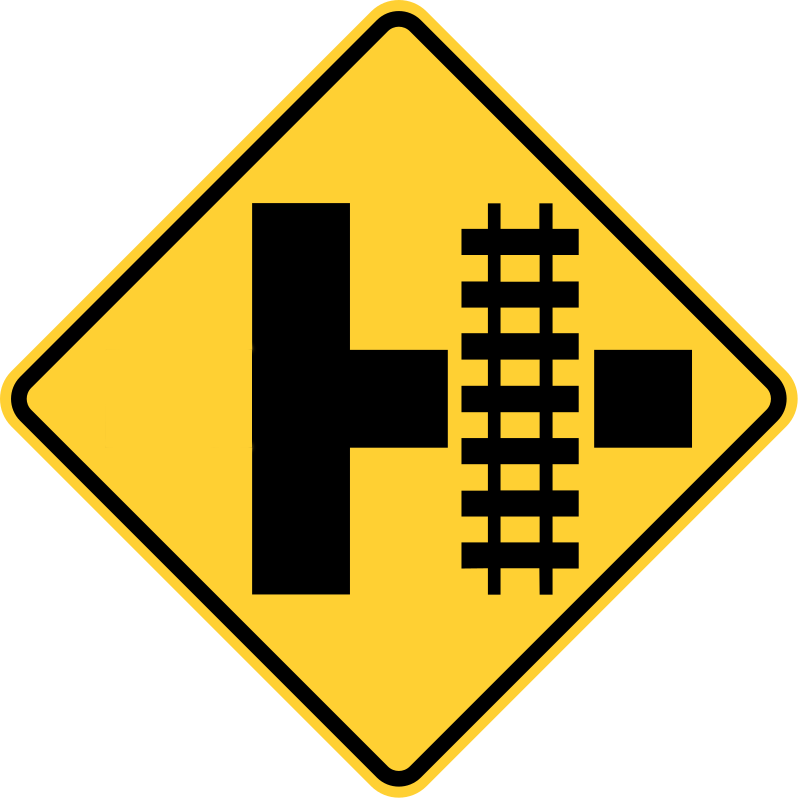
Four-way intersection ahead. Be prepared to yield right-of-way according to traffic control devices.
What does this sign indicate?
A) Parallel railroad crossing (side road)
B) Low ground clearance railroad crossing
C) Parallel railroad crossing (crossroad)
5.
You must pull over to the edge of the road and allow an emergency vehicle to pass:
A) only if the emergency vehicle is following you.
B) regardless of your direction.
C) only if the emergency vehicle is approaching.
D) None of the above.
6.
What should drivers do in case of a brake failure?
A) Shift to a lower gear.
B) Tie a white cloth on the left door handle.
C) Brake lightly.
7.
Traffic lights are normally ____________ from the top to bottom or left to right.
A) red, green and yellow
B) green, yellow and red
C) red, yellow and green
8.
Which shape is a stop sign?
A) Diamond
B) Octagon
C) Upside-down triangle
9.
The road ahead is divided by a median strip or physical barrier into two separate one-way roadways. Keep to the right of the divider.
This sign means:
A) Divided highway ahead.
B) Divided highway ends.
C) Drivers will soon be on a roadway with two-way traffic.
10.
When you prepare to make a left turn from a one-way road into a one-way road, you must:
A) move into the right lane, or to the left side of a single lane.
B) move into the right lane, or to the right side of a single lane.
C) move into the left lane, or to the left side of a single lane.
11.
Indicates a series of three or more consecutive sharp turns or curves ahead. Reduce speed and maintain lane control.
This road sign means:
A) Pavement ends
B) Winding road
C) Double curve ahead
12.
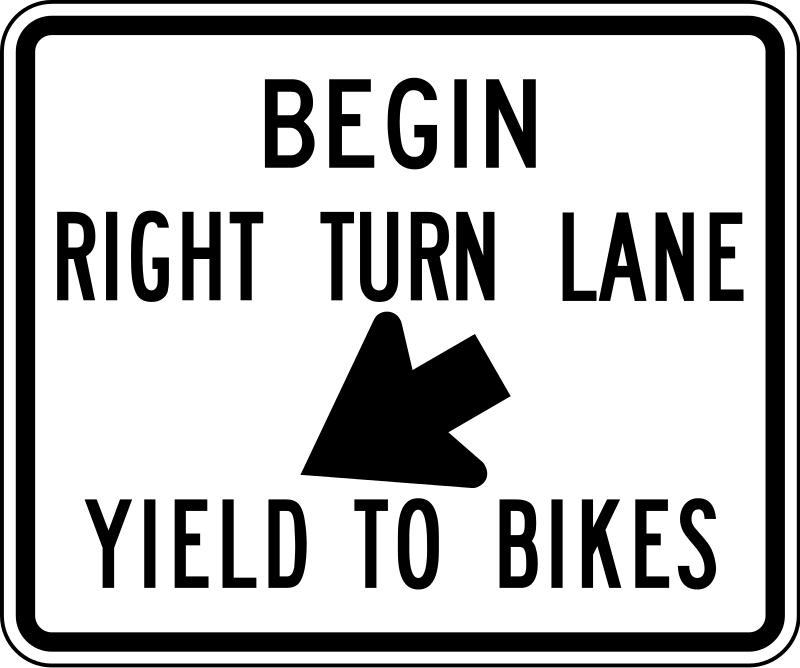
Drivers turning right must merge into the bike lane before turning, first checking mirrors and blind spots and yielding to all cyclists.
What does this road sign indicate?
A) Drivers have the right of way over bikes turning left.
B) Vehicles turning left must yield to bikes entering a right turn lane.
C) Motor vehicles entering an exclusive right-turn lane must weave across bicycle traffic in bicycle lanes.
13.
When getting ready to change lanes, you should:
A) check your rearview mirror.
B) quickly turn your head to check for other vehicles.
C) check your side view mirror.
D) All of the above.
14.
The road makes a sharp 90-degree right turn ahead. Slow down considerably before entering the turn.
This road sign means:
A) School zone ahead
B) Side road
C) Construction zone ahead
D) Sharp turn, slow down
15.
Warns drivers that two separate lanes moving in the same direction are merging into one. Drivers in the right lane must adjust speed and merge smoothly with existing traffic.
This sign means:
A) A road crosses the main highway ahead.
B) The divided highway on which drivers are traveling ends ahead.
C) Drivers are coming to a point where another traffic lane joins the one they are on.
16.
To avoid the risk of being involved in an alcohol-related crash, you should:
A) decide before you start drinking that you are not going to drive.
B) say 'No, thanks' if someone offers you alcohol.
C) call a taxi if you've been drinking.
D) All of the above.
17.
Where are yield signs usually placed?
A) At intersections, if there is no marked stop line.
B) Where auxiliary roads lead into major roads.
C) Where major roads lead into auxiliary roads.
18.
The road makes a sharp 90-degree right turn ahead. Slow down considerably before entering the turn.
This sign warns drivers that:
A) the road will make a sharp turn to the right.
B) right turns are not allowed.
C) another road enters the highway from the direction shown.
19.
When you make a left turn from a two-way road into a four-lane highway, you must:
A) enter the left lane, to the right of the center line.
B) enter the right lane, to the left of the center line.
C) go straight through the intersection, and then make the turn.
20.
What does it mean If an oncoming driver flashes headlights at you during a period of low visibility?
A) Your headlights are too bright. You should turn them off.
B) Your vehicle was difficult to see. You should turn on your headlights.
C) Your headlights are too bright. You should use parking lights instead.
21.
When approaching a highway-rail intersection, the first sign drivers see is usually:
A) an RXR round sign on a yellow background.
B) a stop sign.
C) a yield sign.
22.
At a light rail intersection, you should always:
A) share the road with pedestrians and bicyclists.
B) look both ways before crossing the tracks.
C) be alert and obey all traffic signals.
D) All of the above.
23.
Indicates a two-way left-turn lane in the center of the road. Must only be used to make left turns or U-turns (where permitted), not for regular travel or passing.
This road sign means:
A) Vehicles may only travel in the center lane.
B) The center lane is shared for left turns in both directions of travel.
C) The center lane in both directions of travel will soon turn left.
24.
Before passing another vehicle, you should signal:
A) early enough so other drivers know your intention.
B) after changing lanes.
C) at any time.
D) just before changing lanes.
25.
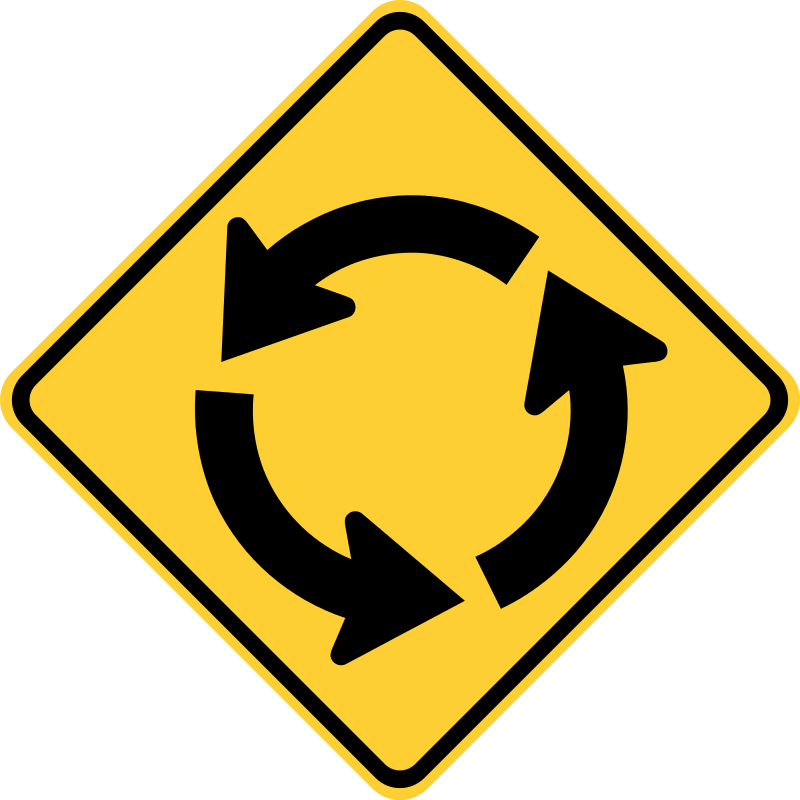
A circular intersection is ahead. Vehicles inside the roundabout have right-of-way; entering traffic must yield to traffic approaching from the left.
This road sign:
A) warns drivers of a sharp turn left. Drivers should slow their speed and keep to the left.
B) provides an advance notice of a roundabout.
C) warns drivers that U-turns are not permitted.
D) is a no-right-turns sign.
26.
If a bus has signaled and is pulling back onto the roadway, you must:
A) yield.
B) honk to let them know you’re there.
C) move to the left lane.
D) speed up to pass.
27.
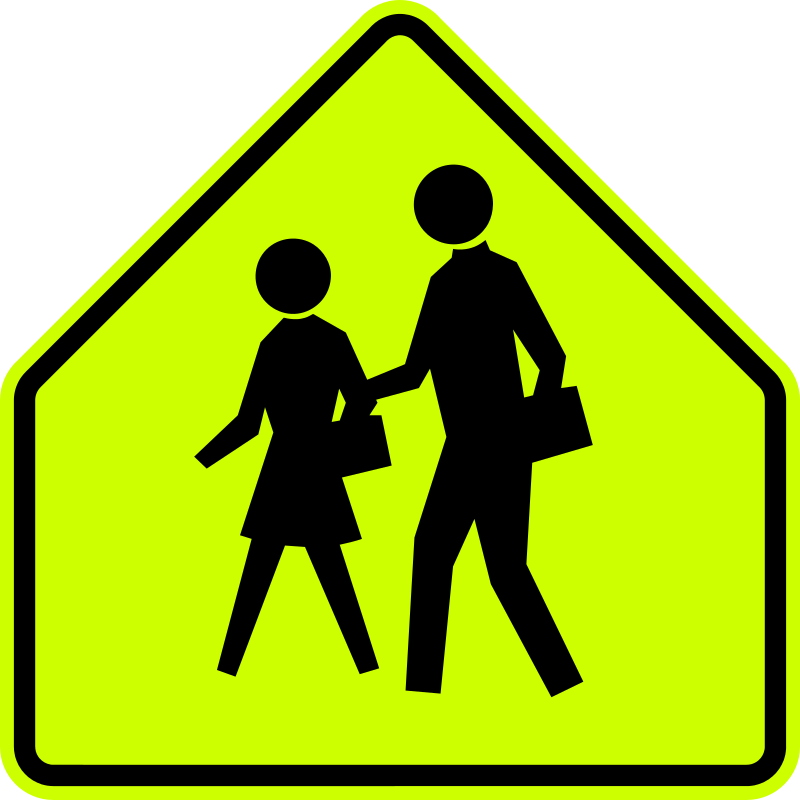
Five-sided pentagon sign indicating an upcoming school area. Watch for children crossing, school buses, and observe posted reduced school speed limits.
This sign means:
A) Business area nearby. Watch for business people.
B) There is a work zone ahead. Watch for workers.
C) The driver is near a school and should watch for children.
28.
Before a school bus stops to load passengers, the driver will usually flash:
A) yellow warning lights.
B) red warning lights.
C) red lights.
29.
Pentagonal signs are used to indicate:
A) possible hazards on roadways.
B) no passing zones.
C) school crossings.
30.
What can you do to prevent skids on snow and ice?
A) Allow the wheels to keep turning.
B) Brake early and gently.
C) All of the above.
ANSWER KEY Check answers after completing the test.
1 B
2 B
3 C
4 A
5 B
6 A
7 C
8 B
9 A
10 C
11 B
12 C
13 D
14 D
15 C
16 D
17 B
18 A
19 A
20 B
21 A
22 D
23 B
24 A
25 B
26 A
27 C
28 A
29 C
30 C