←
Back to Test
Hide Answer Key
Print / Save as PDF
Print / PDF
drive
quiz
.com
TX DMV PERMİT PRACTİCE TEST 1
Texas
Duration: 27 min
|
Questions: 30
Student Name:
Date:
Correct:
Incorrect:
Score:
1.
This sign means:
A)
Reversible lane ahead.
B)
The divided highway ends ahead.
C)
Drivers are coming to a point where another traffic lane joins the one they are on.
2.
When driving on slick roads, drivers should:
A)
accelerate quickly.
B)
take turns more slowly.
C)
use alternate routes.
D)
drive as they would on dry roads.
3.
This sign means:
A)
narrow road ahead.
B)
no turns are allowed on this road.
C)
series of curves ahead.
D)
the road may be slippery when wet.
4.
To reduce their chances of colliding with an animal, drivers should:
A)
scan the sides of the road to watch for the reflection of vehicle headlights in the eyes of animals.
B)
look well down the road and far off to each side.
C)
All of the above.
5.
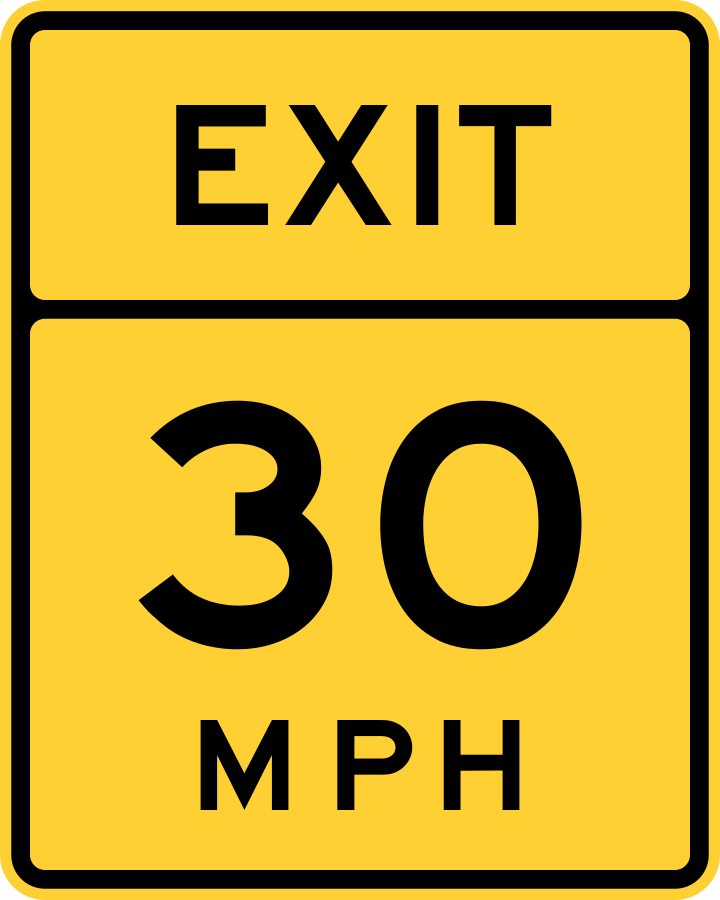
The sign in the picture:
A)
shows the highest speed drivers can travel at the exit of the intersection.
B)
is used to advise motorists of the appropriate ramp speed at the highway exit point.
C)
indicates the minimum ramp speed at the highway exit point.
6.
What are some telltale signs of a drunk driver?
A)
Sudden stops.
B)
Weaving between lanes.
C)
Driving slower than the normal flow of traffic.
D)
All of the above.
7.
What should you do if you see smoke come from under the hood?
A)
Call the fire department and then pull off the road and park your vehicle.
B)
Pull off the road and park your vehicle. Turn off the ignition, get away from the car and call the fire department.
C)
Try to fight the fire yourself.
8.
This road sign warns drivers that:
A)
left turns are not allowed at the intersection.
B)
the road will make a sharp turn to the right.
C)
another road enters the highway from the direction shown.
9.
A driver should be extra alert for motorcyclists, bicycles and pedestrians. Why?
A)
They obey specific traffic laws.
B)
They always have the right-of-way.
C)
They are hard to see in traffic.
D)
They don’t have rearview mirrors.
10.
What is the purpose of minimum speed limits?
A)
To keep a smooth traffic flow.
B)
To halt the traffic flow.
C)
To allow emergency vehicles with red flashing lights to safely pass other vehicles.
11.
When driving on major highways you should:
A)
be ready to react to road hazards.
B)
stay alert.
C)
keep your eyes moving.
D)
All of the above.
12.
Which shape is a warning sign?
A)
Diamond
B)
Triangle
C)
Pennant
13.
Your blind spot is the area of the road:
A)
you see in your rearview mirror.
B)
directly behind your vehicle.
C)
you cannot see without moving your head.
D)
you see in your side mirror.
14.
Never make a U-turn from:
A)
the lane you’re in.
B)
the right lane.
C)
the left part of the lane nearest to the centerline of the roadway.
15.
You must come to a full stop at a yield sign:
A)
Always.
B)
Never.
C)
If traffic conditions require it.
16.
Alcohol:
A)
makes you less aware of what is happening to your driving abilities.
B)
makes it easier to make correct decisions.
C)
improves your reaction time.
17.
A red traffic sign means?
A)
Construction warning.
B)
Railroad crossing.
C)
Stop.
18.
This sign means:
A)
You must yield the right-of-way ahead
B)
Traffic signals ahead
C)
You must stop ahead
D)
Speeding is not allowed
19.
You should never depend on your mirrors when you prepare to change lanes. Why?
A)
Mirrors leave “blind spots” behind both sides of vehicles.
B)
Mirrors need to be adjusted.
C)
Mirrors are useless.
20.
The driver of an emergency vehicle that uses lights and a siren can legally:
A)
pass red lights.
B)
exceed the speed limit
C)
All of the above.
21.
A steady yellow light means:
A)
Be prepared to stop for the red light.
B)
Drive with caution.
C)
Be prepared to go. The light will soon be green.
22.
When you approach this sign, you must:
A)
stop if necessary.
B)
watch for workers crossing the road.
C)
None of the above.
23.
What should you do as you prepare to turn right at an intersection?
A)
Honk your horn.
B)
Yield to bicyclists coming from the opposite direction.
C)
Signal your turn, check for bicyclists, and do not turn directly in front of a bicyclist.
24.
When changing lanes, you should:
A)
check your mirrors, signal and change lanes.
B)
signal, change lanes and check your mirrors.
C)
signal, check your mirrors and blind spot in the direction you plan to move, then change lanes.
D)
signal and change lanes.
25.
For protection, motorcyclists are required to:
A)
keep their headlights and taillights on at all times.
B)
signal turns, lane changes and stops.
C)
wear approved helmets.
26.
A driver approaching a flashing red traffic signal must:
A)
merge to the left.
B)
stop before the intersection.
C)
carefully drive through the intersection without stopping.
D)
slow down at the traffic signal.
27.
Alcohol:
A)
makes drivers more prone to take chances.
B)
increases reaction time.
C)
All of the above.
28.
Drivers may pass another vehicle if the line dividing two lanes is a ________ line.
A)
broken white
B)
double solid yellow
C)
solid yellow
D)
solid white
29.
This road sign means:
A)
Winding road
B)
Side road ahead
C)
Slippery when wet
30.
When driving in bad weather, drivers should:
A)
decrease the following distance.
B)
increase their speed to get to their destination more quickly.
C)
increase the following distance.
D)
None of the above.
ANSWER KEY
Check answers after completing the test.
1
B
2
B
3
C
4
C
5
B
6
D
7
B
8
C
9
C
10
A
11
D
12
A
13
C
14
B
15
C
16
A
17
C
18
B
19
A
20
C
21
A
22
A
23
C
24
C
25
C
26
B
27
C
28
A
29
C
30
C