DriveQuiz drivequiz.com

TN DMV PERMİT PRACTİCE TEST 13

Tennessee
Duration: 27 min
|
Questions: 30
Student Name:
Date:
Correct:      Incorrect:      Score:      
1.
Come to a complete stop before the stop line, crosswalk, or intersection. Look left, right, and left again, and proceed only when it is safe and right-of-way is clear.
When you see this sign you should stop and:
A) check traffic in all direction before proceeding.
B) check for vehicles in the opposite direction, then proceed.
C) yield the right-of way to all vehicles coming from the left.
2.
Warns drivers that two separate lanes moving in the same direction are merging into one. Drivers in the right lane must adjust speed and merge smoothly with existing traffic.
This road sign means:
A) Lane shifting
B) Merging traffic
C) Do not block intersection
3.
Another road crosses the highway ahead. Look left and right for crossing or entering vehicles.
This road sign means:
A) Warning, crossroad ahead
B) All traffic must turn
C) Yield sign ahead
4.
All approaching traffic must stop completely. The first vehicle to reach the intersection and stop has right-of-way; if two vehicles arrive simultaneously, the vehicle on the right goes first.
A four-way stop sign means:
A) traffic from all four directions must stop.
B) if two vehicles reach the intersection at the same time, the driver on the left yields to the driver on the right.
C) All of the above.
5.
The roadway ahead is narrowing or a lane is ending. Merge smoothly into the continuing lane.
This road sign means:
A) Lane reduction - the left lane ends soon
B) Highway entrance ramp ahead
C) Lane reduction - the right lane ends soon
6.
On two-lane, two-way streets or highways, you should start left turns:
A) in the center of the lane.
B) anywhere in the lane.
C) close to the center line.
D) close to the outside line.
7.
While inside the roundabout, you should:
A) remain in your lane until you are ready to exit.
B) change lanes before you check for vehicles behind you.
C) use your left turn signal if you are in position to exit now.
8.
The roadway becomes particularly slippery during wet or rainy conditions. Reduce your speed, increase following distance, and avoid abrupt braking or steering.
This road sign means:
A) Winding road
B) Side road ahead
C) Slippery when wet
9.
Proceed with caution. You do not need to stop unless pedestrians or hazards are present in the intersection.
A flashing yellow light:
A) warns drivers to proceed with caution.
B) is used at dangerous intersections.
C) All of the above.
10.
The roadway ahead is narrowing or a lane is ending. Merge smoothly into the continuing lane.
This sign warns drivers that:
A) there is a one lane bridge ahead.
B) the right lane ends.
C) the road ahead is narrow.
11.
Large trucks:
A) have high-tech air brakes which allow them to stop quickly.
B) take longer to stop than passenger vehicles.
C) are more maneuverable than passenger vehicles.
12.
ABS is the acronym for:
A) Anti-Braking System
B) Average-Beam System
C) Anti-Locking Brake System
13.
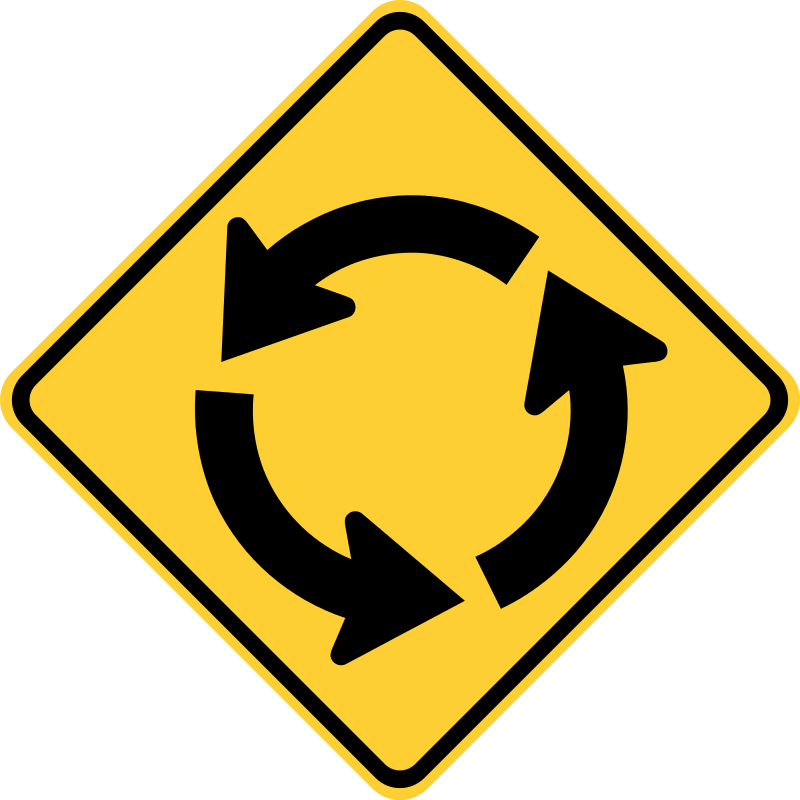
A circular intersection is ahead. Vehicles inside the roundabout have right-of-way; entering traffic must yield to traffic approaching from the left.
This road sign:
A) warns drivers of a sharp turn left. Drivers should slow their speed and keep to the left.
B) provides an advance notice of a roundabout.
C) warns drivers that U-turns are not permitted.
D) is a no-right-turns sign.
14.
Prohibits drivers from making a 180-degree turn to travel in the opposite direction at this intersection or stretch of road.
This road sign means:
A) No left turn
B) No U-turn
C) Detour ahead
15.
Roads are most slippery:
A) just before it rains.
B) when it stops raining.
C) when it first starts to rain.
16.
A traffic signal with a yellow left means:
A) HOV lane is about to end.
B) Prepare to yield to oncoming traffic.
C) All of the above.
17.
You must come to a full stop at a yield sign:
A) Always.
B) Never.
C) If traffic conditions require it.
18.
Blue service guide sign indicating that emergency medical and hospital facilities are located in the direction of the arrow.
What does this road sign indicate?
A) Hospital service
B) Area reserved for people with disabilities
C) Interstate highway
19.
The roadway ahead is narrowing or a lane is ending. Merge smoothly into the continuing lane.
This sign warns that:
A) traffic must merge left.
B) the bridge ahead is wide enough for only one vehicle at a time.
C) traffic must merge right.
20.
Drivers may cross a double yellow line to pass another vehicle if:
A) the yellow line next to the other side of the road is broken.
B) the vehicle ahead moves to the right to let them pass.
C) the yellow line next to their side of the road is broken.
21.
Slow down and give right-of-way to all oncoming vehicles, cyclists, and pedestrians. Stop completely if necessary before entering the intersection or merging.
When coming to an intersection with a yield sign, you should:
A) yield the right-of-way to all traffic on the left.
B) always come to a complete stop before entering the intersection.
C) slow down and yield the right-of-way to other vehicles.
22.
Alerts drivers to an upcoming crosswalk where pedestrians frequently cross. Slow down and yield right-of-way to anyone in or about to enter the roadway.
What should drivers do when they see this road sign?
A) come to a complete stop and wait for a train to cross.
B) slow down, look for a train, and be prepared to stop.
C) look for a human flagger.
23.
Braking distance is:
A) usually 50 feet.
B) how far a vehicle will travel, in ideal conditions, while the driver is braking.
C) the total distance a vehicle has traveled until it comes to a complete stop.
D) how far a vehicle will continue to travel before the driver hits the brakes.
24.
When changing lanes, you should remember that:
A) vehicles with two outside mirrors have no blind spots.
B) You only need to turn and look over your right shoulder for lane changes to the right or left.
C) you should look over your left shoulder for a left lane change and your right shoulder for a right lane change.
25.
What do pennant-shaped signs indicate?
A) A school crossing
B) Yield
C) A No Passing Zone
26.
Alcohol:
A) makes drivers more prone to take chances.
B) increases reaction time.
C) All of the above.
27.
After passing a vehicle, it is safe to return to your lane when:
A) the driver you passed slows down to let you return to your lane.
B) you can see both headlights of the vehicle you just passed in your rearview mirror.
C) you are at least 100 feet ahead of the vehicle you passed.
28.
The maximum legal speed under ideal driving conditions is 50 miles per hour. Always adjust speed downward for adverse weather, traffic, or road conditions.
This sign indicates the _______________ vehicles can safely travel in this area.
A) suggested speed
B) maximum speed
C) minimum speed
29.
When preparing to exit an expressway, drivers should start reducing their speed:
A) about halfway through the deceleration lane.
B) immediately upon entering the deceleration lane.
C) at least 100 feet before entering the deceleration lane.
30.
Tennessee law requires you to notify the Department of Safety of your address change within:
A) 10 days.
B) 90 days.
C) 45 days.
ANSWER KEY Check answers after completing the test.
1 A
2 B
3 A
4 C
5 C
6 C
7 A
8 C
9 C
10 B
11 B
12 C
13 B
14 B
15 C
16 C
17 C
18 A
19 A
20 C
21 C
22 B
23 B
24 C
25 C
26 C
27 B
28 B
29 B
30 A