DriveQuiz drivequiz.com

RI DMV PERMİT PRACTİCE TEST 15

Rhode Island
Duration: 23 min
|
Questions: 25
Student Name:
Date:
Correct:      Incorrect:      Score:      
1.
Just like alcohol and other drugs, drowsiness can:
A) help you to be a better driver.
B) make you feel better.
C) impair your judgment.
2.
When there is a _______ at an intersection, you should come to a complete stop, yield to cross traffic/pedestrians, and then proceed when clear.
A) a solid green light
B) a solid red light
C) a flashing red light
D) a flashing yellow light
3.
Before entering a traffic circle, drivers must slow down and yield to ___________ in the traffic circle.
A) pedestrians
B) vehicles
C) bicyclists
D) All of the above.
4.
When entering a crowded freeway, to merge into traffic you should:
A) yield to vehicles already on the freeway.
B) use the acceleration lane to adjust your speed to the same speed as freeway traffic.
C) check your blind spots.
D) All of the above.
5.
While driving you come upon a sign which says, “reduced speed 35 MPH”. You as a driver should know:
A) that the new 35 MPH speed zone begins at the next “speed limit” sign.
B) that the sign is put there to harass “good” drivers.
C) that the new 35 MPH speed zone begins at this sign.
D) that you have plenty of time to slow down before the speed zone.
6.
What should you do if your rear wheels start to skid?
A) Steer left if your rear wheels slide right.
B) If the vehicle has ABS, pump the pedal carefully.
C) Turn the steering wheel in the direction the vehicle is trying to go.
7.
When you need to change lanes, it is important to:
A) make sure the lane you are about to enter is clear.
B) signal your intentions ahead of time.
C) check your blind spots.
D) All of the above.
8.
What is the main reason night driving is more difficult than daytime driving?
A) The use of headlight is required by law.
B) Reduced visibility.
C) Driving within the range.
9.
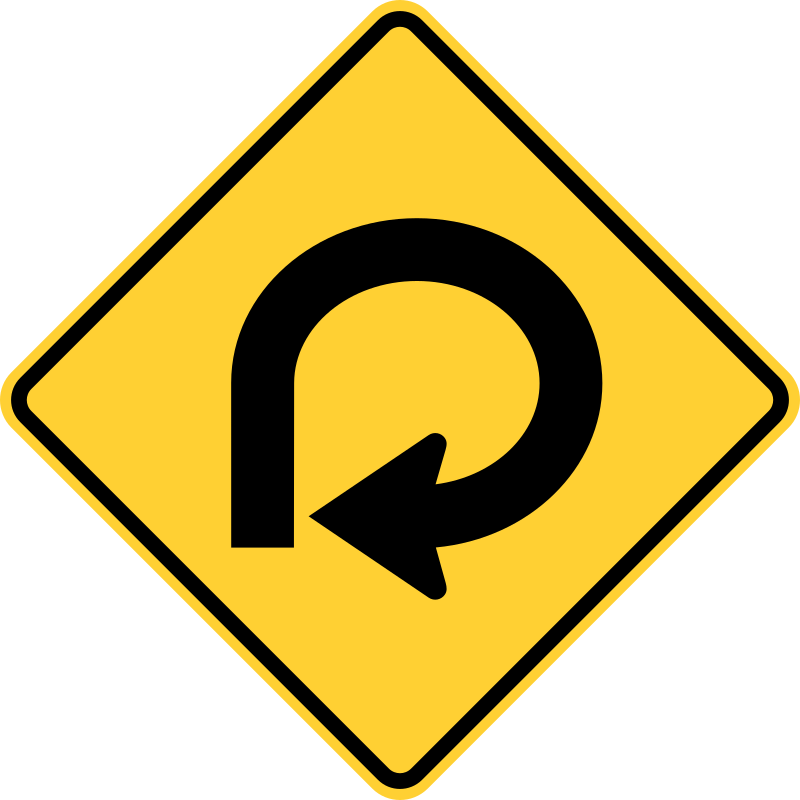
Warns of a circular exit or interchange ramp looping 270 degrees. Slow down significantly to the posted advisory speed.
This sign means:
A) Roundabout ahead.
B) 270 degree turn ahead.
C) Wrong way; Turn around immediately.
10.
To avoid becoming an aggressive driver, you should:
A) drive above the posted speed limit.
B) tailgate the driver in front of you.
C) relax and concentrate on driving.
11.
The shape and color of a route number sign indicate the type of roadway.
A) False
B) True
12.
Designated school crosswalk location. You must yield to all schoolchildren and pedestrians in the crossing.
When they approach this sign, drivers must:
A) slow down and watch for children crossing the road.
B) obey signals from crossing guards.
C) stop if necessary.
D) All of the above.
13.
What is the first thing to do when you make a three-point turn?
A) Signal with your left turn signal, then check carefully for traffic coming toward you.
B) Signal with your right turn signal, then pull over to the right and stop.
C) Turn left, go across the road so you come to a stop while you face the edge of the road.
14.
Lanes of traffic moving in the same direction are divided by ____ lines.
A) orange
B) yellow
C) black
D) white
15.
The roadway becomes particularly slippery during wet or rainy conditions. Reduce your speed, increase following distance, and avoid abrupt braking or steering.
This road sign means:
A) Winding road
B) Side road ahead
C) Slippery when wet
16.
Warns drivers that two separate lanes moving in the same direction are merging into one. Drivers in the right lane must adjust speed and merge smoothly with existing traffic.
This road sign means:
A) Winding Road Ahead
B) Persons with Disabilities Parking
C) Merge
17.
Another road crosses the highway ahead. Look left and right for crossing or entering vehicles.
This road sign means:
A) You must turn right
B) Railroad crossing
C) Crossroad ahead
D) 4-way stop
18.
Your blind spot is the area of the road:
A) you see in your rearview mirror.
B) directly behind your vehicle.
C) you cannot see without moving your head.
D) you see in your side mirror.
19.
When you come to an intersection with a flashing red light, you must:
A) stop at the intersection, then proceed when safe and observe the right-of-way rules.
B) slow down and drive carefully through the intersection.
C) stop at the intersection and wait for a flashing green light.
D) stop only if cars are approaching the intersection.
20.
Before passing a vehicle or changing lanes, remember to:
A) only pass or change lanes if the change can be completed without speeding.
B) signal your return to the left lane.
C) sound your horn as you pass.
21.
Do not pass:
A) on hills or curves.
B) when approaching intersections.
C) when school bus lights are flashing.
D) All of the above.
22.
Warns that a one-way street or divided highway is ending, and you are entering a roadway with oncoming traffic in the opposing lane. Stay to the right.
This sign warns ____________ ahead.
A) of two-way traffic
B) of a reduction of lanes
C) that a divided highway ends
23.
Keeping a space cushion between you and the other vehicles around you is important because it:
A) gives you time to react to situations.
B) prevents distractions from other vehicles.
C) keeps other drivers alert.
D) keeps traffic flowing at a safe pace.
24.
Doing all you can to prevent crashes is called:
A) Anti-Collision Driving
B) Crash-Prevention Driving
C) Defensive Driving
D) ABS Driving
25.
When pedestrians are in a crosswalk, drivers should:
A) pull over to the right and stop.
B) go ahead because drivers have the right-of-way.
C) wait for them to cross.
ANSWER KEY Check answers after completing the test.
1 C
2 C
3 D
4 D
5 C
6 C
7 D
8 B
9 B
10 C
11 B
12 D
13 B
14 D
15 C
16 C
17 C
18 C
19 A
20 A
21 D
22 A
23 A
24 C
25 C