DriveQuiz drivequiz.com

RI DMV PERMİT PRACTİCE TEST 14

Rhode Island
Duration: 23 min
|
Questions: 25
Student Name:
Date:
Correct:      Incorrect:      Score:      
1.
A few drinks after work before driving home:
A) should be avoided because they impair your judgement.
B) should be avoided unless you really need them.
C) are acceptable as far as they are part of your daily routine.
D) have no effect on your driving ability.
2.
Right turns are strictly prohibited at this intersection under all circumstances.
This road sign means:
A) Right turn is not permitted
B) Left turns are permitted
C) You may turn right after yielding the right-of-way to oncoming traffic
3.
Blind spots around a large vehicle are _________________ than the blind spots around a car.
A) larger and deeper
B) less dangerous
C) narrower and shorter
4.
At a stop sign there is no stop line or crosswalk. You must stop:
A) before you enter the intersection.
B) at the next crosswalk.
C) after you enter the intersection, if you have a clear view of traffic on the intersecting roadway.
5.
Blind spots are:
A) Areas to the side or rear of a vehicle that are easy to spot.
B) areas of the road that cannot be seen even when looking into mirrors.
C) traffic control devices.
6.
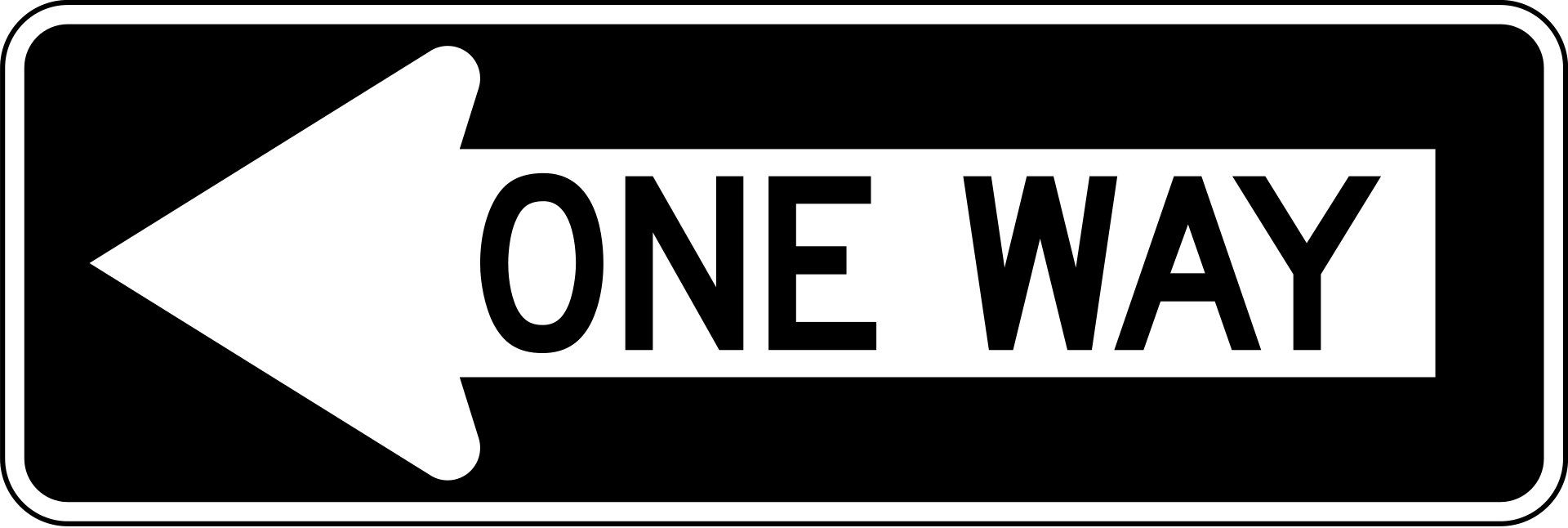
Traffic flows only in the direction indicated by the arrow. Never drive in the opposing direction.
This road sign means:
A) Two way Traffic
B) Traffic must move only in the direction of the arrow
C) Minimum Speed
7.
When parking on a public road, drivers should:
A) move as far away from traffic as possible.
B) always park on the left side of the roadway.
C) All of the above.
8.
If there is no crosswalk and you see a pedestrian crossing your lane, you should:
A) stop and let the pedestrian finish crossing.
B) make sure the pedestrian can see you before proceeding.
C) honk your horn and proceed with caution.
9.
To drive defensively, you must:
A) avoid scanning the road ahead.
B) keep one hand on the steering wheel.
C) keep your eyes moving.
10.
When you are driving, turning your head and looking before changing lanes is:
A) a good driving habit.
B) unnecessary, you should use your rearview mirror instead.
C) a bad driving habit.
D) prohibited.
11.
Reflective orange triangle displayed on vehicles traveling at 25 MPH or slower (such as farm tractors or construction machinery). Approach with caution and pass safely.
This sign indicates:
A) A slow-moving vehicle
B) A no-passing zone
C) Yield
12.
On what three conditions does your blood alcohol content (BAC) depend?
A) Your weight. How much alcohol you drink. How much time passes between drinks.
B) Your weight. The type of beverage you drink. How fit you are.
C) Your height. How much alcohol you drink. The type of beverage you drink.
13.
A side road enters the highway from the right or left. Watch for traffic turning onto or crossing your lane.
This is:
A) a side road sign.
B) a merging traffic sign.
C) a right curve sign.
14.
What does it mean If an oncoming driver flashes headlights at you during a period of low visibility?
A) Your headlights are too bright. You should turn them off.
B) Your vehicle was difficult to see. You should turn on your headlights.
C) Your headlights are too bright. You should use parking lights instead.
15.
When approaching a construction site, drivers should:
A) accelerate to get out of the way quickly.
B) slow down and adjust their driving manner.
C) honk their horn to alert construction workers of their presence.
16.
If an approaching driver does not dim the headlights, you should:
A) move your eyes to the left to help avoid the glare of approaching high beams.
B) move your eyes to the right and avoid looking directly at the bright lights.
C) flash your headlights to low beam for a second, then return to high beam.
17.
Traffic lights are normally ____________ from the top to bottom or left to right.
A) red, green and yellow
B) green, yellow and red
C) red, yellow and green
18.
A driver should be extra alert for motorcyclists, bicycles and pedestrians. Why?
A) They obey specific traffic laws.
B) They always have the right-of-way.
C) They are hard to see in traffic.
D) They don’t have rearview mirrors.
19.
When a pedestrian is crossing a street guided carrying a white cane, drivers must:
A) help the pedestrian cross the street.
B) yield the right of way at corners only.
C) always yield the right-of-way.
20.
Warns drivers that two separate lanes moving in the same direction are merging into one. Drivers in the right lane must adjust speed and merge smoothly with existing traffic.
This road sign means:
A) Cars in right lane must slow down
B) Merging traffic ahead
C) Pass only in the right lane
D) No left turn
21.
Drivers who have been drinking are more likely to:
A) keep a safe following distance.
B) yield right-of-way to oncoming vehicles.
C) be less reactive.
22.
When you are in a line of traffic that is crossing a railroad track that has no signals or gates:
A) you may pass slower drivers crossing the track.
B) before you start to cross, you need to make sure there is space to get all the way across the tracks without stopping.
C) you have the right of way and do not need to check for trains.
D) All of the above.
23.
Work zone signs:
A) mean that road conditions will improve soon.
B) mean that drivers must come to a complete stop and back up.
C) provide information on road work or other temporary road conditions.
D) mean that drivers should drive faster to get out of the work zone.
24.
Two solid yellow lines between lanes of traffic means:
A) neither side can pass.
B) the lanes are designed to carry traffic in one direction at certain times and in the opposite direction at other times.
C) passing is permitted on the left.
25.
Warns that a one-way street or divided highway is ending, and you are entering a roadway with oncoming traffic in the opposing lane. Stay to the right.
This road sign means:
A) School zone ahead
B) Keep right
C) Two-way Traffic
ANSWER KEY Check answers after completing the test.
1 A
2 A
3 A
4 A
5 B
6 B
7 A
8 A
9 C
10 A
11 A
12 A
13 A
14 B
15 B
16 B
17 C
18 C
19 C
20 B
21 C
22 B
23 C
24 A
25 C