←
Back to Test
Hide Answer Key
Print / Save as PDF
Print / PDF
drive
quiz
.com
RI DMV PERMİT PRACTİCE TEST 10
Rhode Island
Duration: 23 min
|
Questions: 25
Student Name:
Date:
Correct:
Incorrect:
Score:
1.
When driving on the freeway behind large trucks, you should:
A)
move to the right of the truck and pass it quickly.
B)
drive closer behind the truck than for a passenger vehicle.
C)
increase your following distance.
2.
Look over your shoulder to check your blind spot:
A)
when changing lanes.
B)
when pulling to the right side of the road or away from a curb.
C)
on all right and left turns.
D)
All of the above.
3.
This sign means:
A)
The road will curve to the right, then to the left.
B)
Road slippery when wet. Drive slowly.
C)
Winding road ahead. Drive with caution.
4.
You are driving and you are feeling drowsy. You should:
A)
avoid drinking coffee.
B)
turn on the radio to keep you awake.
C)
find a safe place to stop for a break.
5.
When driving in fog, you should never use your high beams because:
A)
the light will reflect back into your eyes.
B)
vehicles behind you may follow too closely.
C)
oncoming vehicles might not see you.
6.
A four-way stop sign means:
A)
traffic from all four directions must stop.
B)
if two vehicles reach the intersection at the same time, the driver on the left yields to the driver on the right.
C)
All of the above.
7.
Which statement about drinking alcohol and driving is true?
A)
Alcohol affects judgement and coordination, which are needed to drive safely.
B)
After drinking, a cold shower will sober you up.
C)
If you are under the legal BAC limit, your driving is not affected.
8.
If you remain in the back blind spot of a large vehicle:
A)
you increase the chance of a crash.
B)
the large vehicle will take much longer to stop.
C)
you can reduce fuel consumption.
9.
Where must a pedestrian walk when there are no sidewalks?
A)
On the side of the road, in the same direction of traffic.
B)
In the middle of the road, facing oncoming traffic.
C)
On the side of the road, facing the traffic.
10.
The octagonal shape is used:
A)
for stop signs and railroad advance warning signs.
B)
exclusively for stop signs.
C)
to warn drivers of existing or possible hazards on roadways.
11.
One broken line indicates:
A)
You can pass other vehicles and change lanes, if it is safe.
B)
You can not pass other vehicles or go across the line.
C)
You can change lanes, but only when traffic conditions or obstructions in the road make it necessary.
12.
When passing you should NOT:
A)
leave less than 4 feet of space between your vehicle and the vehicle you are passing.
B)
signal left to let others know that you will be pulling out.
C)
look in your rearview mirrors and glance over your shoulder before pulling out to pass.
D)
go far enough past the vehicle you are passing so that you can see the vehicle in your inside rearview mirror.
13.
This road sign means:
A)
Drive with caution and be ready to stop
B)
Slow down or stop
C)
You must come to a complete stop
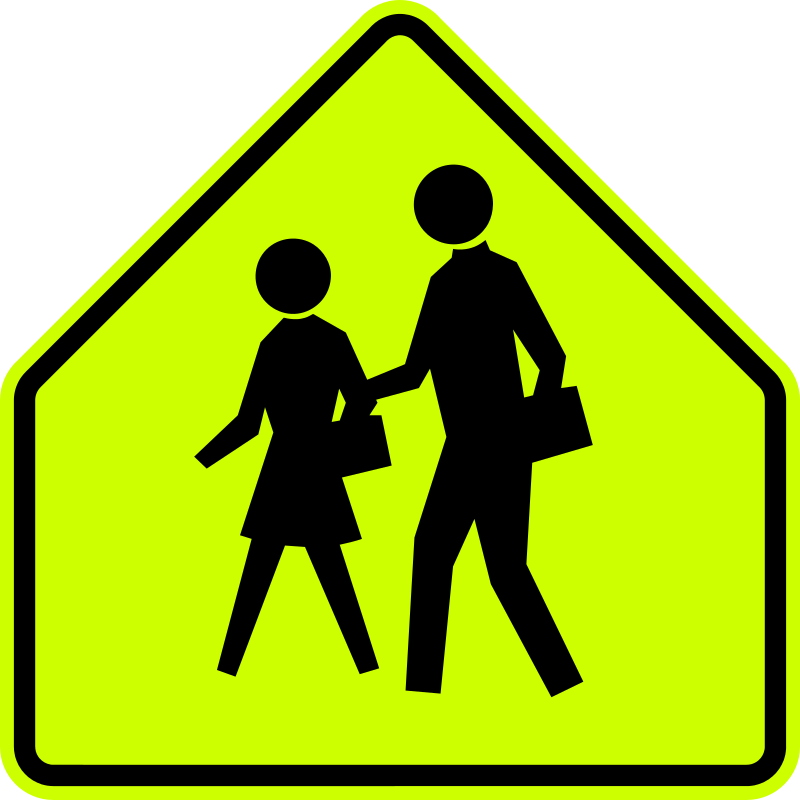
14.
When you see this sign, you should:
A)
be prepared to stop if children are in the crosswalk.
B)
slow down, proceed with caution and watch for blind people.
C)
always stop at the crosswalk.
15.
A thumping sound can be a warning:
A)
that a tire blowout is about to occur.
B)
of a steering failure.
C)
of a brake failure.
16.
What should you do in case of a brake failure?
A)
Pull off the road into an open space, if available.
B)
Apply the parking brake slowly.
C)
All of the above.
17.
Hydroplaning is usually caused by:
A)
excessive rain.
B)
excessive stops.
C)
excessive speed.
D)
sudden turns.
18.
Your BAC depends on:
A)
how fit you are.
B)
the type of beverage you drink.
C)
the amount of alcohol you drink.
19.
Braking distance is affected by:
A)
the condition of your brakes and tires.
B)
pavement conditions.
C)
the speed your vehicle is traveling.
D)
All of the above.
20.
This road sign means:
A)
A four-way intersection is ahead
B)
Do not pass
C)
A steep grade is ahead
21.
This road sign means:
A)
Slow down or stop
B)
Stop
C)
Road narrows ahead
22.
You should never depend on your mirrors when you prepare to change lanes. Why?
A)
Mirrors leave “blind spots” behind both sides of vehicles.
B)
Mirrors need to be adjusted.
C)
Mirrors are useless.
23.
Blocking an intersection during rush hour traffic is not permitted:
A)
under any circumstances.
B)
unless you entered the intersection on a green light.
C)
unless you have the right-of-way.
24.
If a traffic officer signals you to drive through a red light:
A)
you must do it.
B)
you must wait for the red light to turn green.
C)
you must not obey the officer. Signs and signals take precedence over directions given by traffic officers.
25.
Which shape is a warning sign?
A)
Diamond
B)
Triangle
C)
Pennant
ANSWER KEY
Check answers after completing the test.
1
C
2
D
3
B
4
C
5
A
6
C
7
A
8
A
9
C
10
B
11
A
12
A
13
C
14
A
15
A
16
C
17
C
18
C
19
D
20
A
21
B
22
A
23
A
24
A
25
A